


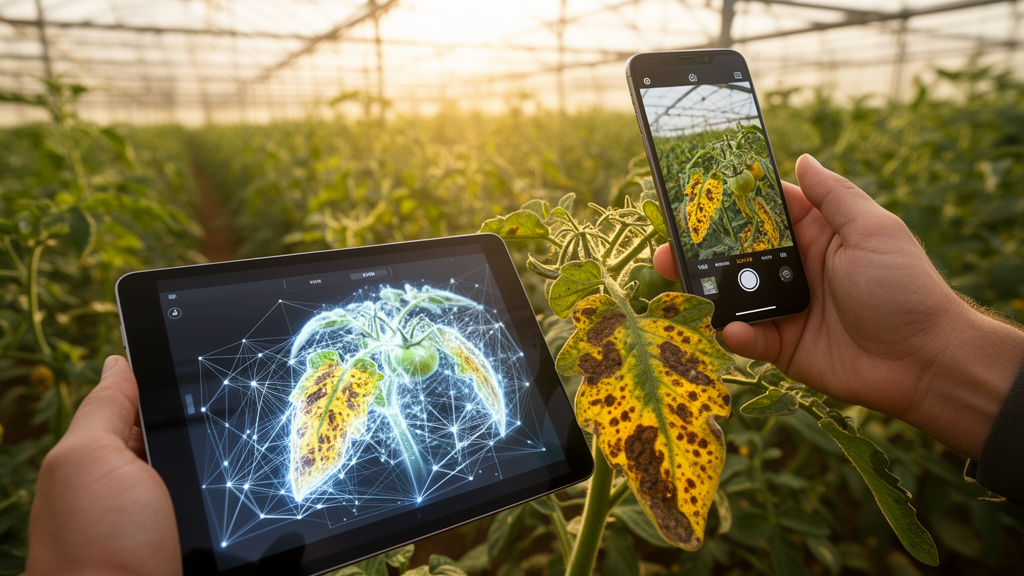
Plant diseases destroy up to 40 percent of global crop production every year, and the race to detect them early has long been hampered by a stubborn bottleneck: deep learning models need thousands of labeled images, yet rare and emerging diseases rarely come with such luxuries. Now a team of researchers in India has shown that a carefully engineered Vision Transformer system can accurately classify leaf diseases it has never seen before, using only five labeled examples per disease. The work, published in Frontiers in Agronomy, tackles a subtle failure mode the authors call the metric domain gap, and their solution may reshape how AI diagnostics reach the world’s resource-constrained farms.
The research, led by Nandhini Chokkalingam, Lakshmi Priya G, Chanthini Baskar, and L. Sumalatha at Vellore Institute of Technology in Chennai and Jawaharlal Nehru Technological University in Kakinada, arrives at a moment of mounting urgency. The United Nations designated 2020 the International Year of Plant Health, and the Food and Agriculture Organization projects that food production must rise by roughly 60 percent by 2050 to feed a population expected to exceed 10 billion. Leaves, the primary engines of photosynthesis, are the first casualties when fungal, bacterial, or viral pathogens strike, and losses in both yield and quality follow quickly.
Automated leaf disease classification has evolved through three broad paradigms. Early pipelines relied on handcrafted features: images were segmented with thresholding and K-means clustering to isolate lesions, and color, texture, and shape descriptors were fed into support vector machines or K-nearest-neighbor classifiers. These systems worked under controlled lighting but were fragile in the field, because their performance was capped by the quality of the engineered features. The deep learning era swept that constraint away, as convolutional networks such as VGG, ResNet, Inception, and DenseNet learned discriminative representations directly from raw pixels, while lightweight variants like MobileNet and EfficientNet brought real-time diagnosis to smartphones and drones.
Yet every one of these approaches shares a fundamental dependency on large, well-annotated datasets, a requirement that is nearly impossible to meet for rare, geographically specific, or newly emerging diseases. Recent attempts to sidestep the problem, including generative adversarial networks that synthesize disease patterns onto healthy leaves and neural architecture search that optimizes transformer designs, introduce heavy computational overhead and still demand substantial base data. Few-shot learning offers a more direct answer: instead of learning each disease from scratch, the model learns a general comparison strategy on a data-rich source domain and then applies it to a new task with only a handful of labeled examples.
The Indian team’s key insight came from probing where that transfer breaks down. In cross-domain few-shot learning, the source and target datasets differ in visual character, imaging conditions, and disease morphology. The researchers found that a learnable similarity metric, even when paired with a state-of-the-art feature extractor, can fail catastrophically if it was meta-trained on a visually dissimilar source domain. In other words, the model may build a perfectly separable embedding space for the new disease images, but its learned way of comparing embeddings, tuned on unrelated data, simply cannot exploit that space. Most prior studies in plant disease few-shot learning tested only on held-out classes of the source dataset itself, so this gap went largely unnoticed.
Their remedy, dubbed ViTRelNet, is a synergistic training strategy that co-adapts two components simultaneously. The backbone is a Vision Transformer, ViT-B/16, pretrained on ImageNet, which slices each 224-by-224-pixel leaf image into 16-by-16 patches and produces a 768-dimensional embedding from its classification token. Rather than freezing the entire backbone, the team unfroze the last three of twelve transformer encoder blocks, updating about 21.3 million of the model’s 85.8 million parameters. The rationale follows standard transfer learning logic: lower blocks capture generic edges and textures, while upper blocks encode task-specific representations, and unfreezing more blocks caused degraded performance through catastrophic forgetting of ImageNet-learned features.
On top of that backbone sits a relation module, a compact two-layer multilayer perceptron that replaces fixed Euclidean distance with a learned, non-linear similarity comparator. For each learning episode, the model averages the ViT embeddings of the five support images per class into a prototype, concatenates each query embedding with every prototype into a 1,536-dimensional vector, and passes the pair through the relation module, which outputs a similarity score between zero and one. Training ran for 2,500 episodes drawn from the PlantVillage dataset, which spans 38 disease classes across 14 crop species and roughly 54,305 images, using a 10-way 5-shot protocol, random flips, rotations up to 20 degrees, and color jitter as augmentation. A dual learning rate scheme kept the large pretrained backbone stable while letting the small relation module adapt quickly, and mean squared error loss proved better suited to the sigmoid-activated scores than cross-entropy alternatives.
The results are striking. Evaluated on 300 episodic trials for each of three completely unseen target datasets, ViTRelNet achieved 92.72 percent accuracy on Guava, 87.38 percent on Jamun, and 91.79 percent on Cassava, all with just five examples per class and no further gradient updates at test time. The Cassava task was the hardest in structure, a three-way classification among blight, mosaic, and healthy leaves against a 33.33 percent random baseline, yet the model’s confidence interval was the tightest of the three. Confusion matrices showed balanced errors, and t-SNE visualizations confirmed well-separated embedding clusters, with the only notable overlap between the visually similar blight and mosaic disease patterns. Even in the one-shot setting, the model reached 84.5 percent on Guava, 86.0 percent on Cassava, and 77.6 percent on Jamun, far above chance.
An ablation study isolated the source of the gains. When the identical architecture was run with a frozen ViT backbone, accuracy dropped by 4.25 to 7.92 percentage points across the three datasets, and episodic variance rose consistently, confirming that feature adaptation and metric adaptation are mutually reinforcing rather than interchangeable. The comparison with prior work is even more telling: the closest cross-domain baseline, SC-FSL, managed only 68.29 percent in a 5-shot setting and 49.12 percent in one shot when transferring from PlantVillage to field potato images, a scenario where the crop species itself overlapped with training data. ViTRelNet, facing a simultaneous shift in crop species, disease categories, and imaging conditions, outperformed it by 19 to 35 percentage points, and even surpassed same-domain methods such as Prune-FSL at 90.70 percent and PMF+FA at 90.12 percent under strictly harder conditions.
The practical implications extend well beyond the benchmark numbers. Meta-training completed in 92.4 minutes on a single NVIDIA Quadro RTX 4000 GPU, and inference requires only one forward pass through the frozen backbone and a lightweight comparator, making deployment feasible on mid-range hardware. The authors note that field agronomists could classify novel crop diseases from as few as five labeled images per class without retraining, a capability well matched to low-resource agricultural settings. Limitations remain, including reduced performance on tasks with more than three classes, sensitivity to severe imaging artifacts such as overexposure, and the need for broader real-world field evaluation. Future work, the team says, will extend the framework to larger N-way benchmarks, domain-adversarial meta-learning, and disease severity quantification through segmentation. For now, ViTRelNet stands as a compelling demonstration that the path to robust agricultural AI lies not in ever-bigger datasets, but in teaching models how to compare, and letting the features and the metric learn together.
Subject of Research: Few-shot learning with Vision Transformers for cross-domain plant leaf disease classification
Article Title: A Vision Transformer-based few-shot learning approach for leaf disease classification
Article References: A Vision Transformer-based few-shot learning approach for leaf disease classification. (n.d.). https://doi.org/10.3389/fagro.2026.1918022
Image Credits: AI Generated
DOI: 10.3389/fagro.2026.1918022
Keywords: few-shot learning, Vision Transformer, plant disease classification, leaf disease, meta-learning, relation network, cross-domain transfer, agricultural AI, PlantVillage, ViTRelNet, food security, deep learning
Cite Scienmag News
Alan Morgan. (October 16, 2026). Vision Transformer AI Diagnoses Crop Diseases From Just Five Leaf Photos. Scienmag. https://scienmag.com/vision-transformer-ai-diagnoses-crop-diseases-from-just-five-leaf-photos/
Alan Morgan. "Vision Transformer AI Diagnoses Crop Diseases From Just Five Leaf Photos." Scienmag, 16 October 2026, https://scienmag.com/vision-transformer-ai-diagnoses-crop-diseases-from-just-five-leaf-photos/. Accessed 16 October 2026.
Alan Morgan. "Vision Transformer AI Diagnoses Crop Diseases From Just Five Leaf Photos." Scienmag. October 16, 2026. https://scienmag.com/vision-transformer-ai-diagnoses-crop-diseases-from-just-five-leaf-photos/


