


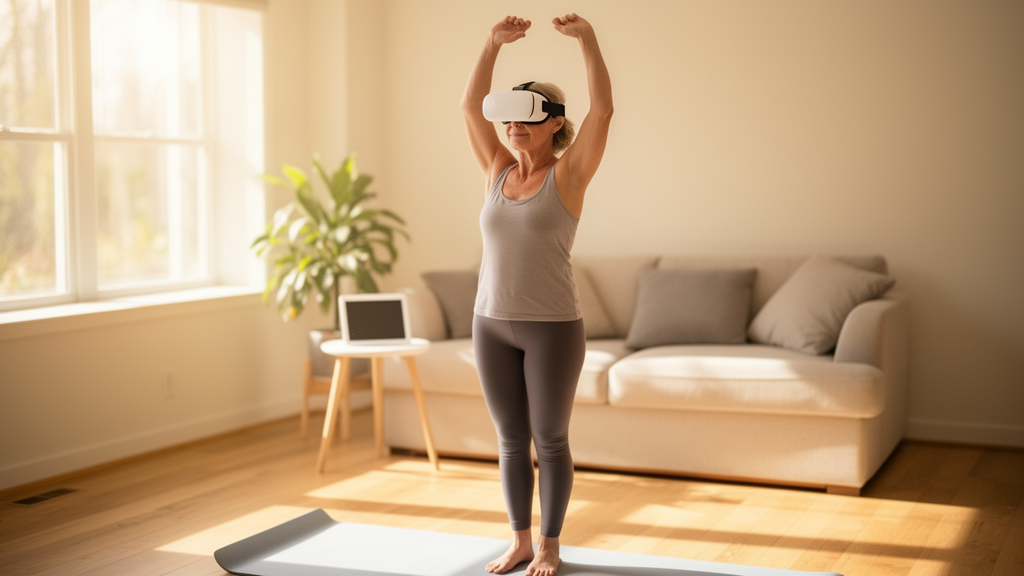
Exercise has quietly become one of the most evidence-backed tools in cancer care, recommended by international guidelines alongside chemotherapy and surgery rather than treated as an optional lifestyle extra. Yet for many people living with cancer, the gap between that recommendation and reality is wide. Fatigue, pain, fear of overexertion, and simple uncertainty about how to move safely can make even the best-intentioned exercise advice impossible to follow. A team of Spanish researchers now believes a headset, a virtual trainer, and a digital copy of your own body might help close that gap.
In a Methods paper published in Frontiers in Virtual Reality, researchers led by Alex Fuentes-Raventos of the University of Barcelona describe NEOBIC-XR, a home-based extended reality exercise platform designed specifically for people with cancer, together with a multicenter evaluation framework being rolled out across three Spanish hospitals. The work is notable less for any single technological breakthrough than for its ambition to make virtual reality exercise clinically deployable, measurable, and reproducible — a combination that has largely eluded the field so far.
The platform runs on Meta Quest 3 standalone headsets and was built in Unity, combining the XR Interaction Toolkit, OpenXR plugins, and Meta’s interaction and movement software development kits. Voice content for the virtual trainers was generated with ElevenLabs and delivered as pre-produced audio assets. Participants move through three distinct virtual environments across the four-week program: a Roman Pantheon in week one, a green field in week two, and a beach in week three, with week four cycling back through the earlier scenes. Each environment is paired with a trainer avatar matched to the setting.
What distinguishes NEOBIC-XR from many exercise apps is its treatment of the body itself. Participants select an avatar — from a standard library or, optionally, a photorealistic avatar generated from a single frontal photograph of their own face. During exercise, the headset’s full-body tracking retargets the participant’s real movements onto that avatar in real time, so the virtual body mirrors what the person is actually doing. This creates conditions for embodiment — the psychological sense of owning and controlling a virtual body — which the researchers argue may matter particularly in oncology, where physical deconditioning often coexists with reduced confidence in movement.
The exercise sessions themselves are tightly structured. Each prescribed routine includes a five-minute embodiment and warm-up phase, four exercises drawn from upper-body tasks such as boxing and reaching, lower-body tasks such as squats and lateral movements, and a guided mixed-reality module, followed by a five-minute breathing routine. Each exercise begins with a tutorial containing two demonstrations at low, medium, and high intensity. The first demonstration is always performed by the trainer. The second is where the study’s most intriguing design question lives: in one condition, the trainer performs it while a visible duplicate of the participant’s own avatar — a body-double — watches from the side; in the other, the body-double performs the movement while the trainer continues delivering the same instructional audio.
That body-double manipulation is not decorative. Previous research, including work by co-author Mel Slater and colleagues, has shown that observing a virtual copy of oneself can influence behavior and even reduce persecutory thoughts in clinical populations. By counterbalancing which condition participants see first and alternating daily, the team can examine whether watching your own avatar perform an exercise changes how intensely you choose to train — a behavioral signal captured because intensity is selected immediately after tutorial exposure. The tutorial-format analysis will use a Bayesian modeling framework with hierarchical random effects to account for repeated day-level exposures within participants.
The evaluation study is a prospective, multicenter, non-randomized implementation study at Hospital Universitario Central de Asturias in Oviedo, Hospital General Universitario de Ciudad Real, and Hospital Universitario Infanta Leonor in Madrid. Adults with stage IV solid tumors who are clinically suitable for light-to-moderate exercise are enrolled in one of two pathways. Those who accept home XR use and can be accommodated within headset and onboarding capacity enter the XR-supported pathway, completing twelve prescribed sessions over four weeks. Everyone else — including those recruited outside the weekly XR-capacity window — receives written evidence-based physical activity recommendations and completes the same hospital-based questionnaires. The allocation ratio is roughly three written-recommendation participants for every XR participant, reflecting device availability and onboarding capacity rather than randomization.
The primary planned endpoint is the change in self-reported physical activity from baseline to three months, scored in MET-minutes per week using an IPAQ-style calculation that combines walking, moderate, and vigorous activity. Secondary endpoints span health-related quality of life, symptom burden, psychological distress, cognitive complaints, supportive care needs, and nutritional indicators. Within the XR pathway, first-day to last-day changes in Godin physical activity, exercise readiness, coping self-efficacy, and wellbeing are analyzed as proximal outcomes, alongside post-session ratings of presence, body ownership, agency, and tolerability symptoms such as nausea and dizziness.
Privacy shaped the architecture in unusual ways. The application stores no raw video or images; instead it records the joint positions and rotations of the retargeted avatar rig, producing derived kinematic trajectories that the researchers explicitly caution should not be interpreted as validated biomechanical measures without separate validation. Headsets are provisioned through study-managed accounts rather than personal Meta accounts, the app is distributed through a restricted Meta Horizon Store deployment, and participant-specific avatars remain locked behind unlock codes so that no one handling a shared device can browse someone else’s virtual self. Progress data are organized around local profiles rather than names, with structured JSON session logs and binary pose files linked to the study database through the local workflow.
Safety monitoring addresses both exercise and headset risks. Participants rate nausea, dizziness, headache, and muscle pain after every session, and serious adverse events judged related to the intervention trigger independent clinical review before any continuation decision. The team has also prespecified a traffic-light feasibility framework covering onboarding completion, home initiation, prescribed-session adherence, three-month retention, event-log completeness, pose-data completeness, and cybersickness-related discontinuation, with green thresholds set at levels such as at least 80 percent onboarding completion and a median of at least nine of twelve prescribed sessions completed. Recruitment, which began in 2026 under protocol NEOBIC-2025-01 approved by the Research Ethics Committee of the Principality of Asturias, is expected to run into 2027, targeting up to 40 XR participants and roughly 120 written-recommendation participants.
The authors are candid about the study’s limits. Because allocation is acceptance-based rather than randomized, between-pathway comparisons will be adjusted but pragmatic, vulnerable to confounding by motivation and technology acceptance. The intervention is deliberately multidimensional, so causal attribution to any single component — beyond the counterbalanced tutorial format — will remain out of reach. Still, if NEOBIC-XR can be delivered consistently across three hospitals, tolerated in repeated home use, and linked cleanly to clinic-based assessments, it would mark a shift for virtual reality in oncology: from a novelty demonstrated in small laboratory studies toward a structured rehabilitation strategy that can be evaluated, refined, and potentially woven into real cancer care pathways.
Subject of Research: A home-based extended reality exercise platform and multicenter evaluation framework for supportive oncology care
Article Title: NEOBIC-XR: a home-based extended reality exercise platform and multicenter evaluation framework for supportive oncology care
Article References: Fuentes-Raventos, A., Slater, M., Jimenez-Fonseca, P., Cruz-Castellanos, P., Ruiz-Eguino, A., Naveiras-Alba, C., Obispo, B., Cerda-Company, X., Menéndez-López, J., & Calderon, C. (2026). NEOBIC-XR: a home-based extended reality exercise platform and multicenter evaluation framework for supportive oncology care. Frontiers in Virtual Reality, 7, Article 1927617. https://doi.org/10.3389/frvir.2026.1927617
Image Credits: AI Generated
DOI: 10.3389/frvir.2026.1927617
Keywords: extended reality, virtual reality, exercise oncology, cancer rehabilitation, home-based exercise, metastatic cancer, embodiment, avatars, supportive care, implementation science, Meta Quest 3, digital health
Cite Scienmag News
Nathaniel Bowman. (October 16, 2026). Virtual Reality Exercise Comes Home: NEOBIC-XR Brings Guided Workouts to People With Metastatic Cancer. Scienmag. https://scienmag.com/virtual-reality-exercise-comes-home-neobic-xr-brings-guided-workouts-to-people-with-metastatic-cancer/
Nathaniel Bowman. "Virtual Reality Exercise Comes Home: NEOBIC-XR Brings Guided Workouts to People With Metastatic Cancer." Scienmag, 16 October 2026, https://scienmag.com/virtual-reality-exercise-comes-home-neobic-xr-brings-guided-workouts-to-people-with-metastatic-cancer/. Accessed 16 October 2026.
Nathaniel Bowman. "Virtual Reality Exercise Comes Home: NEOBIC-XR Brings Guided Workouts to People With Metastatic Cancer." Scienmag. October 16, 2026. https://scienmag.com/virtual-reality-exercise-comes-home-neobic-xr-brings-guided-workouts-to-people-with-metastatic-cancer/


