


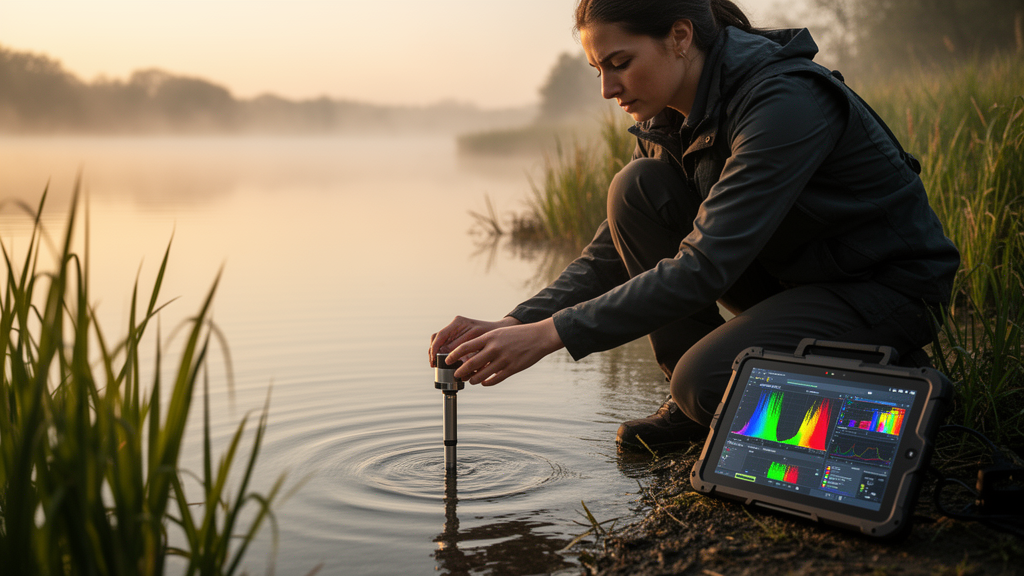
Water is the planet’s most familiar substance and its most fragile resource. Although roughly 71 percent of the Earth’s surface is covered by water, only about 2.5 to 3.0 percent of it is freshwater, and an even smaller fraction is actually drinkable. Less than 1 percent is readily accessible to humans from wells, ponds, shallow groundwater, lakes, and rivers, because the vast majority of freshwater is locked away in glaciers and deep underground aquifers. Against that backdrop, a sweeping new review published in Frontiers in Water argues that the future of water quality assessment belongs not to the laboratory bench but to artificial intelligence. Researchers K. Yukesh Kumar and P. Kumaresan of Vellore Institute of Technology in India systematically surveyed a decade of research to map how machine learning, deep learning, and generative AI are transforming the way scientists monitor, predict, and ultimately protect the world’s water supplies.
The traditional approach to water quality assessment has always been slow, expensive, and labor-intensive. Samples must be collected in the field, transported to laboratories, and analyzed by trained technicians using time-consuming protocols. The review argues that this paradigm is giving way to intelligent, automated AI-based frameworks that can automate tasks, generate hypotheses, and produce highly accurate results in a fraction of the time required by conventional methods. AI systems are described as more effective, more cost-efficient, and less error-prone than traditional assessments, and they can detect patterns in historical observations that human analysts would struggle to identify. This matters because water quality data is notoriously dynamic, noisy, and nonlinear, shaped by seasonal cycles, floods, land-use change, and complex spatial and temporal dependencies that demand highly predictive models capable of capturing that complexity.
To build a rigorous evidence base, the authors conducted a systematic literature review guided by the PRISMA protocol. They began with 351 articles retrieved from major publishers including Springer Nature, Elsevier, IEEE, Taylor and Francis, ACM, MDPI, Wiley, and others, spanning the years 2016 through 2026. After removing duplicates, screening titles and abstracts, and conducting full-text assessments, the final review settled on 107 high-quality studies. The resulting synthesis is organized as a unified, hierarchical taxonomy that classifies water-quality AI methods across three layers: classical machine learning, deep learning, and generative AI. The review benchmarks predictive performance across standardized water quality parameters including the Water Quality Index, dissolved oxygen, turbidity, pH, biochemical oxygen demand, nitrate, and heavy metal concentrations, offering practitioners evidence-based guidance on which architectures suit which tasks.
The taxonomy begins with regression-based machine learning models, which remain surprisingly competitive on small and localized datasets. Linear regression, multiple linear regression, and Gaussian process regression have all been applied to water quality prediction, with studies showing that simpler models can outperform deeper architectures when data is scarce or linearly correlated. One study of groundwater in the Akot basin of India found that multiple linear regression achieved nearly perfect correlation when using all available features, while random forest performed best when restricted to just total dissolved solids and total hardness. Ensemble methods, including bagging, boosting, and stacking, occupy the next tier. Random forests, which combine hundreds of decision trees trained on bootstrap samples, consistently ranked among the best performers across large and imbalanced datasets. Boosting techniques such as CatBoost and XGBoost excelled at capturing nonlinear dynamics, including fecal bacteria concentrations at coastal beaches and urban river pollution mapped from satellite imagery.
Deep learning models form the third and most powerful layer of the taxonomy. Convolutional neural networks excel at image-based tasks, classifying water safety from visual parameters like color, clarity, and texture, and detecting oil spills from satellite and aerial imagery. Recurrent architectures, including long short-term memory networks and gated recurrent units, are designed to capture long-term temporal dependencies in sensor data, making them ideal for forecasting dissolved oxygen, biochemical oxygen demand, and other time-varying parameters. Hybrid models that combine multiple architectures, such as CNN-LSTM networks with attention mechanisms or CEEMDAN decomposition paired with LSTM networks, have achieved some of the highest reported accuracies in the field, with one study reporting an R-squared of 0.9999 for water quality index prediction. Transformer-based architectures with self-attention mechanisms are now emerging as the state of the art, capable of disentangling trend, seasonal, and residual components across multi-scale periodicities.
The review also highlights the growing role of the Internet of Things in enabling real-time monitoring. IoT sensors measuring pH, temperature, turbidity, and flow can feed data to edge devices like Raspberry Pi, which run machine learning models locally and trigger automated alerts through cloud portals. LoRa-based low-power wide-area networks allow long-distance transmission at minimal energy consumption, making continuous monitoring feasible even in remote locations. One study combined IoT sensors with a random forest classifier to achieve 88 percent accuracy in classifying water quality, while another used K-means clustering with pH and total dissolved solids sensors to distinguish between drinking water, municipal water, salt water, and mud water. Satellite and UAV-based remote sensing, integrated with machine learning, offers a cost-efficient alternative to conventional field sampling, enabling continuous water quality assessment across large spatial scales.
Yet the authors are candid about the field’s most pressing weakness: the black-box problem. Deep learning models may achieve extraordinary accuracy, but they offer limited mechanistic insight into contaminant dynamics, which acts as a critical barrier to regulatory approval and environmental policy integration. To address this, the review foregrounds Explainable Artificial Intelligence techniques, particularly SHAP and LIME, which quantify the influence of each input variable on a model’s prediction. SHAP analysis has revealed, for example, that dissolved oxygen and biochemical oxygen demand are the most influential features for identifying water quality index, while population density, solar radiation, and digital elevation models drive nitrogen and phosphorus predictions in rivers. Federated learning, which allows multiple clients to collaboratively train a model without exchanging raw data, is also emerging as a promising approach for privacy-preserving distributed monitoring.
The review identifies six critical research gaps that remain unaddressed. Most published studies are conducted in geographically constrained, single-site settings, limiting the generalizability of model architectures to diverse hydrological contexts such as tropical, arid, and glacially influenced watersheds. Benchmark comparisons remain inconsistent due to heterogeneous datasets, differing input feature sets, and non-standardized evaluation protocols. Temporal dynamics are frequently underexplored, with many studies applying machine learning to static snapshots rather than modelling the continuous spatio-temporal evolution of parameters. Data scarcity for rare but high-impact contamination events, including industrial chemical spills and microbial outbreaks, remains a persistent obstacle that generative AI has only begun to address. Finally, the operational deployment of AI models on resource-constrained edge devices for rural and low-income regions remains largely unexplored.
Looking forward, the authors outline concrete pathways involving physics-informed generative adversarial networks, large multimodal models, and generative digital twins. Diffusion models have shown promise for super-resolution and spatiotemporal gap-filling in environmental raster data, while large language models are being explored for natural language querying of databases and metadata extraction from monitoring reports. One study integrated a Raspberry Pi camera with YOLOv5 object detection and a large language model to identify dead fish, oil spills, industrial waste, and algal blooms in real time, generating autonomous alerts and textual explanations. The review concludes that hybrid methods combining uncertainty-aware regression layers with spatial-temporal features have achieved promising robustness, and that the integration of advanced AI with explainable and privacy-preserving methodologies holds significant potential to support real-time water quality assessment, early contamination detection, treatment optimization, and automated decision support for sustainable water resource management.
Subject of Research: AI-driven water quality monitoring and prediction using machine learning, deep learning, and explainable AI
Article Title: A comprehensive review of AI-driven water-quality monitoring and prediction: advances, challenges, and future directions
Article References: Yukesh Kumar, K., & Kumaresan, P. (2026). A comprehensive review of AI-driven water-quality monitoring and prediction: advances, challenges, and future directions. Frontiers in Water, 8, Article 1946412. https://doi.org/10.3389/frwa.2026.1946412
Image Credits: AI Generated
DOI: 10.3389/frwa.2026.1946412
Keywords: artificial intelligence, water quality, machine learning, deep learning, explainable AI, IoT sensors, federated learning, generative AI, water quality index, environmental monitoring, LSTM networks, remote sensing
Cite Scienmag News
Blake Davidson. (October 16, 2026). How Artificial Intelligence Is Rewriting the Rules of Water Quality Monitoring. Scienmag. https://scienmag.com/how-artificial-intelligence-is-rewriting-the-rules-of-water-quality-monitoring/
Blake Davidson. "How Artificial Intelligence Is Rewriting the Rules of Water Quality Monitoring." Scienmag, 16 October 2026, https://scienmag.com/how-artificial-intelligence-is-rewriting-the-rules-of-water-quality-monitoring/. Accessed 16 October 2026.
Blake Davidson. "How Artificial Intelligence Is Rewriting the Rules of Water Quality Monitoring." Scienmag. October 16, 2026. https://scienmag.com/how-artificial-intelligence-is-rewriting-the-rules-of-water-quality-monitoring/


