


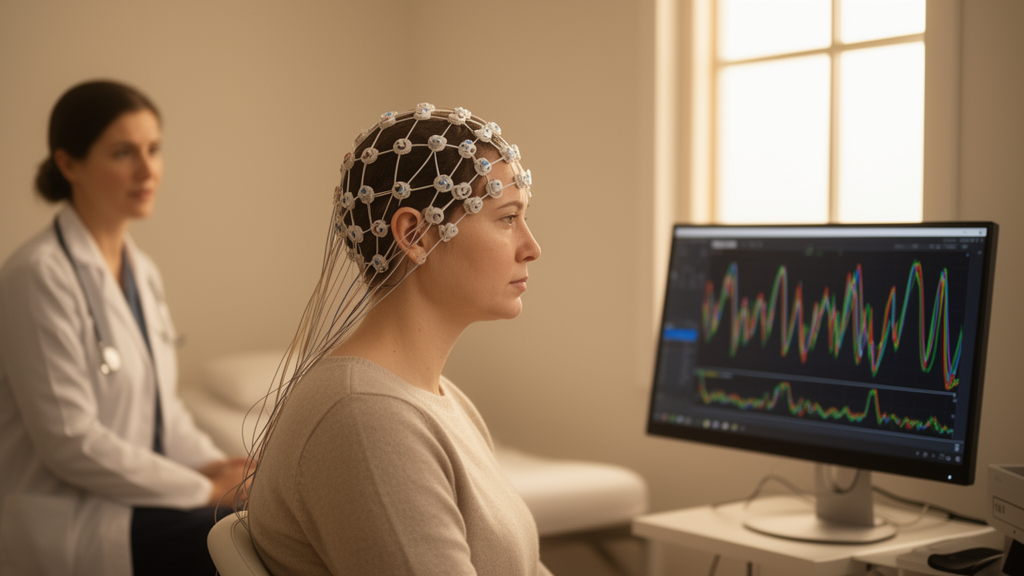
Depression remains one of the most common and disabling mental health conditions worldwide, yet its diagnosis still depends largely on subjective clinical interviews and symptom rating scales rather than objective biological measures. Reported rates of missed diagnosis and misdiagnosis range from 30 to 50 percent, a gap that has pushed researchers toward brain-based biomarkers. Electroencephalography, or EEG, has emerged as a promising candidate: it is non-invasive, captures neuronal electrical activity with millisecond precision, and has repeatedly shown abnormal patterns in patients with major depressive disorder. But while deep learning models can now classify depressive EEG signatures with impressive accuracy, they operate as black boxes, offering clinicians little insight into why a particular brain recording was flagged as depressed.
A research team from Beijing Institute of Petrochemical Technology and Tiangong University has now tackled that interpretability problem head-on. In a study published in Frontiers in Digital Health, they introduce E-MDD, an evidence-guided explainable framework that fuses high-dimensional EEG representations, handcrafted neurophysiological biomarkers, and a large language model to produce short, evidence-based textual explanations for each depression prediction. Rather than asking an AI to guess at reasons after the fact, the framework builds a structured chain of evidence from the model’s own decision process and then constrains the language model to translate that evidence into readable text.
The framework operates in three sequential stages. In the classification stage, preprocessed EEG segments are fed into two parallel feature extraction branches. The first branch uses a parameter-frozen EEGPT encoder, a pre-trained EEG foundation model, which divides each recording into spatio-temporal patches and outputs an embedding for each one. Global average pooling then aggregates these patch embeddings into a 512-dimensional latent representation of the epoch. The second branch extracts physiologically interpretable biomarkers using standard EEG analysis tools: 80 power features spanning the delta, theta, alpha, beta, and gamma frequency bands across the whole brain and seven regions, plus 16 additional features including frequency-band power ratios, hemispheric asymmetry measures, Hjorth parameters, and spectral entropy. After statistical screening with a two-sided Mann–Whitney test, 20 of these 96 candidate biomarkers were retained and concatenated with the deep representation before being passed to a lightweight multilayer perceptron classifier.
The second stage is where the framework earns its interpretability credentials. Using DeepSHAP, a Shapley Additive Explanations-based attribution method, the researchers quantified how much each of the 512 latent dimensions contributed to the model’s decision to classify a sample as depressed. They then performed a cross-space semantic alignment: Pearson correlation coefficients were computed between every latent dimension and every biomarker at the subject level, yielding 4,096 association tests that were corrected for multiple comparisons using the Benjamini–Hochberg false discovery rate procedure. Cohen’s effect sizes were calculated for both dimensions and biomarkers, and an integrated priority score—combining decision importance, correlation strength, and effect sizes—was used to select the 20 strongest latent dimension–biomarker mappings. All of this was done exclusively on a development set, with the independent test set locked away until final evaluation.
To keep the evidence trustworthy, the team added an epoch-level quality control mechanism based on robust z-score statistics. It flags EEG segments showing global power abnormalities, excessive high-frequency energy, low-frequency signal drift, missing features, or incomplete data, and excludes them from evidence construction. This filtering step ensures that the explanations ultimately generated rest on clean, reliable data rather than noisy artifacts.
In the final stage, the structured evidence is injected into a parameter-frozen large language model, DeepSeek-R1-Distill-Qwen-7B, through a carefully engineered evidence-guided prompt. The system prompt defines the model’s role and forbids it from revealing internal reasoning, referencing ground-truth labels, or producing diagnostic conclusions beyond the available evidence. The user prompt supplies anonymized sample information, prediction probabilities, risk stratification results, and up to three precomputed stable evidence entries. The output must follow a strict four-part structure: Risk Stratification, Stable EEG Evidence, Model Mechanism, and Conclusion. If any constraint is violated, the system falls back to a deterministic template-based generation strategy using the same evidence package, guaranteeing stability and reproducibility.
Testing on the publicly available Mumtaz dataset—resting-state, eyes-closed EEG from 34 patients with major depressive disorder and 30 healthy controls recruited at Hospital Universiti Sains Malaysia—the framework achieved an AUC of 0.8472 and an subject-level F1-score of 0.8421 on the held-out test set. The generated explanations scored 100.0 across all five automated quality compliance metrics, covering structural completeness, template adherence, terminology consistency, readability, and absence of information leakage. Faithfulness evaluation, which checks whether the explanations actually reflect the model’s decision basis, reached an overall score of 95.5, with decision alignment, biomarker alignment, and evidence direction all at 100.0 and mechanism traceability at 95.9. The relatively lower feature alignment score of 79.4 reflects the framework’s deliberate choice to present only the most representative evidence rather than exhaustively listing every identified feature.
Ablation experiments confirmed that each component matters. Removing the representation alignment module dropped overall faithfulness from 100.0 to 85.0, with feature alignment and mechanism traceability falling by 35.3 and 33.3 points respectively. Replacing the evidence-guided prompt with a generic one was even more damaging: overall faithfulness collapsed from 95.5 to 40.0, and feature alignment and mechanism traceability fell to zero, showing that a fluent, report-like output alone does not guarantee that the explanation is grounded in the model’s actual decision process. Removing the quality control module slightly reduced evidence coverage, confirming its role in filtering out unreliable inputs.
The framework also proved to be encoder-agnostic. When the EEGPT backbone was swapped for EEGNet, a lightweight convolutional network, or EEGConformer, a convolutional transformer hybrid, the pipeline maintained stable classification performance across ten-fold cross-validation and leave-one-subject-out protocols, with all three encoders achieving epoch-level AUC values above 0.82. At the subject level, EEGNet reached the highest AUC of 0.9444, while the EEGPT-based version achieved the best balance of accuracy, sensitivity, and F1-score. Consistency checks among three different explainable AI methods—DeepSHAP, Integrated Gradients, and Occlusion—showed Spearman correlations exceeding 0.94 in their importance rankings, reinforcing the reliability of the identified discriminative features.
The authors acknowledge limitations: the independent test set contained only 17 subjects, the framework currently focuses on spectral biomarkers rather than more complex measures such as functional connectivity or EEG microstates, and no independent clinician evaluation of the generated explanations has yet been performed. Still, by establishing a complete closed-loop evidence chain—from high-dimensional representation extraction through biomarker mapping to interpretable natural language generation—E-MDD offers a potential paradigm for combining deep learning and large language models in interpretable, neurophysiologically grounded clinical decision support for depression.
Subject of Research: An explainable deep learning framework that links EEG biomarkers to large language model explanations for depression recognition.
Article Title: E-MDD: an evidence-guided explainable framework for EEG-based depression recognition
Article References: Huang, J., Zhang, Z., Cao, Y., Zhao, Z., & Niu, L. (2026). E-MDD: an evidence-guided explainable framework for EEG-based depression recognition. Frontiers in Digital Health, 8, Article 1950514. https://doi.org/10.3389/fdgth.2026.1950514
Image Credits: AI Generated
DOI: 10.3389/fdgth.2026.1950514
Keywords: EEG, depression, explainable AI, large language models, deep learning, biomarkers, SHAP, mental health, neurophysiology, digital health, machine learning, clinical decision support
Cite Scienmag News
Glenn Wilkins. (October 16, 2026). AI Reads Brain Waves and Explains Itself: New Framework Turns EEG Signals Into Plain-Language Depression Clues. Scienmag. https://scienmag.com/ai-reads-brain-waves-and-explains-itself-new-framework-turns-eeg-signals-into-plain-language-depression-clues/
Glenn Wilkins. "AI Reads Brain Waves and Explains Itself: New Framework Turns EEG Signals Into Plain-Language Depression Clues." Scienmag, 16 October 2026, https://scienmag.com/ai-reads-brain-waves-and-explains-itself-new-framework-turns-eeg-signals-into-plain-language-depression-clues/. Accessed 16 October 2026.
Glenn Wilkins. "AI Reads Brain Waves and Explains Itself: New Framework Turns EEG Signals Into Plain-Language Depression Clues." Scienmag. October 16, 2026. https://scienmag.com/ai-reads-brain-waves-and-explains-itself-new-framework-turns-eeg-signals-into-plain-language-depression-clues/


