


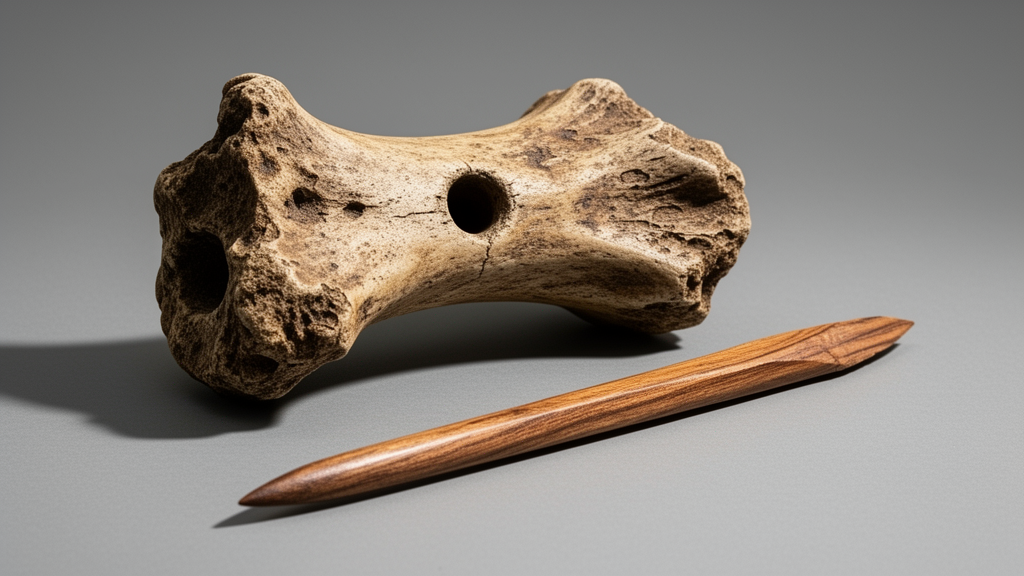
Deep inside Shanidar Cave in the foothills of Iraqi Kurdistan, a round hole roughly fifteen millimetres wide pierces the shoulder blade of a Neanderthal who died around 75,000 years ago. According to a study led by archaeologists at the University of Cambridge and published in the journal Scientific Reports, that perforation may represent the earliest known evidence of lethal interpersonal violence involving a wooden spear anywhere in the hominin fossil record. The finding is remarkable not only for what it says about how this individual died, but for what the surrounding bones reveal about how they lived, and who cared for them in the painful years that preceded a violent end.
The scapula, or shoulder blade, is a broad, flat bone so thin in places that it becomes almost translucent when held up to a light source. Complete scapulae rarely survive even in modern burials, yet this one was preserved nearly intact beneath seven and a half metres of rock and sediment. Dr Emma Pomeroy of Cambridge’s Department of Archaeology, the study’s lead author, described the extraordinary condition of the find, noting that the team was able to lift the bone out in a single piece from under almost eight metres of overlying deposits. Apart from the circular perforation, the bone is whole, giving researchers an unusually clear window into a moment of violence from deep prehistory.
The morphology of the wound itself points strongly toward wood rather than stone. A spear tip of flint or other stone would be expected to leave a flat or angular hole, whereas the round shape of the perforation matches a sharpened wooden point. The researchers argue that the spear entered the left chest cavity from the front and travelled through the body, passing through lung tissue and likely major arteries, before punching through the left scapula on its way out. Beveling around the hole is typical of an exit wound, and the team recovered tiny shards of bone displaced by the weapon, whose positions suggest the spear entered from above on a downward trajectory. Guided by faint ridges on the bone surface left by muscle attachments, the researchers were even able to piece part of the hole back together from those fragments.
The researchers interpret the trajectory and force involved as consistent with an intended heart shot, a killing blow aimed at the centre of the chest. Pomeroy cautions, however, that a hunting accident cannot be ruled out. Large animals such as mammoths may have been hunted at close range with thrusting spears, and lethal injuries in such encounters are easy to imagine. Still, she notes that the position of the wound and the force required to drive the weapon completely through the body bear what she describes as the hallmarks of an intended kill shot directed toward the heart. There is no way to establish the broader context of the violence, or whether modern humans might have been involved, but the researchers consider the most straightforward interpretation to be interpersonal violence between Neanderthals themselves.
Wooden artefacts almost never survive from this depth of time because decomposition destroys organic material, which makes the comparative evidence all the more valuable. Waterlogged spear examples dated to around 200,000 years ago, from the era when early Neanderthals roamed Europe, were recovered at Schöningen in Germany during the 1990s. Some of those preserved spears measure more than two metres long and were manufactured from carefully selected timber with weight distribution optimised for throwing, much like modern javelins, and they were probably used to hunt large game. The earliest known rounded wooden spear is more than 400,000 years old and consists only of a pointed end, pulled from the shoreline at Clacton-on-Sea in England in 1911. Similar technology, the Cambridge team argues, may well have caused the death of the individual now known as Shanidar A, and the wound could represent the first evidence for the use of sharpened wooden spears in the prehistoric Middle East.
Experimental work strengthens that argument. According to Pomeroy, holes left by reconstructions of spears from this period are an excellent fit for the perforation observed in the scapula, demonstrating that the early technology absolutely works for producing this kind of wound. She adds that the available evidence suggests Neanderthals and their ancestors had developed woodworking and weapon-making skills many thousands of years before Shanidar A died, and that this package of capabilities could have spanned the full geographic range of Neanderthal homelands, from Wales to Siberia. If correct, the wound at Shanidar extends the known use of such weapons into a new region of the Neanderthal world and deepens the picture of them as sophisticated toolmakers rather than the brutish figures of older stereotypes.
The shoulder blade was excavated alongside a mostly complete right hand, two left ribs plus a right rib fragment, and seven teeth, all that remains of an adult Neanderthal estimated to have been around 45 years old at death. Among the teeth, one incisor from the front of the lower jaw had been split lengthways, with only half remaining, while the surrounding teeth had rotated inward. The surviving half-tooth carried significant tartar, or dental calculus, build-up along its exposed root canal, indicating that it remained in the mouth for a considerable time after the injury. Scientists interpret this as evidence of major blunt-force trauma to the front of the face, an injury the individual survived.
That survival carries a profound social implication. Pomeroy notes that surviving a blow severe enough to split a tooth in this fashion, and then continuing to live and eat for at least a year and possibly much longer, would have required care and support from other Neanderthals. Shanidar A may have been fed soft food after the initial injury, and previous research on sediment in Shanidar Cave shows that plant foods were being soaked before cooking around the same period. Pomeroy observes that there is no doubt Shanidar A would have had difficulty communicating and would have been in absolute agony for a long stretch of time. The remains, she says, reflect the dual nature of so much of what we recognise as human: evidence of a terribly violent end on one hand, and clear evidence that the individual was cared for during their lifetime on the other.
Shanidar Cave is one of the most famous Neanderthal sites in the world. Excavations in the 1950s led by Ralph Solecki uncovered ten individuals, including a cluster of four found in the same spot despite having died at different times, suggesting the Neanderthals had returned repeatedly to inter their dead. Remains of another individual from a different part of the cave, who lived thousands of years later, showed a paralysed arm, arthritis, deafness and partial blindness, yet that person had lived a long life and must therefore have been cared for. These signs of compassion, social support and ritual around death helped overturn the Victorian view of Neanderthals as brutish and subhuman, and evidence of sophistication has continued to accumulate, from cave art to jewellery, alongside genetic analyses demonstrating interbreeding between Neanderthals and modern humans.
Shanidar A itself was unearthed in 2020 by a Cambridge-led team that has been working in the cave since 2015, and is one of three further Neanderthals found in the burial cluster, bringing the total to five: four adults and an infant, all within an area of the cave just 1.5 metres long by one metre wide and a metre deep. The spot lies directly behind a large vertical boulder that may have served as a prominent marker, and the remains are separated by thin layers of sediment. Shanidar A is the deepest burial yet found in the cluster and may have been the first body laid to rest there, positioned on its back with the head facing east, matching the orientation of the body directly above. Pomeroy argues that the best explanation for this pattern is intentional and symbolic funerary behaviour, with Neanderthals returning to the same place to lay their dead to rest, sometimes depositing new bodies before the earlier ones had fully decomposed, within years or decades of one another. Professor Graeme Barker of St John’s College, Cambridge, who leads the Shanidar Cave excavations, notes that evidence of systematic violence is extremely rare in deep prehistory, with the vast majority coming from settled farming communities thousands of years after hunter-gatherer societies like these Neanderthals. As he puts it, all we can ever know about the end of this Neanderthal’s life is that it was violent, and came at the end of a wooden spear, a statement that captures both the brutality and the humanity preserved in a single, astonishingly fragile bone.
Subject of Research: Paleoanthropological analysis of a fatal spear wound and evidence of care in a 75,000-year-old Neanderthal from Shanidar Cave
Article Title: Fatal Neanderthal wound may be earliest evidence of a wooden spear attack on a human ancestor
Article References: Fatal Neanderthal wound may be earliest evidence of a wooden spear attack on a human ancestor. (n.d.). Original publication
Image Credits: AI Generated
DOI: Not provided
Keywords: Neanderthals, Shanidar Cave, wooden spear, interpersonal violence, paleoanthropology, scapula trauma, Iraqi Kurdistan, funerary behaviour, Scientific Reports, University of Cambridge, Middle East prehistory, dental calculus
Cite Scienmag News
Courtney Benton. (October 16, 2026). A 75,000-Year-Old Hole in Bone May Record the Earliest Wooden Spear Killing. Scienmag. https://scienmag.com/a-75000-year-old-hole-in-bone-may-record-the-earliest-wooden-spear-killing/
Courtney Benton. "A 75,000-Year-Old Hole in Bone May Record the Earliest Wooden Spear Killing." Scienmag, 16 October 2026, https://scienmag.com/a-75000-year-old-hole-in-bone-may-record-the-earliest-wooden-spear-killing/. Accessed 16 October 2026.
Courtney Benton. "A 75,000-Year-Old Hole in Bone May Record the Earliest Wooden Spear Killing." Scienmag. October 16, 2026. https://scienmag.com/a-75000-year-old-hole-in-bone-may-record-the-earliest-wooden-spear-killing/


