


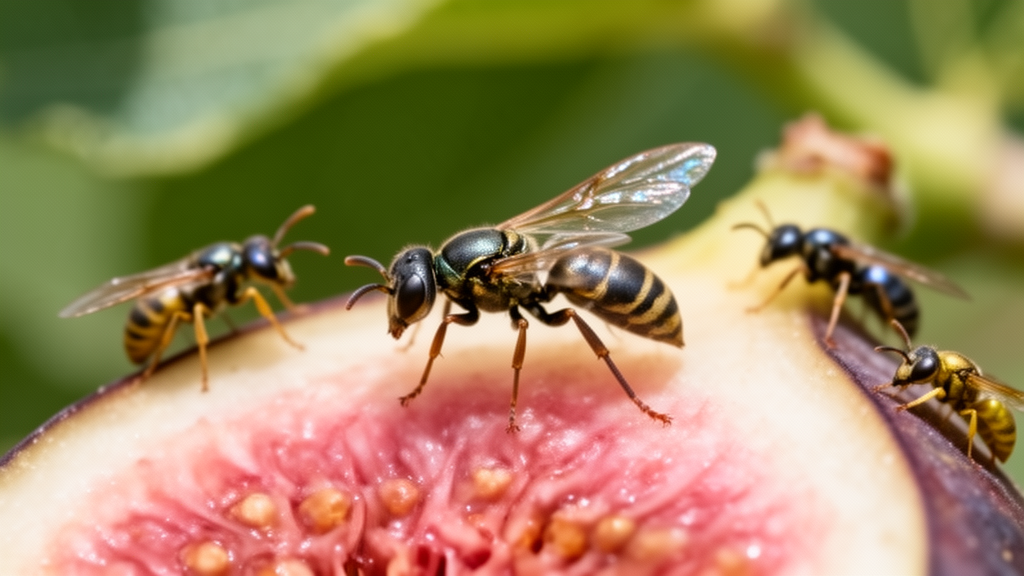
Deep inside the syconia of a widespread tropical fig tree, a lineage of non-pollinating wasps has been quietly diversifying across half the Old World, and a new integrative study has finally put a name to most of its members. In a revision published in the Journal of Hymenoptera Research, researchers reassessed the enigmatic genus Philoverdance, a monotypic taxon erected in 2000 for a morphologically odd wasp from India, and found that it is not a genus at all. Using whole-genome sequencing, mitochondrial DNA barcoding and detailed morphometrics, the team showed that Philoverdance nests squarely within the species-rich genus Philotrypesis, and they synonymized it accordingly. In the process, they described four previously unknown species and uncovered a striking geographic split that mirrors the evolutionary history of the host fig itself.
Philotrypesis is one of the most species-rich genera of non-pollinating fig wasps, belonging to the tribe Otitesellini within the family Pteromalidae. Its females oviposit from outside the fig syconium, usually after pollination and near the end of fig development, driving their long ovipositors through the fig wall into individual ovules. The length of that ovipositor relative to the thickness of the fig wall appears to be a major ecological constraint shaping host use and diversification. Males are generally wingless, often highly polymorphic, and engage in intense competition for mates, sometimes fighting, sometimes adopting alternative reproductive tactics. The genus currently comprises 45 described species, but decades of collecting across more than 2,000 fig samples from roughly 160 host fig species have yielded over 250 putative species, nearly 220 of which appear to be new to science.
The problem with Philoverdance began almost as soon as it was named. The genus was created to accommodate Philoverdance ravii, a distinctive wasp reared from figs of Ficus tinctoria in India, distinguished by a more compact body, less elongate terminal metasomal tergites, monodentate mandibles, a shorter pronotum and smoother body sculpture. Yet all of the diagnostic apomorphies of Philotrypesis were present, and overlap between these distinguishing characters and variation within Philotrypesis was soon noted. A single earlier molecular analysis using Sanger sequencing had recovered Philoverdance within a well-supported Philotrypesis clade, rendering Philotrypesis paraphyletic, but the position remained weakly supported and the question lingered for over a decade.
To settle the matter, the researchers turned to phylogenomics. They sequenced whole genomes of multiple Philotrypesis species on an Illumina NovaSeq 6000 platform, de novo assembled the reads, and extracted single-copy orthologous genes using BUSCO with the hymenoptera_odb12 lineage dataset. A total of 2,471 genes present in at least 90 percent of samples were retained, aligned with MAFFT, trimmed, and concatenated into a supermatrix for maximum-likelihood analysis in IQ-TREE2 with partitioned models and ultrafast bootstrap support. The resulting phylogeny subdivided the sampled Oriental diversity into approximately ten well-supported species groups, and Philoverdance was recovered nested within Philotrypesis with strong support, confirming that it should be treated as the Philotrypesis ravii species group rather than a separate genus.
The team also generated DNA barcodes for the 5′ region of the mitochondrial cytochrome c oxidase subunit I gene, either recovered from whole-genome sequencing data or amplified by PCR and sequenced with Oxford Nanopore Technologies. For the nanopore approach, PCR products were pooled with amplicons from a larger experiment, purified, prepared using the ligation sequencing protocol, and loaded onto Flongle flow cells. Basecalling with the super-accurate model, demultiplexing, removal of unique molecular identifiers and primers, and clustering with VSEARCH at a 0.90 similarity threshold produced consensus sequences that were merged when sharing more than 98 percent identity. Only dominant meta-consensus sequences supported by more than 100 reads and matching congeneric species in NCBI at at least 90 percent identity were retained, providing a reference framework for future species identification.
COI barcoding recovered five well-defined lineages within the Philotrypesis ravii species group, with pairwise genetic distances ranging from 6.1 percent between the most closely related taxa to 8.4 percent between the most divergent. These values substantially exceed those commonly reported among closely related species of Hymenoptera and Pteromalidae and greatly surpass typical intraspecific variation. Combined with consistent morphological differences, the genetic evidence strongly supports recognition of all five lineages as distinct species. The team described four new species: Philotrypesis minang from Sumatra, P. bannaensis from southern China, P. paiwan from Taiwan, and P. arfak from West Papua, joining the previously known P. ravii from India.
The COI topology revealed a pronounced phylogeographic structure within the group. A western lineage comprises P. bannaensis, P. ravii and P. minang, all associated with Ficus tinctoria subsp. gibbosa, the western representative of the host fig complex that extends from Sri Lanka and India through southern China and mainland Southeast Asia to western Malesia. An eastern lineage comprises the sister species P. paiwan from Taiwan and P. arfak from West Papua, both associated with Ficus tinctoria subsp. tinctoria, a widespread Indo-Pacific subspecies ranging from Taiwan and eastern Malesia to New Guinea, the Pacific Islands and northern Australia. Although based on more limited taxon sampling, the BUSCO phylogeny independently supports this same major evolutionary split between western and eastern lineages.
Remarkably, this geographic partition is mirrored by morphology. The eastern species share a suite of characters including a ventrally orange metasoma, a sculptured mesoscutellum and relatively elongate ovipositor sheaths, whereas the western species generally possess a dark ventral metasoma, a smooth mesoscutellum and shorter ovipositors. The concordance among mitochondrial data, genomic data, morphology, geography and host-plant subdivision provides compelling evidence that the P. ravii species group consists of several independently evolving species whose diversification has been shaped by the historical biogeography of the Ficus tinctoria complex across the Indo-Pacific region.
An equally interesting pattern emerges when ovipositor length is examined within each lineage. In the western lineage, the southern Chinese P. bannaensis and the Indian P. ravii possess relatively short ovipositors, whereas the Sumatran P. minang exhibits a much longer one. A similar trend appears in the eastern lineage, where the Taiwanese P. paiwan has a shorter ovipositor than its Papuan sister species P. arfak. Although direct measurements of syconium size and wall thickness across geographic populations of Ficus tinctoria are currently lacking, this repeated pattern is suggestive of parallel ecological adaptation to local host traits, consistent with previous findings in other Ficus-associated wasp lineages where ovipositor length relative to fig wall thickness constrains host use.
The study provides diagnoses, descriptions and identification keys for females and males of all five species, along with a first phylogenetic framework for Philotrypesis that will facilitate future taxonomic revision of this exceptionally species-rich and still poorly known genus. The authors note that the male-based key remains provisional, as some species are currently represented by few specimens and accurate identification often relies on morphometric measurements. Nevertheless, the integration of genomic, mitochondrial, morphological and biogeographic evidence demonstrates how a lineage once considered a genus in its own right is better understood as a morphologically distinctive but deeply nested species group, one whose diversification tracks the fragmentation and expansion of its host fig populations across one of the most biogeographically complex regions on Earth.
Subject of Research: Phylogenomics and taxonomy of non-pollinating fig wasps associated with Ficus tinctoria
Article Title: Testing the generic status of Philoverdance and revising the Philotrypesis ravii species group ( Otitesellini , Pteromalidae ) associated with Ficus tinctoria ( Moraceae )
Article References: Li, Y.-R., Cruaud, A., Nidelet, S., Peng, Y.-Q., & Rasplus, J.-Y. (2026). Testing the generic status of Philoverdance and revising the Philotrypesis ravii species group (Otitesellini, Pteromalidae) associated with Ficus tinctoria (Moraceae). Journal of Hymenoptera Research, 99, 915-954. https://doi.org/10.3897/jhr.99.205393
Image Credits: AI Generated
Keywords: Philotrypesis, Philoverdance, fig wasps, Ficus tinctoria, phylogenomics, COI barcoding, BUSCO, Otitesellini, Pteromalidae, new species, biogeography, Indo-Pacific
Cite Scienmag News
Gavin Prescott. (October 16, 2026). Fig Wasp Genomics Collapses a Century-Old Genus and Reveals Five Hidden Species Across the Indo-Pacific. Scienmag. https://scienmag.com/fig-wasp-genomics-collapses-a-century-old-genus-and-reveals-five-hidden-species-across-the-indo-pacific/
Gavin Prescott. "Fig Wasp Genomics Collapses a Century-Old Genus and Reveals Five Hidden Species Across the Indo-Pacific." Scienmag, 16 October 2026, https://scienmag.com/fig-wasp-genomics-collapses-a-century-old-genus-and-reveals-five-hidden-species-across-the-indo-pacific/. Accessed 16 October 2026.
Gavin Prescott. "Fig Wasp Genomics Collapses a Century-Old Genus and Reveals Five Hidden Species Across the Indo-Pacific." Scienmag. October 16, 2026. https://scienmag.com/fig-wasp-genomics-collapses-a-century-old-genus-and-reveals-five-hidden-species-across-the-indo-pacific/


