


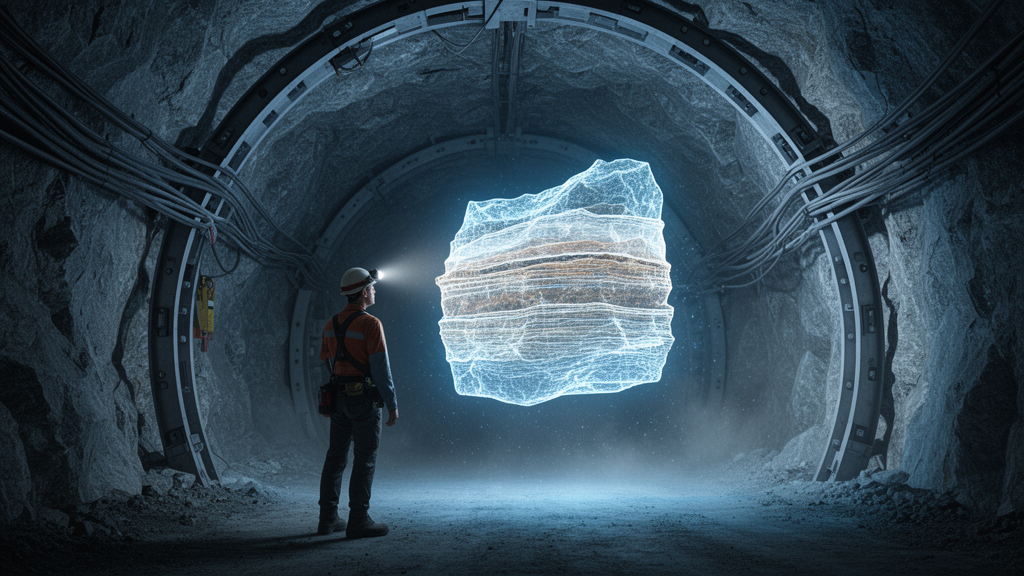
More than a kilometer beneath the peaks of the central Swiss Alps, inside a tunnel that threads through ancient granite, scientists are building something that behaves less like a static map and more like a living organism: a digital twin of the underground. In a new study published in the Swiss Journal of Geosciences, researchers have assembled a suite of interconnected three-dimensional geological models of the Bedretto Underground Laboratory for Geosciences and Geoenergies, a facility carved into the Rotondo granite south of the Gotthard massif. The work lays the computational groundwork for virtual replicas of the subsurface that can be continuously updated as fresh data stream in from experiments, sensors, and simulations.
Digital twins, a concept borrowed from engineering, are dynamic, data-driven virtual representations of physical systems that integrate observations and simulations to reproduce and predict the behavior of their real-world counterparts. In the geosciences, the idea is seductive but notoriously difficult: the subsurface is heterogeneous across enormous ranges of scale, and the datasets that describe it—field measurements, boreholes, tunnel excavations, remote sensing—vary wildly in resolution, accuracy, and spatial extent. The new study confronts this challenge head-on, presenting a geological digital twin framework in which the geometry of faults, shear zones, and rock fabrics is captured in georeferenced 3D meshes that can be updated as knowledge grows.
The Bedretto Lab, operated in a five-kilometer-long tunnel that branches off the Gotthard road tunnel, has become one of the world’s premier sites for studying hydro-seismo-mechanical processes, geothermal energy, and earthquake physics. Its scientific value depends on knowing precisely what kind of rock surrounds the experiments. The tunnel cuts through three main tectonometamorphic units of the Gotthard nappe: the Tremola series of pre- and Early Variscan metasedimentary rocks, the Prato series of high-grade orthogneisses and migmatites older than 439 million years, and the Rotondo granite, an Early Permian intrusion dated to about 295 million years ago. Roughly 4,070 of the tunnel’s 5,218 meters pass through the granite itself.
That granite carries a long and violent history. The researchers document four distinct tectonic phases etched into the rock. The oldest, D1, is a pre-Alpine event recorded in brittle shear fractures, cataclasites, and breccias. During the Alpine collision between roughly 35 and 20 million years ago, ductile shear zones developed under amphibolite-facies conditions of about 550 to 600 degrees Celsius and 1.0 gigapascal, overprinting and exploiting those older brittle structures as nucleation sites. A third phase introduced brittle-ductile strike-slip shear zones as the region shifted toward a transpressive regime that persists today, and a final phase, younger than 12 million years, produced zeolite- and gouge-bearing brittle faults under upper-crustal conditions below 200 degrees Celsius. The result is a geometrically tangled network of fractures and shear zones that directly governs fluid flow, seismicity, and rock strength.
To capture this complexity, the team built three hierarchically linked models using implicit modeling software that interpolates geological surfaces from scattered data points with radial basis functions. Model 1 reconstructs the regional geology of the Val Bedretto area from the 1:25,000 Geological Atlas of Switzerland, projecting lithological boundaries to depth conditioned on mapped structural data. Model 2 zooms into the Rotondo granite, merging remotely sensed topographic lineaments—manually digitized from high-resolution elevation models and aerial imagery at 25 and 10 centimeters per pixel—with field surveys and published structural sketches to map the large-scale architecture of deformation zones.
Model 3 reaches the finest scale, subdividing the rock into volumetric structural domains within 500 meters of the tunnel walls. The researchers classified the granite into domains with distinct textures and deformation styles: undeformed isotropic granite, coarse porphyritic granite rich in centimeter-sized K-feldspar grains, weakly foliated and strongly foliated variants, crosscutting lamprophyre dikes, and the banded metamorphic fabrics of the surrounding metasedimentary units. Only domains longer than 10 meters were modeled, and excavation-induced fractures, stress-relief cracks, and blasting damage were deliberately excluded so the model reflects the primary structural fabric rather than artifacts of tunnel construction.
One of the study’s most elegant methodological moves is a hierarchy of structural domains rooted in geological chronology. When differently oriented boundaries collided in the modeling software, producing geometric conflicts, the team resolved them by ordering domains according to relative age: the undeformed granite volumes came first, then the intruding mafic dikes, then the foliated overprints. Younger, higher-hierarchy domains were defined to cut across and terminate older ones, mirroring the actual intrusive and deformation history of the massif. The same georeferenced coordinate system, CH1903/LV03, ties all three models together, allowing regional tectonic constraints to propagate seamlessly down to the tunnel scale and tunnel observations to refine regional interpretations.
The models already reveal telling patterns. The southern portion of the Rotondo granite, where the main Bedretto Lab sits, preserves large volumes of nearly pristine magmatic texture within a sparse network of east–west and northeast–southwest structures, including low-angle, northeast-dipping deformation zones absent from the north. The northern granite, by contrast, is densely overprinted with predominantly subvertical structures. This north–south gradient in strain echoes patterns documented in the neighboring Aar Massif and underscores how pre-Alpine brittle inheritance controlled where Alpine ductile shear zones later developed—a cascade of structural memory stretching across hundreds of millions of years.
The payoff for digital twin applications is substantial. Because the models encode spatially explicit heterogeneity—foliation intensity, fracture style, strain history—they allow simulation environments to assign geologically informed mechanical and hydraulic properties rather than assuming homogeneous rock. Regional models can anchor boundary conditions and stress-field orientation; the granite-scale fracture architecture can localize fluid migration pathways and stress concentrations; and the tunnel-scale domains can inform seismic velocity anisotropy, stiffness contrasts, and permeability tensors. Real-time microseismicity data and improved hypocenter localization can, in turn, sharpen the modeled geometry of deformation zones, closing the loop between observation and prediction.
The researchers are candid about uncertainty. Sparse structural constraints in the regional maps, limited field coverage in the granite’s northwest, and the extrapolation of tunnel observations into the surrounding rock volume all introduce interpretational bias, and because the models are hierarchically linked, errors can propagate between scales. Yet the implicit modeling approach is precisely what makes the framework resilient: alternative interpretations can be tested rapidly, geometries cross-validated across datasets, and the entire structure updated as new geological, geophysical, and monitoring data arrive. The models have already been exported for online visualization and augmented reality, letting anyone with a smartphone place the Alps’ hidden architecture on their desk. As the authors emphasize, these are not passive pictures of the underground but dynamic representations—living frameworks designed to evolve with every experiment conducted in the deep.
Subject of Research: Multi-scale 3D geological modeling for digital twin applications at the Bedretto Underground Laboratory in the Swiss Alps
Article Title: 3D geologic modeling for digital twin applications: insights from the Bedretto Underground Laboratory
Article References: 3D geologic modeling for digital twin applications: insights from the Bedretto Underground Laboratory. (n.d.). https://doi.org/10.3897/sjg.119.181128
Image Credits: AI Generated
Keywords: digital twin, 3D geological modeling, Bedretto Lab, Rotondo granite, Gotthard nappe, implicit modeling, structural geology, fracture networks, Alpine tectonics, geothermal energy, seismicity, Swiss Alps
Cite Scienmag News
Violet Maxwell. (October 16, 2026). Deep Beneath the Swiss Alps, a Digital Twin of the Rock Is Taking Shape. Scienmag. https://scienmag.com/deep-beneath-the-swiss-alps-a-digital-twin-of-the-rock-is-taking-shape/
Violet Maxwell. "Deep Beneath the Swiss Alps, a Digital Twin of the Rock Is Taking Shape." Scienmag, 16 October 2026, https://scienmag.com/deep-beneath-the-swiss-alps-a-digital-twin-of-the-rock-is-taking-shape/. Accessed 16 October 2026.
Violet Maxwell. "Deep Beneath the Swiss Alps, a Digital Twin of the Rock Is Taking Shape." Scienmag. October 16, 2026. https://scienmag.com/deep-beneath-the-swiss-alps-a-digital-twin-of-the-rock-is-taking-shape/


