


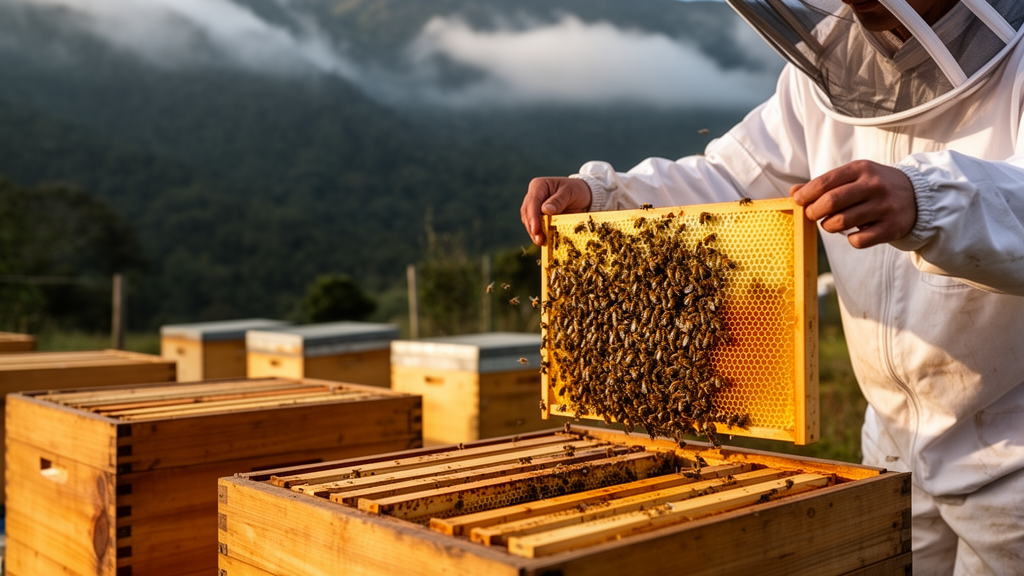
Honey bees are quietly holding up a large share of Peru’s agriculture. A new systematic review published in Frontiers in Bee Science pulls together a century of research on Apis mellifera in Peru and delivers a stark diagnosis: the country’s honey bees underpin major crops such as coffee, blueberries, avocados, citrus fruits and cacao, yet they are being squeezed by deforestation, parasitic mites, pesticide exposure and a shifting climate, all while the science needed to protect them remains patchy and unevenly distributed across the country.
The review, led by Deysi Ruiz-Llontop of Peru’s Instituto Nacional de Innovación Agraria together with colleagues at the Universidad Nacional Toribio Rodríguez de Mendoza de Amazonas, followed the PRISMA 2020 guidelines for systematic reviews. The team searched international databases including Scopus, Web of Science and Google Scholar, along with institutional repositories from public and private Peruvian universities, using Boolean search strings in both English and Spanish. After screening and eligibility assessment, 89 studies published between 1914 and 2024 made the final cut. The temporal pattern is telling: research activity has risen sharply in the last decade, reflecting growing scientific interest in pollinators, apiculture and ecosystem services in Peru.
The composition of that literature is itself a finding. Of the 89 studies, 29, or 32.6 percent, were peer-reviewed research articles, 3 were short communications, and 56, a full 64 percent, were academic theses. The authors caution that this heavy reliance on unpublished undergraduate theses could bias conclusions and limit the reliability of the evidence base. The studies spanned eleven thematic categories, from bee characterization and diversity to colony performance, nutrition, reproduction, health, honey, beeswax, propolis, pollen, apiculture and pollination services. Characterization studies and honey research tied as the largest groups with 22 studies each, while bee health work, much of it focused on the parasitic mite Varroa destructor, accounted for 15 studies. Pollination research, by contrast, was remarkably thin: only three studies addressed pollination and its impact on Peruvian crops, specifically avocado and sweet potato.
Keyword analysis reinforced the imbalance. The most frequent term in the reviewed literature was honey, appearing in 5.28 percent of keyword instances, followed by Apis mellifera at 4.58 percent and Varroa destructor at 2.46 percent. Terms such as diversity and beekeeping each registered 2.11 percent, while pollination itself appeared at just 0.70 percent. In other words, Peruvian bee science has concentrated on products and parasites, while the ecology of the pollination service, the very function that links bees to food production, has been largely neglected.
Geography compounds the problem. La Libertad dominated the research map with 25 studies, or 28 percent of the total, followed by Lima and Junín with 12 studies each, Cajamarca with 10, and Amazonas with 6. At the other extreme, regions including Arequipa, Pasco, Huancavelica, Tacna, Madre de Dios and Ucayali each accounted for only 1 percent. Strikingly, several departments, among them Áncash, Apurímac, Ayacucho, Cusco, Huánuco, Ica, Moquegua and Puno, plus the Constitutional Province of Callao, registered no studies at all. The authors note that in many of these unsampled regions climatic conditions are considered unfavorable for Apis mellifera breeding, which is why research institutions have not prioritized the species there, but the result is a national picture drawn from a fraction of the map.
Why does this matter agronomically? Pollination is vital for producing roughly one-third of the world’s food crops, according to the IPBES assessment cited in the review. In Peru, coffee and cacao rely heavily on bee pollination to enhance fruit set and quality, which is crucial for the country’s coffee and chocolate industries. Bees also aid in fertilizing fruits such as camu-camu and tomato, enhancing yield and quality. Evidence from elsewhere in Latin America underscores the stakes: in Jalisco, Mexico, watermelon and green tomato crops showed a complete lack of fruit production without pollinators. Yet in Peru, no studies have quantified the economic value of pollination services for agriculture, a gap the review flags as one of the most pressing.
The threats facing Peruvian bees are multiple and interacting. Habitat loss driven by deforestation is a leading pressure: Peru lost nearly 1.5 million hectares of forest between 1990 and 2000, with agricultural expansion accounting for 44.18 percent of deforested areas, converting flowering habitats into land that offers bees little food or shelter. The parasitic mite Varroa destructor invades bee larvae cells and reproduces within them, weakening colonies and increasing susceptibility to disease. Research in northern Peru has used geometric morphometry to characterize the ectoparasite, and field surveys found that unmanaged colonies carry higher Varroa infestation rates, particularly near human settlements, while infestation decreases with altitude. Notably, the review highlights a management recommendation: selecting hives with good hygienic behavior rather than relying on acaricides, because chemical treatments risk contaminating bee products for human consumption and the environment.
Pesticides add a third layer of stress. In Lima’s coastal valleys, farmers predominantly use organophosphates and carbamates, chemical classes associated with negative effects on bee health, including alterations in foraging behavior and reproductive performance. In Cusco, pesticide impacts on arthropod communities have been documented in association with potato cultivation. The review notes that studies on pesticide effects on Apis mellifera health in Peru remain limited, leaving a critical blind spot in national risk assessment. Climate change compounds everything: shifting precipitation patterns and extreme events modify flowering cycles and reduce nectar and pollen availability. Peru is experiencing significant water shortages, especially in the north, worsened by climate change and the El Niño effect, and climate forecasts suggest the Upper Amazon will face drier conditions while the Andes could see increased rainfall, potentially producing extreme flooding and droughts.
The review also elevates an ecosystem often overlooked in pollinator debates: grasslands. Peru holds nearly 21 million hectares of natural high-Andean pastures, ecosystems with distinctive floristic diversity, from tussock grasses to puna grass and wetlands, that support livestock such as cattle, alpacas, vicuñas and sheep. These grasslands provide essential habitat for bees, offering diverse flowering plants that supply nectar and pollen throughout the growing season, along with nesting sites and protection from predators and extreme weather. They also act as buffer zones between agricultural fields and natural habitats, reducing the impact of intensive farming on pollinators while delivering pollination services to nearby crops. However, an extensive portion of these grasslands is in a degradation process, and although protected areas such as the National Sanctuary of Ampay exist, the authors argue that urgent conservation efforts are needed.
Bees, the review notes, contribute beyond pollination. Their waste and dead individuals, along with pollen that breaks down into inorganic nitrogen, add essential nutrients to soil, and research in Andean-Amazon Peru reported that soil organisms and pollinators enhance soil fertility and boost crop production. Bee products can also serve as environmental bioindicators: honey bees can collect microplastic pollution and act as biomonitors for heavy metals in the air. This is particularly relevant in Peru, where agricultural soils in some regions show concentrations of arsenic, cadmium and lead exceeding national Environmental Quality Standards. One Peruvian study found that local products, including honey and propolis, exceed World Health Organization safety standards for metals such as cadmium and lead, often at higher levels than reported elsewhere. On the applied side, beeswax coatings have been shown to extend the shelf life of pears, and propolis has been used as a natural preservative for peach nectar, highlighting antimicrobial effects.
The authors are candid about the limitations of their synthesis. The evidence base is skewed toward Apis mellifera, limiting what can be concluded about the broader diversity of native bees and wild pollinators in Peru, and the uneven geographic distribution of research introduces regional biases that may undermine national representativeness. Their prescriptions are correspondingly broad: comprehensive assessments of native bee diversity, pollinator-plant interactions and ecosystem services using standardized monitoring; strengthened national research networks and long-term biodiversity monitoring programs; and integration of scientific evidence with public policies, conservation strategies and sustainable beekeeping practices. Peruvian Law No. 32685, which recognizes apiculture and pollination as strategic productive activities and establishes a National System of Apiculture and Pollination, provides a policy framework, but the review makes clear that law alone will not fill the data void.
The bottom line is a country whose agricultural future is partly written in the foraging paths of its honey bees, yet whose scientific record on those bees is concentrated in a handful of northern and coastal regions and dominated by theses rather than peer-reviewed research. Closing the gaps in pollination ecology, quantifying the economic value of pollination, and extending monitoring into the silent departments of the Peruvian map, the authors argue, are prerequisites for safeguarding Apis mellifera and, with it, the biodiversity and agricultural productivity that depend on it.
Subject of Research: The role, threats, and research gaps surrounding Apis mellifera honey bees and their impact on agriculture and ecosystems in Peru
Article Title: Apis mellifera bee: importance, challenges, and its impact on agriculture in Peru
Article References: Ruiz-Llontop, D., Paucar, Y., Bardales, W., & Saucedo-Uriarte, J. A. (2026). Apis mellifera bee: importance, challenges, and its impact on agriculture in Peru. Frontiers in Bee Science, 4, Article 1904918. https://doi.org/10.3389/frbee.2026.1904918
Image Credits: AI Generated
DOI: 10.3389/frbee.2026.1904918
Keywords: Apis mellifera, Peru, pollination, beekeeping, Varroa destructor, pesticides, deforestation, climate change, grasslands, ecosystem services, agriculture, systematic review
Cite Scienmag News
Sloane Callahan. (October 16, 2026). Peru’s Honey Bees Face a Perfect Storm of Deforestation, Mites, Pesticides and Climate Change. Scienmag. https://scienmag.com/perus-honey-bees-face-a-perfect-storm-of-deforestation-mites-pesticides-and-climate-change/
Sloane Callahan. "Peru’s Honey Bees Face a Perfect Storm of Deforestation, Mites, Pesticides and Climate Change." Scienmag, 16 October 2026, https://scienmag.com/perus-honey-bees-face-a-perfect-storm-of-deforestation-mites-pesticides-and-climate-change/. Accessed 16 October 2026.
Sloane Callahan. "Peru’s Honey Bees Face a Perfect Storm of Deforestation, Mites, Pesticides and Climate Change." Scienmag. October 16, 2026. https://scienmag.com/perus-honey-bees-face-a-perfect-storm-of-deforestation-mites-pesticides-and-climate-change/


