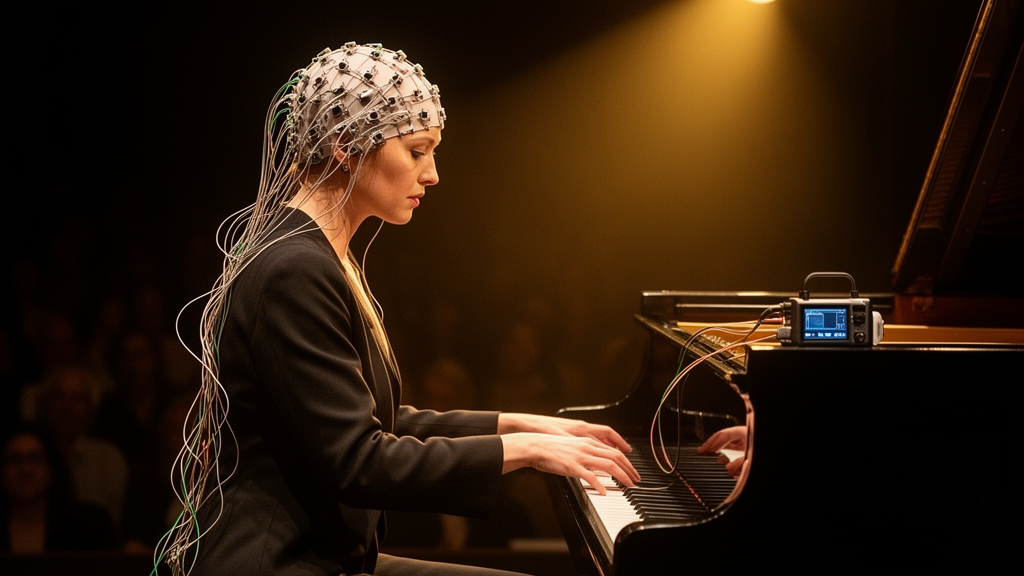
For more than a century, neuroscientists have asked how listeners’ brains respond to the emotional pull of music. Far less attention has gone to the other end of the communicative chain: the performer, the origin rather than the endpoint of the emotional signal. A new single-case study published in Frontiers in Cognition now offers an unprecedented performer-side view, recording the brain activity of a professional, internationally active concert pianist while he played Bach, Beethoven, and Chopin in a continuous, concert-like performance of roughly 27 minutes. Using 128-channel EEG and source reconstruction, the researchers traced how expressive intent is instantiated in a specialized, left-dominant sensorimotor-limbic network modulated by affective valence.
The performer was a right-handed, 30-year-old professional male pianist in excellent health, who began musical training at age four and had performed at major venues in New York, Nagoya, and Hong Kong. He played six works without interruption: four Contrapuncti from Bach’s Die Kunst der Fuge, the Adagio section of Beethoven’s Piano Sonata No. 31 in A-flat major, Op. 110, and an excerpt from Chopin’s Ballade No. 1 in G minor, Op. 23. The continuous-performance design was central to the study’s ecological aim. A trial-based design, in which short passages are repeatedly performed under explicit emotional instructions, would have interrupted interpretative continuity and forced the pianist to adopt externally imposed categorical labels such as Joy or Melancholy. Instead, phrasing, timing, dynamics, and motor organization unfolded naturally, and the expressive profiles were identified afterward by independent listeners.
From the continuous recording, the team extracted 99 two-second clean EEG segments, each containing 1,024 time points per channel, or 131,072 EEG data points per fragment. The segments were assigned to one of six previously validated performance-emotion categories based on listener evaluations: Joy, Peacefulness, Melancholy, Argumentative/Proactive, Tension, and Power. In the companion behavioral validation study, 20 professional musicians rated longer musical phrases in a forced-choice task, and one-sample t-tests confirmed that mean accuracy for every category exceeded the 16.67 percent chance level. A machine-learning analysis using Support Vector Machine, Random Forest, and Gradient Boosting algorithms further showed that the excerpts elicited sufficiently robust and discriminable oscillatory brain activity to permit reliable computational decoding of emotional performance states, with the Random Forest classifier providing the highest accuracy.
Cortical and subcortical source generators were reconstructed with standardized weighted Low-Resolution Electromagnetic Tomography, or swLORETA, an extension of sLORETA that incorporates singular-value-decomposition-based lead-field weighting to improve depth accuracy and localization stability under noisy conditions. The analysis yielded 1,056 dipoles, each associated with its gyrus and Brodmann area. Activation was quantified both as frequency of occurrence and as dipole magnitude across three macro-regions: anterior, posterior, and subcortical. A chi-square test on activation frequencies showed a significant association between region and emotional category, and repeated-measures ANOVAs revealed significant region- and emotion-dependent differences in dipole magnitude.
Across virtually every emotional category, the left basal ganglia, left thalamus, and left precentral gyrus (BA4) emerged as the most consistently recruited generators, indicating a stable left-lateralized fronto-striato-thalamic axis subserving fine motor control within this performance. The basal ganglia were active in 85 to 100 percent of segments in every category, and the left subcortical complex reached 100 percent occurrence in Argumentative/Proactive, Joy, and Power. Superimposed on this stable motor substrate, emotion-specific modulations emerged. Joy was associated with the highest subcortical activation magnitude, while Melancholy showed the lowest subcortical magnitude together with a selective recruitment of right-hemisphere generators, including right BA10, the right somatosensory cortex, and the right insula, consistent with valence-based hemispheric asymmetry accounts.
The magnitude analyses sharpened the contrast. Joy elicited the highest subcortical magnitude, differing significantly from Tension and, most markedly, from Melancholy, which showed the lowest subcortical magnitude overall. The sharpest gradient was observed between Joy, with left thalamic magnitude of 6.59 and left basal ganglia magnitude of 6.37, and Melancholy, with left thalamic magnitude of 2.31 and left basal ganglia magnitude of 2.10. Power was further distinguished by increased right cerebellar and right thalamic magnitude alongside a renewed left thalamic peak, not observed for any other category, suggesting heightened demands on motor error-monitoring during forceful and acoustically intense performance.
Pearson correlations further linked activation of the left basal ganglia, left thalamus, and left premotor cortex (BA6) to objective performance parameters, including gestures per second, notes per phrase, and acoustic intensity, suggesting that neurofunctional engagement scales with the motor complexity of the material performed. Left basal-ganglia and left thalamic activation magnitude correlated positively with gestures per second, indicating stronger subcortical recruitment during performances characterized by higher motor output. In contrast, left insular activation magnitude correlated negatively with the overall number of notes per musical phrase and, more strongly, with the number of left-hand notes per phrase, suggesting reduced insular recruitment during note-dense passages that may rely more on automatized subcortical control than on sustained interoceptive monitoring.
The authors caution that the emotional categories refer not to emotions necessarily experienced by the pianist, but to those perceived by listeners. These perceptual judgments arise from the interaction between the performer’s expressive interpretation and the structural characteristics of the musical piece. The naturalistic design is a major strength for ecological validity, but it prevents a clean separation of affective modulation from the motor-acoustic properties through which emotion is communicated. Moreover, because the 99 EEG segments were obtained from a single continuous performance and were nested within musical phrases, the observations cannot be regarded as fully independent, and the inferential statistics should be interpreted cautiously as exploratory within-performance analyses rather than as population-level evidence.
Despite these constraints, the findings provide a performer-side perspective complementary to models of music-evoked emotion largely derived from listeners, and suggest that, in this elite performer, expressive intent was instantiated in a specialized, left-dominant sensorimotor-limbic network modulated by affective valence. The study is complemented by animated audiovisual materials that dynamically trace the moment-to-moment evolution of LORETA source activity in synchrony with the unfolding musical passage, offering a vivid window into the neural choreography of expressive performance.
Subject of Research: Neuroscience of music performance
Article Title: Neural dynamics of emotionally expressive piano performance: a single-case study
Article References: Proverbio, A. M., & Carta, G. (2026). Neural dynamics of emotionally expressive piano performance: a single-case study. Frontiers in Cognition, 5, Article 1945714. https://doi.org/10.3389/fcogn.2026.1945714
Image Credits: AI Generated
DOI: 10.3389/fcogn.2026.1945714
Keywords: EEG, swLORETA, piano performance, music-evoked emotion, hemispheric lateralization, motor expertise, basal ganglia, thalamus, Neural, dynamics, emotionally, expressive
Cite Scienmag News
Cassandra Pierce. (October 16, 2026). Inside the concert pianist’s brain: EEG reveals how emotion is played, not just felt. Scienmag. https://scienmag.com/inside-the-concert-pianists-brain-eeg-reveals-how-emotion-is-played-not-just-felt/
Cassandra Pierce. "Inside the concert pianist’s brain: EEG reveals how emotion is played, not just felt." Scienmag, 16 October 2026, https://scienmag.com/inside-the-concert-pianists-brain-eeg-reveals-how-emotion-is-played-not-just-felt/. Accessed 16 October 2026.
Cassandra Pierce. "Inside the concert pianist’s brain: EEG reveals how emotion is played, not just felt." Scienmag. October 16, 2026. https://scienmag.com/inside-the-concert-pianists-brain-eeg-reveals-how-emotion-is-played-not-just-felt/