


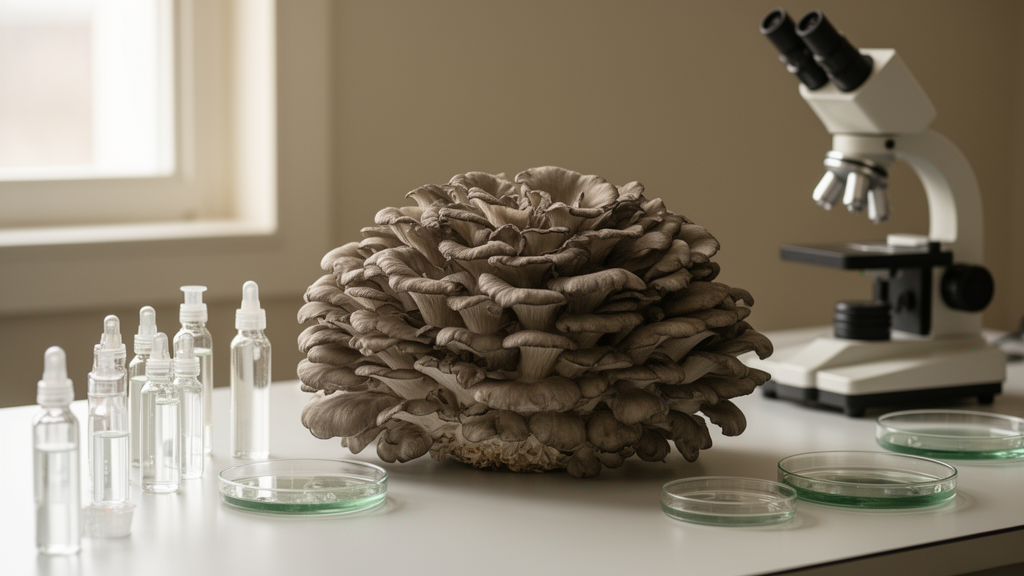
The maitake mushroom, Grifola frondosa, has long occupied a curious position in science: celebrated in East Asian food and medicine traditions, yet studied by researchers in fragments scattered across immunology, oncology, food chemistry, and biotechnology. A new scientometric analysis published in Frontiers in Fungal Biology has now pulled those fragments together into a single quantitative map. By analyzing 605 English-language journal articles indexed in Scopus from 1980 to 2025, a team of Philippine researchers has charted how research on maitake’s bioactive compounds grew from a handful of isolated studies into a mature, internationally connected field now pushing toward clinical and commercial translation.
The study, led by Christian Joseph N. Ong and colleagues at De La Salle University and partner institutions in the Philippines, used bibliometric software including Bibliometrix and VOSviewer to trace publication and citation trends, author and institutional networks, keyword co-occurrence patterns, and thematic evolution. The results reveal a field with a distinctive life cycle. Publication output remained low and sporadic from the 1980s through the late 1990s, began climbing in the early 2000s, and accelerated sharply after 2005. By the mid-2010s, annual output generally exceeded 20 articles, peaking at roughly 40 articles in 2025. A logistic growth model fitted to the data showed strong explanatory power, with an R-squared of 0.895, and projects a peak of approximately 37 publications per year around 2027, with a saturation level of roughly 1,403 cumulative publications. In plain terms, the field is approaching maturity, but it has not yet hit its ceiling.
Citation patterns tell a parallel story. Early citation averages from the 1980s and 1990s were modest and irregular, reflecting a small literature base. Citation activity rose visibly in the early 2000s, with notable peaks around 2002 to 2004, when studies on maitake polysaccharides and beta-glucans gained scholarly attention. Impact became more pronounced from the mid-2010s onward, with the highest average citation level observed around 2017 and sustained high values through 2019 to 2021. The apparent decline after 2022 should be read with caution, the authors note, because newer publications simply have not had enough time to accumulate citations.
Geographically, the indexed literature is heavily concentrated in East Asia. China leads with 238 publications, followed by Japan with 116, the United States with 70, Taiwan with 37, and South Korea with 29. Italy, the most productive European country, contributed 17 papers, with Spain and Germany at 14 each. The authors are careful to frame these rankings as measures of bibliographic visibility within English-language, Scopus-indexed literature rather than definitive counts of national research activity, since work published in local-language journals or unindexed sources may be underrepresented. Still, the pattern is consistent with the deep historical entanglement of medicinal mushrooms in traditional Chinese and Japanese Kampo medicine, where maitake has been valued both as food and therapeutic resource.
The authorship structure is strikingly Japan-centered. Naohito Ohno of Tokyo University of Pharmacy and Life Sciences ranks first with 39 publications, followed by Hiroaki Nanba of Kobe Pharmaceutical University with 32 and Toshiro Yadomae with 30. Most of the top ten authors are affiliated with Japanese institutions, and the list even includes Nippon Beet Sugar Manufacturing Co., Ltd., an industry-affiliated organization with 22 publications, evidence that product-oriented research has long been part of the field. The presence of Feng-Jie Cui and Liuqing Yang of Jiangsu University in China signals the growing Chinese contribution, which now dominates institutional rankings: six of the top ten institutions are Chinese, including the Ministry of Education of the People’s Republic of China in first place with 47 publications.
At the heart of the field sits a single conceptual anchor: beta-glucans. These are beta-(1,3)-D-glucans with beta-(1,6)-linked branches, found in maitake fractions such as the well-known D-fraction and grifolan. Their biological activity depends critically on molecular architecture, including molecular weight, branching patterns, solubility, and triple-helical conformation, which together govern receptor binding and immune recognition. Unlike conventional cytotoxic chemotherapeutics, these beta-glucans act primarily as biological response modifiers. They are recognized by pattern-recognition receptors, most notably Dectin-1, which is highly expressed on macrophages, dendritic cells, neutrophils, and monocytes. Dectin-1 engagement activates spleen tyrosine kinase-dependent signaling and the CARD9-NF-kappa-B pathway, driving production of pro-inflammatory cytokines such as TNF-alpha, IL-1beta, IL-6, and IL-12. Cooperative signaling through complement receptor 3 and Toll-like receptors amplifies both innate and adaptive immune responses, providing the mechanistic basis for the extensive antitumor literature identified in the keyword networks.
The scientometric maps show that this classical immunological paradigm is now being extended rather than replaced. Keyword overlay visualizations reveal a temporal shift: earlier studies clustered around beta-glucan, antitumor activity, and immune mechanisms, while more recent keywords include structural characterization, purification, fermentation, gut microbiota, oxidative stress, and hypoglycemic activity. Multidimensional scaling identified four major conceptual clusters: a central polysaccharide-focused cluster spanning isolation, characterization, and functional assessment; an immunological cluster built around beta-1,3-glucan, Dectin-1, and TNF-alpha; a cluster linking submerged culture technology with cytokine outcomes; and a biomedical cluster centered on apoptosis and inflammation. Experimental studies have shown that maitake polysaccharides can induce breast cancer cell apoptosis through the mitochondrial pathway, involving BAX upregulation, Bcl-2 suppression, cytochrome c release, and caspase-9 and caspase-3 activation. Meanwhile, antioxidant mechanisms involve scavenging reactive oxygen species, enhancing endogenous enzymes such as superoxide dismutase and catalase, and activating the Nrf2/HO-1 signaling axis to restore redox homeostasis.
Perhaps the most consequential emerging theme is the gut microbiota. Recent studies indicate that maitake polysaccharides improve glucose homeostasis by enhancing insulin sensitivity, activating AMP-activated protein kinase, suppressing hepatic gluconeogenesis, preserving pancreatic beta-cell function, and remodeling gut microbial communities that produce beneficial short-chain fatty acids. This integration of microbiome research reflects a transition from reductionist pharmacology toward systems-level understanding of host-microbe interactions, expanding the therapeutic relevance of maitake to metabolic syndrome, obesity, and chronic inflammatory diseases. The field is also exploring novel applications: one homogeneous beta-glucan, GFPS, has been shown to act as a Dectin-1-mediated carrier for antisense oligonucleotide delivery, positioning maitake polysaccharides as potential biomaterials for targeted nucleic acid therapeutics. Separately, a structurally distinct alpha-glucan, GFI-21alpha, has demonstrated strong in vivo antitumor efficacy by enhancing intratumoral CD8-positive T-cell activation and interferon-gamma-associated cytotoxicity.
Yet the path from laboratory to clinic remains fraught. The authors identify several translational barriers that the scientometric data alone cannot overcome. The overwhelming majority of evidence remains confined to in vitro experiments and animal models, with relatively few well-designed human intervention studies. A meta-analysis of 24 animal studies confirmed significant reductions in tumor growth and immune improvements following maitake polysaccharide administration, but the included studies exhibited substantial risks of selection, detection, and reporting bias. More broadly, only an estimated 5 to 10 percent of promising preclinical interventions ultimately progress to positive Phase II clinical trials. Preparation heterogeneity compounds the problem: maitake polysaccharides differ in backbone architecture, branching, molecular weight, monosaccharide composition, protein conjugation, and extraction source, whether fruiting body, mycelium, or fermentation broth, and extraction methods ranging from hot-water to alkaline to fermentation-based generate preparations with distinct biological activities. Pharmacokinetic uncertainties, including poor oral bioavailability and rapid metabolism of mushroom-derived bioactives, further limit systemic exposure despite strong experimental activity.
There are encouraging regulatory signals. The D-fraction has demonstrated a favorable safety profile, receiving exemption from Phase I toxicology testing by the United States Food and Drug Administration and approval for an Investigational New Drug application for a Phase II pilot study in patients with advanced cancers. A maitake polysaccharide-based drug was approved in China in 2010 as an adjunctive cancer therapy. But broader international implementation remains constrained by manufacturing consistency, quality assurance, pharmacovigilance, and long-term clinical evidence requirements. The authors argue that the way forward requires standardized cultivation, extraction, and quality-control platforms; rigorous structure-activity relationship studies; multicenter randomized controlled trials evaluating long-term efficacy, safety, and immune biomarkers; and interdisciplinary collaboration spanning mycology, pharmacology, immunology, food science, and clinical medicine. They also emphasize that translating scientific advances into public adoption will require positioning maitake as an accessible, scientifically supported functional food, incorporated into familiar formats such as soups, beverages, powders, and fermented products, with transparent labeling and standardized bioactive content. For a mushroom that has traveled from traditional remedy to scientometrically mapped research field, the next chapter depends less on discovering new bioactivities than on proving, in rigorous human studies, that the old ones hold up.
Subject of Research: Scientometric analysis of global bioactivity research on the medicinal mushroom Grifola frondosa (maitake)
Article Title: Bioactivity research in Grifola frondosa: a global scientometric analysis of emerging bioactivities and translational applications
Article References: Bioactivity research in Grifola frondosa: a global scientometric analysis of emerging bioactivities and translational applications. (n.d.). https://doi.org/10.3389/ffunb.2026.1940029
Image Credits: AI Generated
DOI: 10.3389/ffunb.2026.1940029
Keywords: Grifola frondosa, maitake, beta-glucans, polysaccharides, immunomodulation, antitumor activity, scientometrics, gut microbiota, functional foods, nutraceuticals, medicinal mushrooms, translational research
Cite Scienmag News
Roger Howard. (October 16, 2026). Maitake Mushroom Science Matures: Global Analysis Maps Four Decades of Bioactivity Research. Scienmag. https://scienmag.com/maitake-mushroom-science-matures-global-analysis-maps-four-decades-of-bioactivity-research/
Roger Howard. "Maitake Mushroom Science Matures: Global Analysis Maps Four Decades of Bioactivity Research." Scienmag, 16 October 2026, https://scienmag.com/maitake-mushroom-science-matures-global-analysis-maps-four-decades-of-bioactivity-research/. Accessed 16 October 2026.
Roger Howard. "Maitake Mushroom Science Matures: Global Analysis Maps Four Decades of Bioactivity Research." Scienmag. October 16, 2026. https://scienmag.com/maitake-mushroom-science-matures-global-analysis-maps-four-decades-of-bioactivity-research/


