


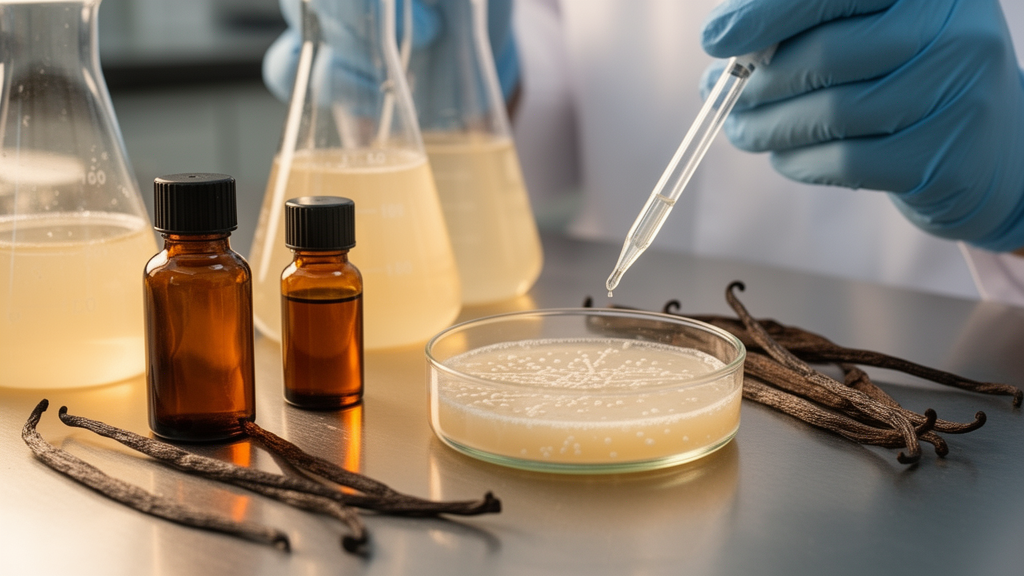
Vanilla is everywhere. It perfumes ice cream, chocolate, cosmetics, and even pharmaceuticals, and the world consumes more than 20,000 metric tons of vanillin—the molecule behind vanilla’s signature sweet, creamy aroma—every year. Yet fewer than one percent of that total comes from actual vanilla pods, which are expensive and scarce. Most of the rest is synthesized from petrochemicals or lignin, a route that cannot legally be labeled as natural in major markets. Now, a research team in Greece has shown that an unlikely microorganism, a bacterium famous for making wine taste smoother, can transform two inexpensive precursor molecules into natural vanillin and another prized aroma compound, offering a glimpse of a more sustainable flavor industry.
The study, published in Frontiers in Industrial Microbiology by researchers from Vioryl Chemical and Agricultural Industry and the University of West Attica, focused on Oenococcus oeni, a lactic acid bacterium that dominates malolactic fermentation in winemaking. The team isolated thirty bacterial strains from five spontaneously fermented Xinomavro wines from different Greek regions and confirmed their identity through 16S rRNA gene sequencing. Strain-level typing by multiplex PCR revealed three distinct profiles, designated MD00, MD02, and MD05. Intriguingly, the same strains appeared in wines from different vintages, suggesting that resilient resident populations persist in the winery environment, likely protected by biofilms on cellar surfaces.
The researchers fed these strains two different precursor molecules. The first was ferulic acid, a hydroxycinnamic acid abundant in plant biomass and agro-industrial waste, which is already a well-established vanillin precursor. The second was vanillylmandelic acid, or VMA, a vanilloid that is produced industrially as an intermediate in the classic two-step Rhône-Poulenc chemical synthesis of vanillin from guaiacol. VMA had never before been demonstrated as a microbial substrate for vanillin biosynthesis, making this aspect of the study a genuine first.
The results revealed a striking divergence in how the bacterium handles each substrate. When given ferulic acid, the O. oeni strains rapidly depleted it within forty-eight hours, converting it primarily into 4-vinylguaiacol, a smoky, clove-like aroma compound valued in its own right, with only modest amounts of vanillin appearing alongside. The researchers attribute this pattern to phenolic acid decarboxylases, cofactor-independent enzymes that cleave the ferulic acid side chain through a quinone methide intermediate. Vanillin formation from ferulic acid likely requires a slower, less efficient route involving hydration of the double bond and subsequent redox reactions, and under the tested conditions only about 4.3 milligrams per liter of vanillin was produced from 776 milligrams per liter of ferulic acid.
VMA told a very different story. Because it lacks the conjugated acrylic side chain of ferulic acid and carries an alpha-hydroxyl group instead, the decarboxylase route is blocked, and the bacterium channels it almost exclusively toward vanillin. The vanillin concentrations achieved from VMA were roughly nine times higher than those from ferulic acid, and only trace amounts of 4-vinylguaiacol appeared, confirming that the two substrates follow fundamentally separate biochemical pathways. The authors hypothesize that a cofactor-dependent decarboxylase or reductase system is at work, possibly analogous to thiamine pyrophosphate-dependent enzymes such as benzoylformate decarboxylase or prenylated flavin mononucleotide-dependent decarboxylases, though the exact enzymatic machinery remains to be identified through future genomic and biochemical screening.
Feeding strategy proved critical to productivity. In a one-time feeding approach, where all the VMA was added at the start of fermentation, vanillin production surged initially but plateaued as the substrate was exhausted, a classic signature of substrate-limited kinetics. In contrast, a continuous feeding regime, in which VMA was supplied incrementally at 1.818 millimoles per liter on multiple days, maintained a near-constant substrate concentration and sustained enzymatic activity over extended periods of up to twenty-four days. The team also tested higher substrate loadings of 10.9 and 16.36 millimoles per liter, monitoring the process kinetics through periodic sampling.
Strain differences emerged as a decisive factor. MD05 consistently outperformed its counterparts, exhibiting a steep, linear increase in vanillin production rate even at the highest VMA concentration, with no plateau or decline over fourteen days. Peak cell viability and maximum vanillin production coincided on day fourteen, underscoring how tightly biosynthesis depends on microbial health. MD02, by comparison, showed a peak in production followed by a decline at elevated substrate levels, which the authors attribute to metabolic stress, substrate overloading, or product toxicity. MD00 produced the lowest yields and was excluded from prolonged trials. The maximum metabolic efficiency reached approximately 25.7 percent yield relative to the theoretical biocatalytic conversion, a figure the researchers consider a promising starting point for optimization.
A subtle but important methodological challenge involved thermal decomposition. Autoclaving the fermentation medium, which was necessary because the precursors were insufficiently soluble at room temperature to allow membrane sterilization, caused some VMA to break down chemically into vanillin without any microbial help. To disentangle this abiotic contribution from genuine biotransformation, the team ran uninoculated controls subjected to identical sterilization and incubation conditions, then subtracted the background vanillin from the microbial cultures. Across all experiments, the uninoculated controls showed negligible vanillin formation, confirming that the compound in the inoculated flasks was overwhelmingly of microbial origin.
Downstream processing revealed both the promise and the practical hurdles of scaling the process. After fermentation, the cultures were centrifuged and the supernatant extracted twice with diethyl ether, then concentrated under vacuum. Quantification by ultra-high-performance liquid chromatography before extraction and gas chromatography-mass spectrometry afterward showed that between 31 and 46 percent of the produced vanillin was lost during recovery, likely through incomplete phase partitioning, surface adsorption, volatilization, and degradation. Strain MD05 again fared best, with the smallest absolute gap between measured and recovered vanillin. The GC-MS analysis of the final extract detected only expected fermentation byproducts, including lactic, butyric, isobutyric, and isovaleric acids and benzaldehyde, with no toxic or unexpected compounds, supporting the biosafety of the process.
The broader significance lies in regulation and sustainability. Under both European Regulation (EC) No. 1334/2008 and U.S. food labeling standards, vanillin can only be marketed as natural if it derives from natural precursors through processes free of synthetic chemical reagents and catalysts. Microbial conversion of natural precursors like ferulic acid satisfies these criteria, which is why biovanillin commands premium market value. O. oeni brings additional advantages: it is generally recognized as safe, uniquely adapted to harsh conditions of low pH, high ethanol, and nutrient limitation, and already deeply embedded in food fermentation practice. The authors suggest that future work should focus on identifying the specific enzymes behind the VMA-to-vanillin conversion, using comparative genomics to select high-performing strains like MD05, optimizing fermentation parameters such as pH and temperature, and exploring alternative downstream approaches such as adsorption resins to cut recovery losses. If those steps succeed, the wine cellar’s favorite bacterium could become an industrial workhorse for natural flavor production, turning agricultural byproducts into one of the world’s most beloved aromas.
Subject of Research: Microbial bioconversion of ferulic acid and vanillylmandelic acid to vanillin and 4-vinylguaiacol by Oenococcus oeni for sustainable natural flavor production
Article Title: Bioconversion of ferulic acid and vanillylmandelic acid to 4-vinyl guaiacol and vanillin mediated by Oenococcus oeni: towards sustainable flavor production
Article References: Dermitzaki, E., Gkanatsios, N., Tzamourani, A., Vamvakias, M., Bardouki, C., Zormpa, O. G., Dourtoglou, V. G., & Dimopoulou, M. (2026). Bioconversion of ferulic acid and vanillylmandelic acid to 4-vinyl guaiacol and vanillin mediated by Oenococcus oeni: towards sustainable flavor production. Frontiers in Industrial Microbiology, 4, Article 1868633. https://doi.org/10.3389/finmi.2026.1868633
Image Credits: AI Generated
DOI: 10.3389/finmi.2026.1868633
Keywords: Oenococcus oeni, vanillin, biovanillin, ferulic acid, vanillylmandelic acid, 4-vinylguaiacol, biotransformation, natural flavors, lactic acid bacteria, fermentation, wine microbiology, sustainable biotechnology
Cite Scienmag News
Morgan Morrow. (October 16, 2026). Wine Bacteria Turn Industrial Byproducts Into Natural Vanilla Flavor. Scienmag. https://scienmag.com/wine-bacteria-turn-industrial-byproducts-into-natural-vanilla-flavor/
Morgan Morrow. "Wine Bacteria Turn Industrial Byproducts Into Natural Vanilla Flavor." Scienmag, 16 October 2026, https://scienmag.com/wine-bacteria-turn-industrial-byproducts-into-natural-vanilla-flavor/. Accessed 16 October 2026.
Morgan Morrow. "Wine Bacteria Turn Industrial Byproducts Into Natural Vanilla Flavor." Scienmag. October 16, 2026. https://scienmag.com/wine-bacteria-turn-industrial-byproducts-into-natural-vanilla-flavor/


