


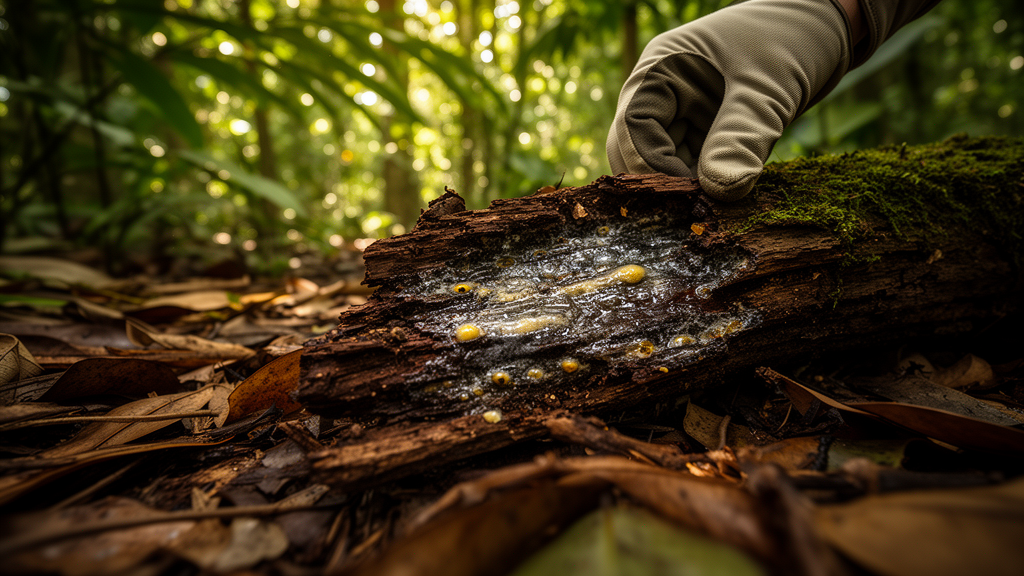
Deep in the Xishuangbanna Tropical Rainforest of Yunnan Province, southwestern China, decaying logs have yielded two previously unknown species of basidiomycetous yeasts. Researchers surveying fungi associated with rotting wood in Xishuangbanna Primeval Forest Park, near the city of Jinghong, isolated three strains that could not be matched to any known species. Detailed morphological, physiological, and genetic analyses published in MycoKeys now establish them as two new species: Oberwinklerozyma jinghongensis and Rosettozyma fusiformis. The discovery expands the known diversity of two small but taxonomically intriguing genera within the class Microbotryomycetes, a group in which many relatives live as mycoparasites, fungi that parasitize other fungi.
The survey that led to the discovery began with the simple act of collecting rotting wood from the forest floor. The study area lies south of the Tropic of Cancer and experiences a tropical monsoon climate, with an average annual temperature of roughly 21 degrees Celsius, mean annual precipitation between 1,200 and 1,700 millimeters, and 108 to 146 foggy days each year. The region is frost-free and snow-free throughout the year, conditions that sustain exceptional biodiversity. Notably, the researchers observed ant activity in the rotting wood at the time of sampling, hinting at the complex ecological community inhabiting these decaying substrates. Each sample was sealed in a sterile plastic bag, kept on ice, and transported to the laboratory within 24 hours for processing.
Isolation followed established yeast-culture protocols. One gram of each sample was added to 20 milliliters of sterile yeast extract-malt extract broth supplemented with the antibiotic chloramphenicol to suppress bacterial growth, then incubated at 25 degrees Celsius for three days on a rotary shaker. Dilutions of the enrichment cultures were spread onto agar plates, and colonies displaying distinct yeast-like morphologies were purified by repeated streaking. The effort proved remarkably productive: yeasts were recovered from more than 90 percent of the samples examined, yielding 96 strains from 52 samples. Most belonged to familiar species such as Candida tropicalis, Lachancea thermotolerans, and Scheffersomyces stipitis, but three isolates defied assignment to any described taxon.
To resolve the identity of these mystery strains, the team turned to DNA sequencing of two standard yeast barcoding loci: the D1/D2 domain of the large subunit ribosomal RNA gene and the internal transcribed spacer, or ITS, region. Genomic DNA was extracted from actively growing cells, amplified with established primer pairs, sequenced in both directions, and compared against reference sequences in GenBank using BLAST searches. The researchers then aligned the sequences with the MAFFT program, concatenated the two loci into a single dataset of 1,166 characters, and reconstructed evolutionary relationships using maximum likelihood analysis with 1,000 bootstrap replicates to gauge statistical support.
The phylogenetic tree, rooted with two Phyllozyma species as outgroups, delivered a clear verdict. Strains NYNU 181056 and NYNU 181073, which shared identical D1/D2 and ITS sequences and are therefore conspecific, formed a separate basal branch within the Oberwinklerozyma clade. They differed from all other known species of the genus by more than 22 nucleotide substitutions, roughly 4.1 percent, in the D1/D2 domain and by 42 nucleotide mismatches, about 6.8 percent, in the ITS region. These divergences are far larger than the thresholds typically used to delimit yeast species, justifying the description of a new species named Oberwinklerozyma jinghongensis, after its place of origin.
The third strain, NYNU 181054, landed within the Rosettozyma clade, but its position was equally distinctive. It clustered near two unpublished strains isolated from bromeliads in Brazil, though those strains differed from the Yunnan isolate by 28 nucleotide substitutions, about 5.1 percent, in the D1/D2 domain, suggesting they may represent yet another separate species. Against the three known Rosettozyma species, the Chinese strain showed even starker differences: 47 to 50 nucleotide substitutions, roughly 8.2 to 8.8 percent, in the D1/D2 domain and 70 to 75 mismatches, about 11.6 to 12.5 percent, in the ITS region. The team named the new species Rosettozyma fusiformis, a nod to the elongated, spindle-shaped cells that characterize the type strain.
Under the microscope, the two species reveal contrasting architectures. Oberwinklerozyma jinghongensis forms white-cream, butyrous, smooth and glistening colonies on YM agar, with ellipsoidal to cylindrical cells measuring 2.8 to 4.1 by 5.6 to 10.3 micrometers that reproduce by polar budding. Rosettozyma fusiformis produces whitish to cream, slightly wrinkled, semi-glossy colonies and elongate fusiform cells of 1.9 to 2.1 by 7.6 to 13.9 micrometers that often gather in rosette-like clusters, a hallmark of the genus. Neither species produced ballistoconidia, the forcibly discharged spores seen in some basidiomycetous yeasts, and neither formed pseudohyphae in Dalmau plate cultures. No sexual structures appeared on any of the media tested over six weeks of observation, leaving their sexual cycles unknown.
Physiological profiling sharpened the distinctions further. Both new species are nonfermentative, unable to convert glucose to alcohol, and both can use nitrate, nitrite, and L-lysine as sole nitrogen sources while rejecting ethylamine and cadaverine. Oberwinklerozyma jinghongensis assimilates a broad palette of carbon compounds, including inulin, D-ribose, L-rhamnose, and erythritol, capabilities that separate it from every other member of its genus. It grows at 25 degrees Celsius but not at 30. Rosettozyma fusiformis likewise assimilates inulin, L-rhamnose, galactitol, and D-glucosamine, and uniquely among Rosettozyma species it tolerates 30 degrees Celsius, though it cannot grow at 35. Both species show positive urease activity and a positive diazonium blue B reaction, classic markers of basidiomycetous yeasts.
The taxonomic placement of the two genera reflects their deep evolutionary divergence. Oberwinklerozyma, first proposed in 2015 to accommodate three anamorphic species, is distinguished by coenzyme Q-9 as its major ubiquinone and by its ability to assimilate raffinose and myo-inositol, traits that set it apart from the related genera Pseudohyphozyma and Slooffia, which carry Q-10 and lack those abilities. Rosettozyma, established in 2020, sits in its own family, Rosettozymaceae, and order, Rosettozymales, near the base of the Microbotryomycetes. Its members are typically epiphytes on plant leaves, important inhabitants of the phyllosphere, which makes the recovery of R. fusiformis from rotting wood an unusual and noteworthy record.
The findings underscore how much yeast diversity remains hidden in decaying wood, particularly in China. To date, 69 yeast species have been isolated from rotting wood in the country, 39 of them originally described there. The Xishuangbanna survey alone added 11 species newly recorded for China alongside the two novel species. Yet vast regions, especially the forests of eastern China, remain almost entirely unsampled for wood-inhabiting yeasts. Because rotting wood is rich in assimilable carbon compounds, it serves as a critical reservoir of fungal diversity with potential agricultural, environmental, and biotechnological applications, and the researchers argue that comprehensive surveys in underexplored regions should be a high priority for understanding both the ecology and the industrial promise of these overlooked microorganisms.
Subject of Research: Taxonomic description of two novel basidiomycetous yeast species isolated from rotting wood in Yunnan, China
Article Title: Two new species of Oberwinklerozyma and Rosettozyma ( Microbotryomycetes ) from Yunnan, southwestern China
Article References: Two new species of Oberwinklerozyma and Rosettozyma ( Microbotryomycetes ) from Yunnan, southwestern China. (n.d.). https://doi.org/10.3897/mycokeys.141.204237
Image Credits: AI Generated
DOI: 10.3897/mycokeys.141.204237
Keywords: yeast, Oberwinklerozyma, Rosettozyma, Microbotryomycetes, rotting wood, Yunnan, Xishuangbanna, new species, taxonomy, phylogenetics, biodiversity, basidiomycetes
Cite Scienmag News
Roger Howard. (October 16, 2026). Two New Yeast Species Unearthed in China’s Tropical Rainforest Rotting Wood. Scienmag. https://scienmag.com/two-new-yeast-species-unearthed-in-chinas-tropical-rainforest-rotting-wood/
Roger Howard. "Two New Yeast Species Unearthed in China’s Tropical Rainforest Rotting Wood." Scienmag, 16 October 2026, https://scienmag.com/two-new-yeast-species-unearthed-in-chinas-tropical-rainforest-rotting-wood/. Accessed 16 October 2026.
Roger Howard. "Two New Yeast Species Unearthed in China’s Tropical Rainforest Rotting Wood." Scienmag. October 16, 2026. https://scienmag.com/two-new-yeast-species-unearthed-in-chinas-tropical-rainforest-rotting-wood/


