


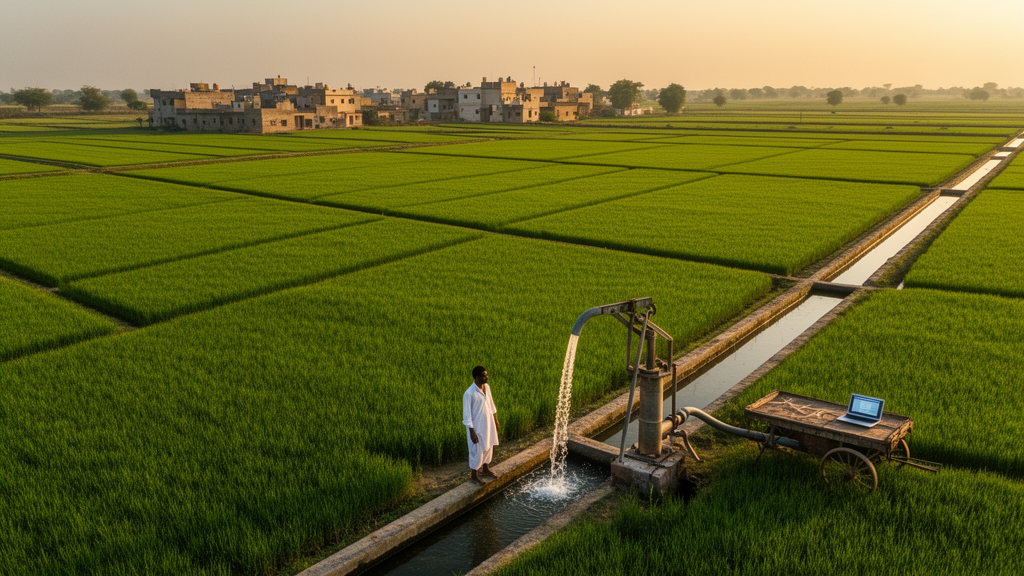
Groundwater is disappearing across northwestern India faster than almost anywhere else on Earth, and the consequences ripple far beyond the water table. In the Bist-Doab region of Punjab State, one of the world’s most intensively irrigated agricultural landscapes, declining aquifer levels threaten both equitable drinking water supply and the sustainability of farming that feeds millions. A new study published in Hydrogeology Journal by Amit Umesh Kantode of the Indian Institute of Technology Bombay and colleagues Sayantan Ganguly and Thallam Prashanth of IIT Ropar offers a fresh technical answer: a hybrid modeling framework that fuses the physics-based groundwater simulator MODFLOW with machine learning algorithms to squeeze out systematic errors and deliver markedly more accurate predictions of groundwater levels.
The core problem the researchers tackle is uncertainty. Physically based regional groundwater models, which solve the equations of subsurface flow using hydrogeological data such as aquifer properties, recharge rates and boundary conditions, are indispensable tools for understanding groundwater flow dynamics. Yet they are built on imperfect knowledge of the subsurface. Geological heterogeneity, uncertain recharge estimates and simplified conceptualizations of the aquifer system all conspire to introduce errors between what the model predicts and what monitoring wells actually measure. These errors are not merely academic. As the authors note, uncertainties in modeling and estimating groundwater resources can misdirect water allocation decisions, undermining both resource sustainability and crop yields in regions where every cubic meter counts.
The team’s solution is what hydrogeologists call a data-driven model, or DDM, framework layered on top of the physical simulation. Rather than abandoning MODFLOW, the researchers keep it as the backbone of the analysis and then deploy machine learning to correct its residuals, the differences between observed and simulated hydraulic heads. Those residuals, together with geographic coordinates, groundwater levels and time information, are fed as inputs into three distinct machine learning architectures: support vector regression, random forest and artificial neural networks. Each of these algorithms approaches the error-correction task differently, and their collective goal is to identify systematic patterns in the physical model’s mistakes that a purely physical model cannot resolve on its own.
Support vector regression works by finding a mathematical function that maps input features to predicted residuals while tolerating a controlled margin of error, making it robust to noisy field data. Random forest, by contrast, builds an ensemble of decision trees, each trained on random subsets of the data, and averages their outputs to capture complex nonlinear relationships without overfitting. Artificial neural networks, the most flexible of the three, use layers of interconnected nodes to learn hierarchical representations of the relationships between location, time, water level and model error. By training these algorithms on historical observations, the framework effectively teaches them where and when the physical model tends to go wrong, and by how much.
The results, according to the study, are striking. Integrating MODFLOW with machine learning significantly improves accuracy compared with the standalone physical model, and the hybrid approach effectively captures both seasonal fluctuations and long-term trends in groundwater levels. This matters enormously in a region like Bist-Doab, where water levels swing with the monsoon cycle and the intensive irrigation season, and where the long-term trajectory has been relentlessly downward. A model that can faithfully reproduce both the seasonal pulse and the secular decline gives water managers a far more reliable basis for deciding how much water can be safely extracted, where, and when.
The significance of this work extends well beyond one district in Punjab. Northwestern India has been under scientific scrutiny for decades, with satellite-based estimates published in Nature as far back as 2009 documenting substantial groundwater depletion across the region. The Central Ground Water Board’s periodic assessments of dynamic groundwater resources of India have repeatedly flagged the state’s aquifers as stressed. Against this backdrop, the Bist-Doab case study serves as a proving ground for a methodology that could be transferred to other agriculturally intensively irrigated basins facing similar pressures, from the Indo-Gangetic Plain to other over-exploited aquifer systems worldwide.
What makes the hybrid approach conceptually elegant is that it respects the strengths of both paradigms. Purely data-driven models, including the machine learning techniques used here, excel at pattern recognition but lack the physical grounding needed to extrapolate reliably to unseen conditions, such as unprecedented droughts or changes in pumping policy. Purely physics-based models encode scientific understanding of flow through porous media but are hampered by uncertain parameters and simplified geology. By using machine learning specifically to correct the errors of the physical model, rather than to replace it, the framework preserves the interpretability and physical consistency of MODFLOW while borrowing the pattern-recognition power of modern algorithms. The machine learning component learns what the physics misses, not what physics cannot say.
The residual-correction strategy also has practical advantages for water managers. Because the errors being corrected are systematic, meaning they recur in predictable ways across space and time, the machine learning layer can be retrained as new monitoring data arrive, continuously sharpening the model’s performance without requiring a full recalibration of the underlying physical model. This adaptability is crucial in a management context, where decisions about water allocation must respond to changing conditions on seasonal to annual timescales. The authors position the hybrid framework as a robust tool for optimizing water allocation and supporting sustainable groundwater management in agriculturally stressed regions, a description that fits the Bist-Doab context precisely.
The study builds on a growing body of research at the intersection of hydrogeology and artificial intelligence. Prior work has explored artificial neural networks for groundwater level forecasting, Bayesian calibration of groundwater models with uncertain inputs, and the use of machine learning to reduce predictive error of regional groundwater models. More recent studies have pushed toward deep learning-based data assimilation and physics-informed neural networks that embed physical constraints directly into the learning process. The Bist-Doab study contributes to this lineage by demonstrating, at regional scale in a real-world stressed aquifer, that a relatively straightforward residual-correction architecture using well-established algorithms can deliver meaningful accuracy gains over the physical model alone.
For a region where groundwater underpins both drinking water security and the agricultural economy, the implications are concrete. Better predictions of groundwater levels translate directly into better-informed decisions about pumping quotas, crop choices and recharge interventions. The framework offers a pathway toward precision modeling of a resource that has long been managed with coarse tools and imperfect information. As aquifers worldwide come under intensifying stress from climate variability and expanding irrigation, the marriage of physical simulation and machine learning exemplified in this study may well become a standard component of the hydrogeologist’s toolkit, turning the uncertainty that once clouded water allocation decisions into a quantified, correctable and manageable component of the modeling process.
Subject of Research: Hybrid MODFLOW and machine learning framework for reducing uncertainty in regional groundwater level modeling in the Bist-Doab region of Punjab, India
Article Title: Leveraging machine learning tools to minimize uncertainties of physically based regional-scale groundwater models: A case study on precision modeling of groundwater levels in the Bist-Doab region, India
Article References: Leveraging machine learning tools to minimize uncertainties of physically based regional-scale groundwater models: A case study on precision modeling of groundwater levels in the Bist-Doab region, India. (n.d.). https://doi.org/10.1007/s10040-026-03191-3
Image Credits: AI Generated
DOI: 10.1007/s10040-026-03191-3
Keywords: groundwater, MODFLOW, machine learning, support vector regression, random forest, artificial neural networks, Bist-Doab, Punjab, India, hydrogeology, water management, uncertainty
Cite Scienmag News
Teresa Odom. (October 16, 2026). Machine Learning Meets MODFLOW: Sharper Groundwater Forecasts for India’s Stressed Breadbasket. Scienmag. https://scienmag.com/machine-learning-meets-modflow-sharper-groundwater-forecasts-for-indias-stressed-breadbasket/
Teresa Odom. "Machine Learning Meets MODFLOW: Sharper Groundwater Forecasts for India’s Stressed Breadbasket." Scienmag, 16 October 2026, https://scienmag.com/machine-learning-meets-modflow-sharper-groundwater-forecasts-for-indias-stressed-breadbasket/. Accessed 16 October 2026.
Teresa Odom. "Machine Learning Meets MODFLOW: Sharper Groundwater Forecasts for India’s Stressed Breadbasket." Scienmag. October 16, 2026. https://scienmag.com/machine-learning-meets-modflow-sharper-groundwater-forecasts-for-indias-stressed-breadbasket/


