


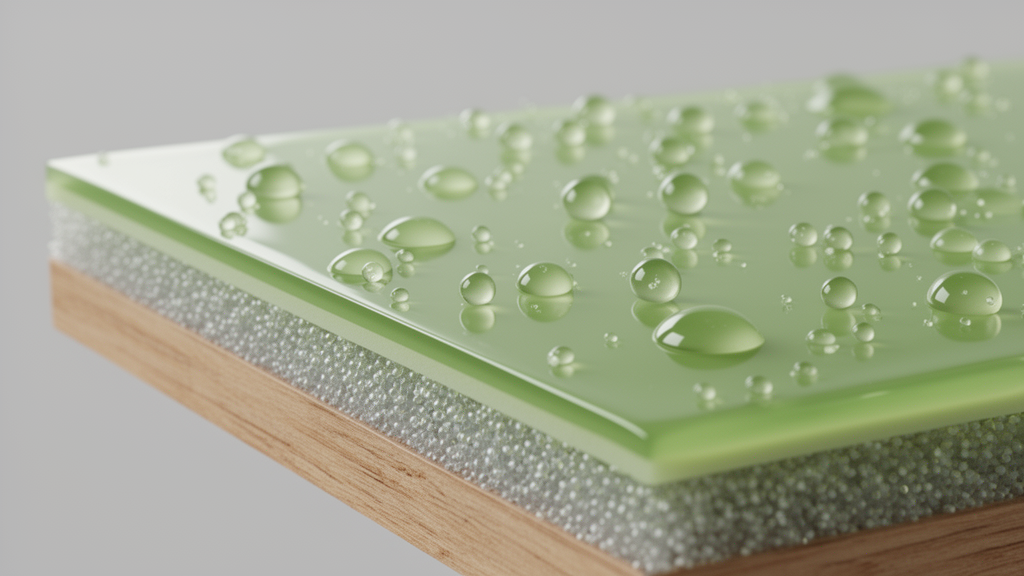
Waterborne polyurethane coatings have long been celebrated as the greener face of the coatings industry. Unlike their solvent-borne cousins, they release far lower levels of volatile organic compounds, the reactive chemicals that contribute to smog formation and pose health risks to workers and occupants alike. Yet these environmentally friendly formulations carry an awkward secret: the same chemistry that lets them disperse in water also makes them attract it. Their inherent hydrophilicity means that when a waterborne polyurethane film is asked to keep moisture out—in a marine setting, on structural steel, or on outdoor furniture—it often underperforms. A research team at Universiti Malaysia Terengganu believes it has found a surprisingly simple fix, and their results, published in Applied Nanoscience, suggest that a pinch of the right nanoparticles can transform a water-loving polymer into a genuinely water-repellent shield.
The team, led by Nursabrina Amirah Mohd Nasir and Mohd Sabri Mohd Ghazali, set out to boost the hydrophobicity of waterborne polyurethane using additives drawn from two very different chemical worlds. The first was calcium carbonate, one of the most abundant and inexpensive minerals on Earth. The second was silica, in the form of silicon dioxide nanoparticles. Crucially, they did not stop at pristine calcium carbonate. Using sodium stearate—a sodium salt of stearic acid, the saturated fatty acid found in everything from soap to candle wax—they chemically modified the mineral surface, converting its naturally water-attracting character into something decidedly water-avoiding. Sodium stearate molecules anchor to calcium carbonate through their charged carboxylate head groups, leaving long hydrocarbon tails projecting outward, a molecular disguise that turns the particle exterior greasy and water-shunning.
From these ingredients the researchers formulated four distinct coatings and applied each to mild steel substrates, the workhorse material of construction and engineering where corrosion protection matters most. The first formulation, labelled P1, was the pristine waterborne polyurethane on its own, serving as the baseline. The second, P2, blended in unmodified calcium carbonate. The third, P3, replaced that with the sodium stearate-modified version. The fourth and most elaborate formulation, P4, combined the modified calcium carbonate with silica nanoparticles. This progressive design allowed the team to isolate the contribution of each additive, teasing out whether water repellency came from the fatty-acid coating, the mineral filler, the silica, or the interplay between them.
To verify that the additives were genuinely incorporated into the polymer matrix rather than sitting inertly within it, the researchers turned to Fourier-transform infrared spectroscopy. This technique identifies chemical bonds by the specific frequencies of infrared light they absorb, and it confirmed the formation of the composite materials. One subtle but telling detail emerged from the spectra: the intensity of the O–H band, which corresponds to hydroxyl groups—the chemical signatures of water-loving behaviour—was lower in the P4 formulation than in the others. In other words, the dual-additive coating carried fewer of the very chemical groups that draw water molecules in, hinting early on that this formulation would be the driest of the bunch.
X-ray diffraction provided the next layer of evidence. By analysing how X-rays scatter off the crystalline components of the coatings, the technique reveals information about crystal structure and, importantly, how finely dispersed the nanoparticles are. The diffraction data showed that dispersion of the silica nanoparticles in the P4 coating was improved, an outcome that coincided with a reduction in crystallite size to 22.38 nanometres. That figure matters enormously in nanocomposite science. Smaller crystallites mean more particle surfaces and, when well dispersed, a more uniform distribution throughout the polymer. Agglomerated nanoparticles clump together and create defects; well-dispersed ones build a fine, engineered texture. The XRD results indicated that the P4 system achieved the finer, more even dispersion that surface engineers strive for.
Scanning electron microscopy then made that texture visible. The images showed that the surface roughness of the P4 coating increased as silica nanoparticles became enriched on the coating surface. This might sound like a flaw—surely a smooth finish is better?—but in the science of water repellency, roughness is a weapon. When a water droplet lands on a surface, its behaviour depends on both the surface chemistry and the surface geometry. On a rough, low-energy surface, air becomes trapped beneath the droplet between the microscopic peaks, so the liquid rests partly on air and partly on solid. This reduces the effective contact area and encourages the droplet to bead up and roll off rather than spread and soak in. The silica nanoparticles, decorating the coating surface, essentially sculpted a microscopic landscape designed to defeat wetting.
Energy-dispersive X-ray spectroscopy, run alongside the electron microscope, mapped the elemental composition of the coatings and confirmed the corresponding elemental distribution, revealing a higher proportion of oxygen in the analysed regions—consistent with the silica enrichment. Together with the microscopy, this spectroscopic mapping demonstrated that the nanoparticles were not merely buried inside the polymer but were present at the surface, exactly where they needed to be to influence how water interacts with the coating.
The decisive test came from water contact angle measurements, the standard yardstick of hydrophobicity. A droplet on a surface forms an angle with that surface: low angles below 90 degrees indicate a hydrophilic surface that water spreads across, while angles above 90 degrees signal hydrophobic behaviour, with higher angles meaning stronger repellency. The measurements ranked the formulations clearly. The P4 coating achieved the best hydrophobicity of the series, with a water contact angle of 105.08 degrees, give or take 0.74 degrees of measurement uncertainty. The researchers attribute this superior performance directly to the surface roughness produced by the nanoparticles: the combination of sodium stearate-modified calcium carbonate and silica nanoparticles created the most water-hostile topography of any formulation tested.
Why does this matter beyond the laboratory? Waterborne polyurethane sits at the intersection of two competing pressures in the coatings industry. On one side, environmental regulation and public health concerns are steadily squeezing out solvent-based systems, whose volatile organic compounds are both pollutants and occupational hazards. On the other side, customers demand performance: coatings for steel structures, marine equipment, wood, and building materials must repel water, resist corrosion, and endure harsh conditions. Historically, achieving high water repellency often meant either returning to solvent chemistry or incorporating fluorinated compounds, which carry their own environmental baggage. The Malaysian team’s approach offers a third path—an aqueous, low-toxicity coating whose water repellency is engineered through inexpensive mineral chemistry and surface physics rather than exotic or problematic ingredients.
The study’s findings indicate that the presence of both the sodium stearate-modified calcium carbonate and the silica nanoparticles enhances the performance and water repellence of waterborne polyurethane, strengthening its prospects as an environmentally friendly coating for demanding applications. There is also a lesson here about the power of synergy: neither additive alone achieved what the combination did. The fatty-acid modification supplied the low surface energy, while the silica nanoparticles supplied the roughness that amplifies it—a pairing in which each component covers the other’s weakness. As industries from shipbuilding to construction seek coatings that protect steel and satisfy environmental mandates, research like this suggests that the future of water repellency may rest not on new polymers alone, but on cleverly modified particles, measured in nanometres, that reshape the way water meets a surface.
Subject of Research: Effect of silica nano-additives on the water repellency of waterborne polyurethane coatings
Article Title: The effect of silica nano-additive on the water repellency of waterborne polyurethane coatings
Article References: Nasir, N. A. M., Kamaruzzaman, W. M. I. W. M., Daud, N. H. M., Suhaimi, A. M. A. A. M., Sabri, N. H., & Ghazali, M. S. M. (2026). The effect of silica nano-additive on the water repellency of waterborne polyurethane coatings. Applied Nanoscience, 16(5), Article 57. https://doi.org/10.1007/s13204-026-03188-0
Image Credits: AI Generated
DOI: 10.1007/s13204-026-03188-0
Keywords: waterborne polyurethane, silica nanoparticles, calcium carbonate, sodium stearate, water repellency, contact angle, hydrophobic coatings, nano-additives, surface roughness, coatings, mild steel, FTIR spectroscopy
Cite Scienmag News
Denise Maddox. (October 16, 2026). Silica Nanoparticles Turn Eco-Friendly Polyurethane Coatings Water-Repellent. Scienmag. https://scienmag.com/silica-nanoparticles-turn-eco-friendly-polyurethane-coatings-water-repellent/
Denise Maddox. "Silica Nanoparticles Turn Eco-Friendly Polyurethane Coatings Water-Repellent." Scienmag, 16 October 2026, https://scienmag.com/silica-nanoparticles-turn-eco-friendly-polyurethane-coatings-water-repellent/. Accessed 16 October 2026.
Denise Maddox. "Silica Nanoparticles Turn Eco-Friendly Polyurethane Coatings Water-Repellent." Scienmag. October 16, 2026. https://scienmag.com/silica-nanoparticles-turn-eco-friendly-polyurethane-coatings-water-repellent/


