


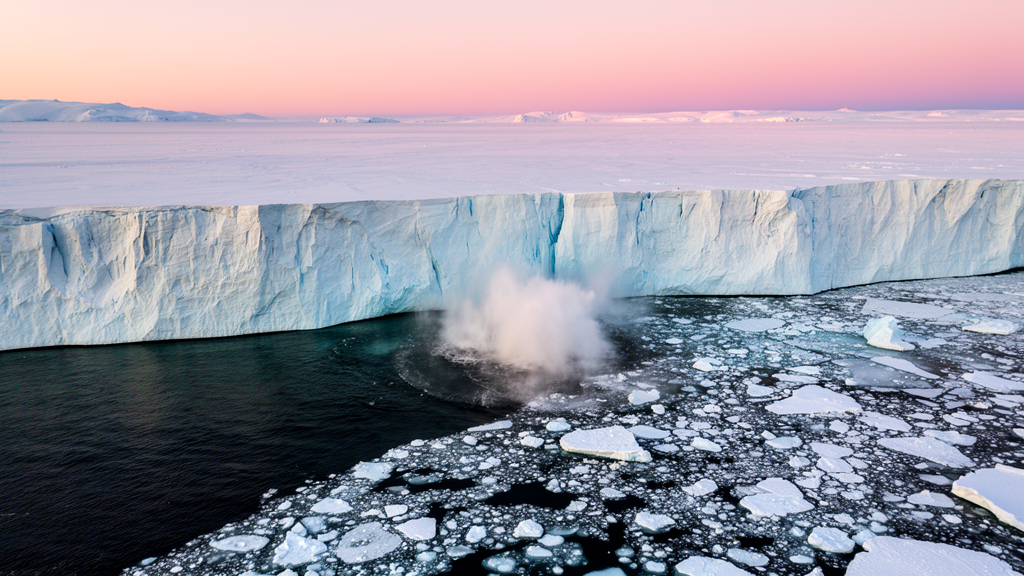
Some of the most alarming projections of future sea level rise rest on a process that has never actually been witnessed: the progressive, self-sustaining collapse of towering ice cliffs at the edges of the great ice sheets. Now, two decades of laser measurements of the Antarctic and Greenland coastlines suggest that while these cliffs can calve faster than scientists once assumed, the runaway chain reaction known as marine ice cliff instability, or MICI, may be harder to set off than many models have feared.
Ice sheets do not end quietly. Where glaciers and ice streams meet the ocean, they terminate either in floating ice shelves or in sheer walls of ice that rise directly from the water. When a retreating glacier exposes a cliff tall enough, the stresses at its face can become too great for the ice to bear, causing large blocks to fracture and collapse into the sea. The concern underlying MICI is a feedback loop: as the cliff collapses, the glacier retreats inland, exposing an even taller face, which collapses in turn. If each retreat step exposes progressively higher cliffs, the process could theoretically sustain itself and drain ice from the interior at catastrophic rates. But because no one has directly observed this cycle in action, its contribution to future sea level rise has remained one of the largest uncertainties in ice sheet science.
To put empirical bounds on the problem, Caroline Needell and colleagues assembled an unusually comprehensive dataset, combining airborne and satellite laser altimetry collected between 2003 and 2023. These instruments measure the elevation of the ice surface with high precision, allowing the team to map both the positions and the heights of ice cliffs along the entire marine margins of Antarctica and Greenland. The result is the first broad, observationally grounded census of how tall Earth’s ice cliffs actually are — a crucial baseline, because every model of MICI depends on assumptions about cliff height.
The census delivered a striking conclusion: very tall cliffs are rare. In Antarctica, only 5 percent of the observed cliffs exceeded 52.2 meters in height. In Greenland, the equivalent threshold was higher — only 5 percent of cliffs there topped 76.6 meters — but in both ice sheets, very few cliffs approached the roughly 100-meter height that previous theoretical work had proposed as the threshold beyond which cliff collapse could become self-sustaining. Despite the profound geological and climatic differences between the two ice sheets, their cliffs showed remarkably similar average and maximum heights, hinting that common physical processes govern how tall a calving front can grow before it fails.
Where tall cliffs did exist, the team found them clustered in predictable places. The tallest cliffs were concentrated at glaciers flowing rapidly toward the ocean, where fast-moving ice is delivered to the calving front and steep faces can persist. More revealing was what the cliff heights correlated with. The analysis showed that ice cliff height is most strongly associated with three factors: the depth of the water at the glacier front, the thickness of the ice mélange — the floating mass of sea ice and broken icebergs that can pack against a cliff face and buttress it — and the degree of crevassing near the glacier’s terminus. Each of these variables makes physical sense. Deeper water allows taller faces to stand; a thick, solid mélange can press against the cliff and suppress calving; and heavily crevassed ice, riddled with pre-existing fractures, breaks apart before it can build up to extreme heights.
Height alone, however, is only half of the MICI question. The other half is behavior: what actually happens when a cliff does grow tall enough to flirt with the instability threshold? To answer this, the researchers narrowed their focus to 16 glaciers whose cliffs exceeded 90 meters — close to the proposed danger zone. Of these, four glaciers had both detailed repeat observations and measurable retreat during the 20-year study window, making them natural laboratories for testing how near-critical cliffs behave over time.
The observations showed that these very tall cliffs do calve more rapidly than previous estimates had assumed. Ice at the tallest fronts is shed at rates exceeding what many models had built in, meaning that cliff faces may not simply stand and accumulate height passively. In a sense, the cliffs relieve their own stress: by calving quickly, they prevent the extreme oversteepening and height buildup that sustained runaway collapse would require. This dynamic calving acts as a kind of natural brake on the feedback loop at the heart of MICI.
The second brake emerges from the shape of the bed and the ice above it. The team found that the likelihood of runaway retreat depends strongly on how ice thickness changes inland from the calving front. Where the ice surface slopes down gradually toward the sea — meaning thickness increases slowly with distance inland — each step of retreat exposes only a modestly taller cliff, and the escalating geometry needed to drive sustained instability never materializes. This finding links the fate of ice cliffs to bedrock topography, a variable that is increasingly well mapped around the margins of Antarctica and Greenland and that can now be used to sharpen regional projections.
The implications are most consequential for Thwaites Glacier in West Antarctica, often described as the most vulnerable ice stream on the continent because its bed lies below sea level and slopes inward. Thwaites has become the emblematic case study for worst-case sea level scenarios, precisely because a collapsing ice shelf there could theoretically expose a vast calving face. Applying their empirical findings, Needell and colleagues argue that Thwaites would be unlikely to undergo immediate MICI-driven retreat if an ice shelf failure exposed tall cliffs at its current grounding line. The cliffs that would appear, given the local water depths, mélange conditions and inland ice thickness profile, do not meet the geometric and behavioral conditions the observations identify as necessary for runaway collapse.
The study, published in Science, does not declare the MICI hypothesis dead; rather, it replaces speculation with measurement and narrows the space of plausible futures. Tall ice cliffs calve quickly, tall cliffs are uncommon, and gradual inland thickening appears to limit the buildup required for sustained instability — three empirical constraints that models of Antarctic and Greenland retreat must now honor. For a scientific community that has had to bracket sea level projections with the caveat that MICI has never been observed, the message is cautiously reassuring: the most catastrophic cliff-collapse scenarios look less likely than feared, though the slow, steady retreat of the ice sheets continues to track the warming ocean beneath them.
Subject of Research: Empirical constraints on ice cliff calving and marine ice cliff instability in Antarctica and Greenland
Article Title: Tall ice cliffs calve quickly, but may not trigger runaway ice retreat alone
Article References: Tall ice cliffs calve quickly, but may not trigger runaway ice retreat alone. (n.d.). Original publication
Image Credits: AI Generated
DOI: Not provided
Keywords: marine ice cliff instability, ice cliffs, calving, Antarctica, Greenland, Thwaites Glacier, sea level rise, ice sheets, laser altimetry, Science, glaciology, ice mélange
Cite Scienmag News
Violet Maxwell. (October 16, 2026). Tall ice cliffs calve fast but may not spark runaway Antarctic collapse, study finds. Scienmag. https://scienmag.com/tall-ice-cliffs-calve-fast-but-may-not-spark-runaway-antarctic-collapse-study-finds/
Violet Maxwell. "Tall ice cliffs calve fast but may not spark runaway Antarctic collapse, study finds." Scienmag, 16 October 2026, https://scienmag.com/tall-ice-cliffs-calve-fast-but-may-not-spark-runaway-antarctic-collapse-study-finds/. Accessed 16 October 2026.
Violet Maxwell. "Tall ice cliffs calve fast but may not spark runaway Antarctic collapse, study finds." Scienmag. October 16, 2026. https://scienmag.com/tall-ice-cliffs-calve-fast-but-may-not-spark-runaway-antarctic-collapse-study-finds/


