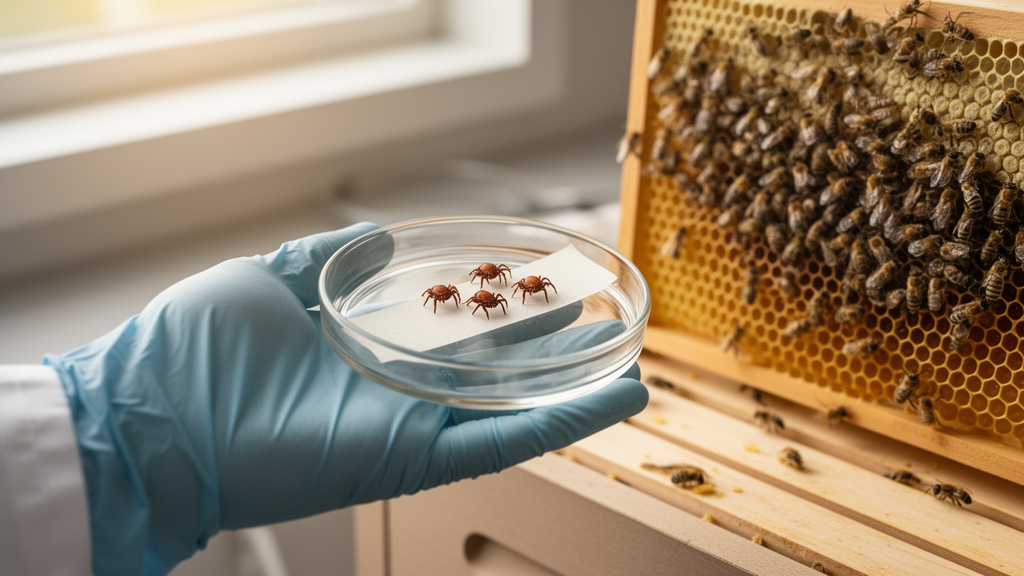
Amitraz has become one of the most important weapons beekeepers have against Varroa destructor, the parasitic mite widely regarded as the single most damaging pest of honey bee colonies worldwide. Yet in recent years, scattered reports of treatment failure have raised fears that the mites are quietly evolving around this formamidine pesticide, potentially contributing to the alarming colony losses documented across the United States. A new two-year study from the University of Florida and the Florida Department of Agriculture and Consumer Services now delivers a sobering and somewhat counterintuitive message: a laboratory assay designed to detect amitraz resistance reliably identifies resistant mites, but it does a poor job of predicting whether a real-world treatment will actually work.
The research, published in Frontiers in Bee Science, set out to connect three levels of evidence that are usually examined in isolation. The team, led by Devan Rawn and Cameron Jack, wanted to know whether a standard laboratory resistance bioassay could predict the presence of a specific genetic mutation in the mites, and whether that mutation, in turn, predicted failure of Apivar, the registered amitraz product containing 3.33 percent active ingredient. This chain of inference underpins much of the diagnostic advice currently offered to beekeepers, so any weak link matters enormously for practical pest management.
The laboratory bioassay itself is elegantly simple. The researchers collected roughly 300 infested worker bees from colonies at a Gainesville field site in December of both 2023 and 2024, housed them in small containers fitted with mesh floors, and glued a four-centimeter square piece of Apivar strip to the bottom. After three hours of exposure, mites that had fallen through the mesh were classed as phenotypically susceptible, while those still clinging to the bees were classed as resistant. Across the two seasons, the apparent efficacy suggested by these bioassays was strikingly low and highly variable, ranging from 21.4 to 94.7 percent mite mortality and averaging well below the 80 percent threshold that would normally signal acceptable performance.
Crucially, the team did not stop at the phenotype. Each mite sampled from the bioassay was subjected to genetic analysis using probe-based quantitative PCR to detect the Y215H mutation in the beta2-octopamine receptor, currently the only mutation identified in North America that has been linked to amitraz resistance. Amitraz belongs to the formamidine class of pesticides, which overexcite arthropod nerve cells by mimicking octopamine, a key neurotransmitter in the invertebrate endocrine system. A substitution at position 215 of the receptor, replacing tyrosine with histidine, is thought to alter this binding and blunt the drug’s lethal effect.
The genetic results validated the bioassay as a detector of the mutation, at least in one direction. When a mite survived the laboratory exposure, the assay correctly predicted a resistant genotype 94.6 percent of the time across both years combined. But the reverse prediction was considerably weaker: mites classified as susceptible in the bioassay carried the susceptible genotype only 66.8 percent of the time. Heterozygous individuals, carrying one copy of each allele, were split almost exactly down the middle, with a measured probability of 0.536 of appearing susceptible in the bioassay. Extrapolating these reliability factors to all 1,867 mites collected, the researchers estimated that roughly 70.5 percent of the population carried the resistant genotype in 2023 and 48.2 percent in 2024.
Here comes the twist that makes the study remarkable. Despite these worrying bioassay numbers and the high prevalence of the Y215H mutation, actual field treatment with Apivar worked extraordinarily well. Thirty-two treated colonies, categorized in advance as having either high or low expected efficacy based on their bioassay results, both saw mite infestations collapse by 98.2 percent over the standard 42-day treatment period. Twelve untreated control colonies, tracked in the second year of the trial, showed no significant change at all, with mite numbers declining only 23 percent. Statistical models using a negative binomial error structure confirmed that both treated groups differed dramatically from controls, and that the low expected efficacy group ended the trial statistically indistinguishable from the high expected efficacy group.
In other words, colonies whose mites had flunked the laboratory test, and whose populations carried the resistance mutation at substantial frequencies, responded to the full field treatment essentially as if they were fully susceptible. The bioassay predicted genotype well, but it failed entirely as a predictor of colony-level treatment outcome. The authors argue this has major implications for how resistance diagnostics are interpreted, because many previous studies have connected receptor mutations to treatment failure based largely on beekeeper reports rather than controlled experiments, and some have relied on short observation windows rather than the full recommended treatment duration.
The researchers propose several possible explanations that remain to be tested. One intriguing hypothesis involves amitraz metabolism: the active ingredient breaks down into several compounds, including DPMF, DMF, and DMA, and mites resistant to the parent molecule may still succumb to these breakdown products given enough time. A three-hour bioassay may simply be too brief to capture this, whereas a 42-day field treatment provides ample opportunity. Seasonality offers another plausible factor, since previous work has found Apivar to be most effective during winter, precisely when the Florida trials were conducted. The state’s mild climate, where capped brood persists through winter, also creates unusual population dynamics for the mites compared with more northern regions.
The study also complicates the emerging genetic picture of amitraz resistance. The Y215H mutation has now been documented across North America, with Canadian surveys reporting prevalence ranging from roughly 32 to 96 percent in different Alberta regions, and a recent survey of surviving colonies after severe US winter losses found the mutation in 100 percent of genotyped mites. Yet the mutation has not been found in European populations, and its true functional significance remains unclear. Notably, the Florida team found only 14 heterozygous mites among 525 genotyped, a surprisingly low frequency given that both alleles were well represented, and this challenges an earlier assumption that heterozygous individuals are fully susceptible.
The authors are careful to acknowledge the limitations of their work, including the geographic concentration of their colonies, the absence of untreated controls in the first field season, and the fact that only about 28 percent of mites were directly genotyped, with the remainder estimated through statistical correction using a Rogan-Gladen adjustment. Still, their central conclusion stands firm: beekeepers and researchers alike should be cautious about treating a positive resistance bioassay, or the mere presence of the Y215H mutation, as a verdict on treatment failure in the field. Understanding what actually determines amitraz efficacy, from seasonal mite susceptibility to pesticide metabolism and formulation delivery, may prove essential for preserving this critical tool before resistance truly catches up with it.
Subject of Research: Laboratory amitraz resistance testing and field efficacy of amitraz treatments against Varroa destructor mites in honey bee colonies
Article Title: A laboratory amitraz resistance assay for Varroa destructor may not be a reliable predictor of field-level amitraz efficacy
Article References: Rawn, D., Epperson, K. J., Fulton, J. C., & Jack, C. J. (2026). A laboratory amitraz resistance assay for Varroa destructor may not be a reliable predictor of field-level amitraz efficacy. Frontiers in Bee Science, 4, Article 1886628. https://doi.org/10.3389/frbee.2026.1886628
Image Credits: AI Generated
DOI: 10.3389/frbee.2026.1886628
Keywords: Varroa destructor, amitraz, honey bee, acaricide resistance, Y215H mutation, octopamine receptor, Apivar, bioassay, beekeeping, colony losses, pesticide efficacy, Florida
Cite Scienmag News
Juliet Wilcox. (October 16, 2026). Lab Test for Amitraz Resistance in Varroa Mites Misses the Full Picture in Real Hives. Scienmag. https://scienmag.com/lab-test-for-amitraz-resistance-in-varroa-mites-misses-the-full-picture-in-real-hives/
Juliet Wilcox. "Lab Test for Amitraz Resistance in Varroa Mites Misses the Full Picture in Real Hives." Scienmag, 16 October 2026, https://scienmag.com/lab-test-for-amitraz-resistance-in-varroa-mites-misses-the-full-picture-in-real-hives/. Accessed 16 October 2026.
Juliet Wilcox. "Lab Test for Amitraz Resistance in Varroa Mites Misses the Full Picture in Real Hives." Scienmag. October 16, 2026. https://scienmag.com/lab-test-for-amitraz-resistance-in-varroa-mites-misses-the-full-picture-in-real-hives/