


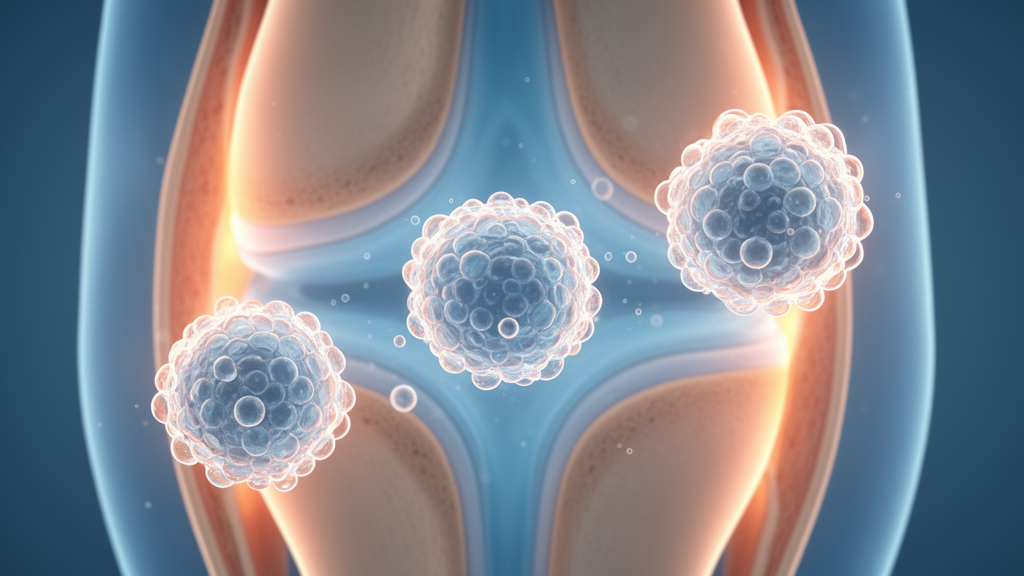
Knee osteoarthritis affects hundreds of millions of people worldwide, and for many patients the best available options—corticosteroid injections and hyaluronic acid gels delivered directly into the joint—provide only fleeting relief. Now, a research team in Ireland has engineered a nanoparticle that combines both therapies in a single injectable carrier, and early laboratory results suggest it could keep anti-inflammatory drugs working in the joint far longer than current formulations. The study, published in Frontiers in Drug Delivery, describes hyaluronic acid-coated solid lipid nanoparticles loaded with dexamethasone palmitate, a fat-soluble prodrug of the potent glucocorticoid dexamethasone.
The scale of the problem the researchers are targeting is enormous. Osteoarthritis affected approximately 595 million people in 2020, roughly 7.6 percent of the global population, and case numbers are projected to rise substantially by 2050 as populations age. One in eight adults over the age of 60 lives with knee osteoarthritis, making it the most common form of arthritis and a leading cause of disability. Although the disease was long viewed as simple wear-and-tear of cartilage, it is now recognised as a whole-joint condition involving synovial inflammation, subchondral bone remodelling, and inflammatory signalling across multiple tissues, with low-grade inflammation playing a driving role in disease progression.
Current treatments struggle to keep pace with that biology. Intra-articular corticosteroid injections are recommended in clinical guidelines and can reduce swelling and pain, but their benefits typically fade within weeks, forcing patients back for repeated injections that carry risks of swelling, infection, and septic arthritis. Hyaluronic acid injections restore lubrication and exert their own anti-inflammatory effects, yet the molecule persists in the joint for only about a day. Intra-articularly injected steroids typically remain in the knee for just one to four hours before being cleared. Oral anti-inflammatory drugs carry their own burdens, with long-term NSAID use linked to gastrointestinal, renal, and cardiovascular adverse events, particularly in older adults.
The Irish team, led by Jinxin Zhang and David Brayden at University College Dublin with collaborators at the Royal College of Surgeons in Ireland and the National Orthopaedics Hospital Cappagh, designed a dual-function carrier to address both problems at once. The core of each particle is a solid lipid nanoparticle built from tristearin, a stable, ordered triglyceride that can trap lipophilic drugs in its matrix. A small amount of the cationic lipid DOTAP gives the particle surface a positive charge, while DMG-PEG 2000 provides a steric stabilising layer. Wrapped around that positively charged core is a shell of hyaluronic acid, whose negatively charged carboxyl groups bind electrostatically to the particle surface.
Manufacturing was a central challenge, and the researchers turned to microfluidics to solve it. Conventional hot homogenisation, in which molten lipid is sheared into droplets at high speed, produced particles of 240 to 390 nanometres with variable size distributions and modest drug encapsulation. By contrast, the NanoAssemblr Ignite system, which rapidly splits and merges streams of organic and aqueous phases to achieve uniform mixing, yielded monodisperse particles of roughly 90 nanometres with an encapsulation efficiency of 88 percent and a drug loading of 6 percent by weight—outperforming even the commercial liposomal dexamethasone palmitate formulation Lipotalon, which achieved only 4 percent loading before being discontinued. The same microfluidic technology underpins the mRNA COVID-19 vaccines, and its scalability is a key advantage for translating laboratory formulations toward clinical use.
Characterisation confirmed that the hyaluronic acid coating had attached as intended. Infrared spectroscopy revealed the signature carboxylate and hydroxyl peaks of the polymer on the coated particles, and enzyme-linked immunoassays quantified roughly 0.45 milligrams of hyaluronic acid per gram of nanoparticles. The coating also transformed the particle surface, shifting the zeta potential from a strongly positive +30.8 millivolts to a negative −17.3 millivolts, and it improved colloidal stability: over four weeks of storage, coated particles held their size and uniformity while uncoated controls swelled and became more heterogeneous. Notably, the 90-nanometre final size sits near the mesh size of the dense superficial cartilage matrix, estimated at 50 to 60 nanometres, which governs how deeply particles can penetrate joint tissue.
Drug release studies revealed a biphasic profile that the coating further moderated. In buffered saline at body temperature, both coated and uncoated particles released an initial burst of drug within the first eight hours, followed by a slower, diffusion-dominated phase. By 120 hours, uncoated particles had released about 96 percent of their payload, while coated particles reached about 94 percent—but at every intermediate time point the coated formulation released less drug, showing that the hyaluronic acid shell acts as an additional diffusional barrier without preventing eventual release. In mouse plasma, enzymes cleaved the palmitate ester of the prodrug, converting dexamethasone palmitate into active dexamethasone, which accumulated steadily over 72 hours. This enzymatic activation is the chemical trick that makes the prodrug strategy work: the hydrophobic palmitate chain anchors the drug in the lipid matrix, preventing premature leakage, while esterases in the joint gradually liberate the active steroid.
The biological experiments provided the study’s most striking results. When human THP-1 monocytes were stimulated with bacterial lipopolysaccharide to trigger inflammation, both coated and uncoated nanoparticles suppressed secretion of prostaglandin E2, a key inflammatory mediator linked to pain signalling, cartilage catabolism, and bone remodelling in osteoarthritis. But the hyaluronic acid-coated particles outperformed their uncoated counterparts at every concentration tested. The same pattern held in primary chondrocytes derived from actual osteoarthritis patients, where coated particles again suppressed prostaglandin E2 more effectively while maintaining cell viability above 95 percent. Confocal microscopy confirmed that fluorescently labelled nanoparticles were internalised by the patient-derived chondrocytes within hours, with fluorescence distributed throughout the cytoplasm around the nuclei.
The enhanced efficacy of the coated particles likely reflects the biology of CD44, the principal cell-surface receptor for hyaluronic acid. CD44 is overexpressed on activated macrophages, synoviocytes, and chondrocytes within inflamed joint tissue, and hyaluronic acid functionalisation has previously been shown to boost cellular uptake and therapeutic effect in rheumatoid arthritis models and in oncology settings. The authors note that the coating contributes actively to therapeutic efficacy rather than serving merely as a stabiliser, extending a strategy validated in other inflammatory diseases into primary osteoarthritic cells for the first time. Importantly, the cationic lipid DOTAP, which can be toxic at high concentrations, was shielded by the PEG and hyaluronic acid layers, and neither free drug nor nanoparticles harmed the cells under test conditions.
The researchers caution that these are in vitro findings, and that the 72-hour plasma release profile reflects enzymatic activation under sink conditions rather than joint retention in a living animal. In the synovial environment, restricted diffusion through viscous fluid, limited lymphatic clearance of particles around 90 nanometres, and binding of the hyaluronic acid shell to cartilage components via CD44 could all prolong drug exposure well beyond what the laboratory assays suggest. The team’s next step is in vivo evaluation in clinically relevant animal models that replicate both cartilage and subchondral bone pathology. If those studies succeed, a single injection that merges the anti-inflammatory power of a corticosteroid with the joint-protecting biology of hyaluronic acid could reduce the frequency of painful repeat injections for millions of patients whose knees currently demand them every few weeks.
Subject of Research: Hyaluronic acid-coated solid lipid nanoparticles for intra-articular delivery of dexamethasone palmitate in knee osteoarthritis
Article Title: Synthesis, characterisation, and in vitro assessment of hyaluronic acid-coated solid lipid nanoparticles entrapping dexamethasone palmitate designed for intra-articular administration
Article References: Zhang, J., Khandelia, R., Hogg, B., Bahlool, A. Z., Hodgkinson, T., Cryan, S.-A., O’Byrne, J., & Brayden, D. J. (2026). Synthesis, characterisation, and in vitro assessment of hyaluronic acid-coated solid lipid nanoparticles entrapping dexamethasone palmitate designed for intra-articular administration. Frontiers in Drug Delivery, 6, Article 1809275. https://doi.org/10.3389/fddev.2026.1809275
Image Credits: AI Generated
DOI: 10.3389/fddev.2026.1809275
Keywords: osteoarthritis, solid lipid nanoparticles, hyaluronic acid, dexamethasone palmitate, intra-articular drug delivery, microfluidics, glucocorticoids, prostaglandin E2, chondrocytes, CD44, drug release, nanomedicine
Cite Scienmag News
Eric Holt. (October 16, 2026). Hyaluronic Acid-Coated Lipid Nanoparticles Show Promise for Longer-Lasting Knee Osteoarthritis Injections. Scienmag. https://scienmag.com/hyaluronic-acid-coated-lipid-nanoparticles-show-promise-for-longer-lasting-knee-osteoarthritis-injections/
Eric Holt. "Hyaluronic Acid-Coated Lipid Nanoparticles Show Promise for Longer-Lasting Knee Osteoarthritis Injections." Scienmag, 16 October 2026, https://scienmag.com/hyaluronic-acid-coated-lipid-nanoparticles-show-promise-for-longer-lasting-knee-osteoarthritis-injections/. Accessed 16 October 2026.
Eric Holt. "Hyaluronic Acid-Coated Lipid Nanoparticles Show Promise for Longer-Lasting Knee Osteoarthritis Injections." Scienmag. October 16, 2026. https://scienmag.com/hyaluronic-acid-coated-lipid-nanoparticles-show-promise-for-longer-lasting-knee-osteoarthritis-injections/


