


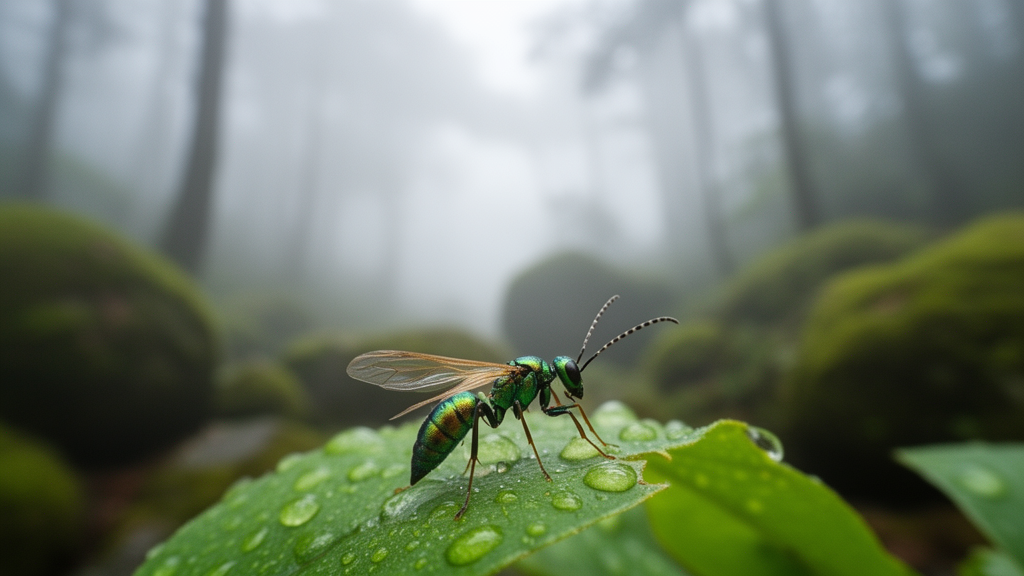
Deep in the mountain forests of southern and western China, entomologists armed with sweep nets and Malaise traps have been quietly collecting a group of insects so small that most hikers would never notice them. A new study published in the Deutsche Entomologische Zeitschrift announces the discovery of six previously unknown species of Stigmus, a genus of tiny predatory wasps in the family Crabronidae. The new species, formally described by Li and Ma, bring the number of Stigmus species known from China to 22, making the country one of the richest known hotspots for a genus that has long remained in the taxonomic shadows.
The six newcomers are Stigmus dentiserratus, S. nullirugatus, S. rugibrevis, S. rugilongus, S. sulcipervius and S. tibisulcatus. Each was identified on the basis of a distinctive suite of anatomical characters, including features of the mesopleuron and propodeum on the thorax, the petiole that joins the thorax to the abdomen, and the venation of the hind wing. All six are described in detail from female specimens, and in the case of S. rugilongus, the male is known as well, allowing the researchers to illustrate its genitalia, which in wasps often provide decisive evidence for species boundaries.
The type specimens tell a story of patient fieldwork across remarkably varied landscapes. The holotype of S. dentiserratus was collected in 2009 at 2,210 metres in the Liupan Mountains of Ningxia, in north-central China. Three other species come from Yunnan Province: S. nullirugatus from Bulang Mountain near Jinghong, S. rugibrevis from the Ailaoshan Ecological Station at nearly 2,450 metres, and S. rugilongus from alpine sites above 3,500 metres in Shangri-La City, on the edge of the Tibetan Plateau. S. sulcipervius was found in Huping Mountain in Hunan, while S. tibisulcatus turned out to be the most widespread of the new species, with specimens from Yunnan and Hainan, an island in the tropical south.
What makes these wasps interesting beyond their novelty is their natural history. Stigmus species are small solitary hunters whose larvae feed on aphids. Females construct nests in decaying wood or in abandoned burrows made by beetles, arranging their brood cells in a linear series inside the tunnel. Adults frequently visit flowers, making them part-time pollinators as well as predators. According to earlier studies cited in the paper, a single female can capture roughly sixty aphids to provision her offspring, a habit that gives these inconspicuous insects a meaningful role in suppressing one of the world’s most notorious agricultural pests.
Distinguishing species within Stigmus is a task that demands microscopic precision, and the new paper is a masterclass in the method. The authors examined specimens under an Olympus stereomicroscope with an ocular micrometer, taking measurements at eight times magnification, and captured high-resolution images with a digital microscope system. Their descriptions rely on an extensive array of standardised measurements, from head width and eye dimensions to the lengths of the scape, pedicel and flagellomeres of the antenna, the hind femur and hind tibia, and the proportions of the petiole. These ratios allow other researchers to compare specimens objectively rather than relying on vague impressions of similarity.
The diagnostic characters themselves are wonderfully specific. Stigmus dentiserratus, as its name suggests, is named for the four pointed teeth along the free margin of its clypeus, a facial feature that sets it apart from its closest relative, S. solskyi, which has only two. S. tibisulcatus bears a conspicuous short longitudinal groove on the outer surface of the hind tibia, a feature never before recorded in the genus. S. sulcipervius is defined by its notauli, the paired grooves on the upper surface of the thorax, which run the entire length of the scutum, whereas in related species they are short. The names of the other species refer to the sculpture of the petiole: S. rugilongus carries a strong, long longitudinal ruga, and S. rugibrevis a short one.
Perhaps the most useful contribution for future researchers is the updated identification key, now illustrated with photographs and covering all 22 Chinese species. Keys like this work as a series of either-or questions, guiding the user through contrasts in clypeal shape, the completeness of the occipital carina at the back of the head, the pattern of rugae on the petiole, and a subtle but critical character of wing venation: whether the media vein of the hind wing diverges from the point cu-a or beyond it. Such dichotomous keys are the taxonomist’s equivalent of a flowchart, and an illustrated, up-to-date version for an entire national fauna is a rare and valuable resource.
The study also situates Stigmus in a broader biogeographical picture. The genus, established by Panzer in 1804 with Stigmus pendulus as its type species, currently comprises 35 recognised species and four subspecies distributed almost worldwide, although it is conspicuously absent from the Afrotropical and Australasian regions. The Northern Hemisphere holds most of the diversity: ten species and two subspecies in the Nearctic, ten in the Palaearctic, eleven species and two subspecies in the Oriental region, and two in the Neotropics. Within China, the newly expanded tally of 22 species includes eleven confined to the Oriental region, four to the Palaearctic, and one that spans both, reflecting the country’s position at the intersection of these great zoogeographical realms.
One of the most interesting close relatives in the classification is Carinostigmus, a genus so similar in morphology that it was originally treated as a subgenus of Stigmus before being elevated to full generic status by Bohart and Menke in 1976 on the basis of phylogenetic analysis of morphological data. Distinguishing the two genera depends on features documented in a prior study by the same team. A hallmark of Stigmus itself is a small opaque area between the eye and the ocellar triangle, a character that separates it from other genera within the subfamily Pemphredoninae. Such fine anatomical distinctions underscore how much diversity can hide within outwardly similar lineages of small insects.
The authors are candid about the limits of a purely morphological approach. Molecular data for Stigmus remain very scarce, which means that species are currently delineated almost entirely on anatomy, a method that risks conflating variation within a species with genuine differences between species. They argue that robust species boundaries can only be established by integrating multiple datasets, and they call for genetic barcoding of all known species, systematic surveys in under-sampled provinces such as Sichuan and Chongqing, and biogeographical modelling to reconstruct the evolution, origin and dispersal history of the genus. They also advocate conservation biology research on the role these aphid-hunting wasps play in natural pest regulation.
For a genus of wasps barely a few millimetres long, Stigmus is having a moment. Six new species in a single paper, an illustrated key to an entire national fauna, and a research agenda that spans taxonomy, genetics and conservation together mark a substantial leap in what science knows about these insects. The next time a gardener notices aphid colonies failing to explode out of control, the quiet work of a female Stigmus, stocking a tunnel in a rotten branch with paralysed prey, may be part of the reason. Discoveries like these are a reminder that biodiversity science is far from finished, and that some of its most rewarding frontiers are measured in millimetres.
Subject of Research: Taxonomy and diversity of predatory Stigmus wasps (Hymenoptera, Crabronidae) in China
Article Title: Six new species of Stigmus ( Hymenoptera , Crabronidae ) from China, with an updated key to all Chinese species
Article References: Li, J., Li, Q., & Ma, L. (2026). Six new species of Stigmus (Hymenoptera, Crabronidae) from China, with an updated key to all Chinese species. Deutsche Entomologische Zeitschrift, 73(2), 435-451. https://doi.org/10.3897/dez.73.188761
Image Credits: AI Generated
Keywords: Stigmus, Crabronidae, Hymenoptera, new species, China, taxonomy, wasps, aphid predators, entomology, biodiversity, Yunnan, identification key
Cite Scienmag News
Gavin Prescott. (October 16, 2026). Tiny Predatory Wasps Reveal Six Hidden Species in China’s Mountains. Scienmag. https://scienmag.com/tiny-predatory-wasps-reveal-six-hidden-species-in-chinas-mountains/
Gavin Prescott. "Tiny Predatory Wasps Reveal Six Hidden Species in China’s Mountains." Scienmag, 16 October 2026, https://scienmag.com/tiny-predatory-wasps-reveal-six-hidden-species-in-chinas-mountains/. Accessed 16 October 2026.
Gavin Prescott. "Tiny Predatory Wasps Reveal Six Hidden Species in China’s Mountains." Scienmag. October 16, 2026. https://scienmag.com/tiny-predatory-wasps-reveal-six-hidden-species-in-chinas-mountains/


