


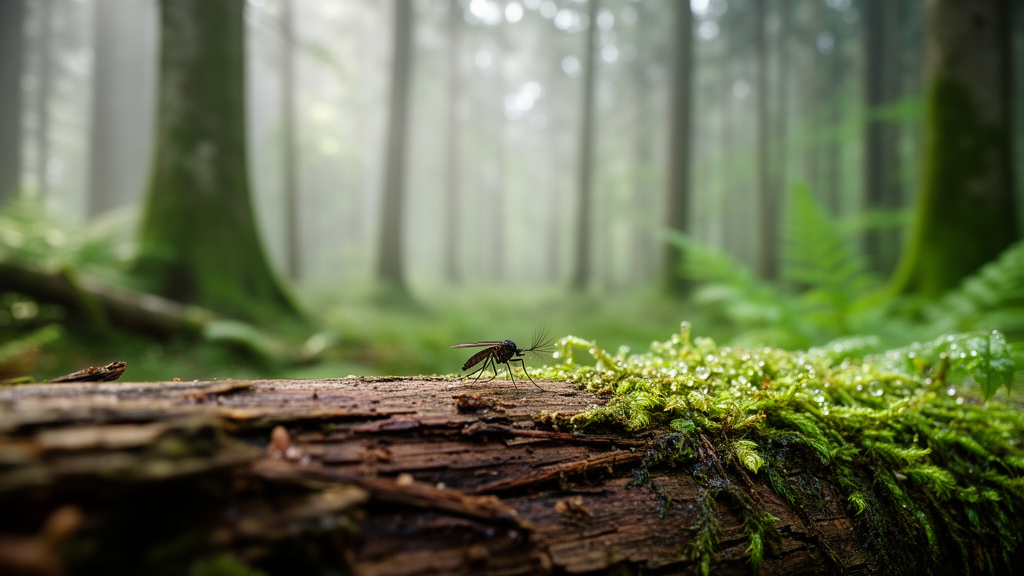
In a steep, mist-shrouded forest reserve in the Bavarian Alps, Malaise traps set beside a fungus-riddled old beech tree have caught something extraordinary: a tiny fly not seen in Central Europe since 1877. The fungus gnat Boletina kowarzi, described in 1943 from a single specimen collected in Thuringia nearly seven decades earlier, has finally been recorded again, ending a gap of almost 150 years. The discovery, published in the journal Alpine Entomology, combines classic morphology with modern DNA barcoding to confirm that this enigmatic species is not only still with us, but genetically far more distinct than anyone expected.
The new specimens were collected in the Totengraben natural forest reserve, part of the Mangfall Forest protected area south of Munich. The reserve spans 46.7 hectares and harbours a roughly 5-hectare fragment of genuine primeval forest, with trees estimated at 200 to 450 years old, perched on a cool, northwestern slope between 970 and 1,390 metres above sea level. Mean annual temperature sits at just 4.5 °C, with 1,800 to 2,000 millimetres of precipitation and a growing season of about 185 days. Crucially, the forest floor and dead trunks carry around 150 cubic metres of dead wood per hectare, sustaining a rich community of wood-inhabiting fungi — the very resources fungus gnat larvae depend on.
It was in this setting that two Malaise traps, operated between late May and late June 2023, yielded four specimens of B. kowarzi: three males and one female. One trap stood near an old, broken beech heavily infested with fungi; the other, about 260 metres away, in a stand of old beech, fir and spruce. For a species known from a single nineteenth-century capture, four individuals in one season represents a remarkable stroke of luck — and a hint that suitable habitat may be the key to finding it.
The history of the species reads like a detective story. Ferdinand Kowarz, a nineteenth-century telegraph official who became one of Europe’s leading dipterologists, collected the original specimen at Bad Liebenstein in Thuringia in 1877. Forced by economic necessity to sell his collections piecemeal, Kowarz left his material scattered across European museums; part of his fungus gnats now resides in Stockholm, while the holotype of B. kowarzi is kept at the Zoological Institute in St. Petersburg. In 1943, the Russian entomologist Aleksander Stackelberg formally described the species from that lone specimen, naming it in Kowarz’s honour. Aside from two old-growth broadleaved forest sites in southeastern Norway in the late 1990s, where it is now red-listed as vulnerable, the fly simply vanished from the record.
Confirming the identity of the Bavarian specimens required a careful dissection of the male terminalia, the most reliable diagnostic features in fungus gnats. The researchers macerated the structures in potassium hydroxide, neutralised them with acetic acid, and examined them in glycerine under a Leica stereomicroscope, producing image stacks that reveal the anatomy in unprecedented detail — including the first-ever illustrations of the species’ general habitus and aedeagal complex. The male is a medium-sized gnat, 4.6 millimetres long, brown to dark brown, with a well-developed medial fork on the wing venation and characteristic bristles along the laterotergite.
Those terminalia place B. kowarzi firmly within a species group centred on B. dubia, defined by a two-branched gonostylus with both branches elongated. Yet subtle details set it apart. The inner branch of the gonostylus bears a single short spine at its posterior third, whereas in B. dubia it lacks a spine entirely and in B. plana the spine sits at the tip. The cerci of B. kowarzi carry two incomplete combs of stout spines, unlike the nearly full-width combs of its relatives, and its tarsal claws are unmodified rather than shaped as in B. dubia. Because the female of the species had never been described, the team linked the single female specimen to the males solely through DNA — an association the authors caution remains provisional until female terminalia across the group are compared.
The molecular evidence proved striking. All four Bavarian specimens shared an identical COI haplotype, and when the team compared their sequences against more than 9,000 Boletina barcodes from the BOLD database, the genetic distances to related species ranged from roughly 10 to 14 percent under uncorrected p-distance, and 11 to 15.5 percent under the Kimura 2-parameter model. The nearest neighbour varied with the metric — B. dubia under p-distance, B. villosa under K2P — but the overall pattern was unambiguous. These divergences dwarf the conventional 2 percent insect species threshold and even the regional mean nearest-neighbour distance of about 7 percent in the Nordic fungus gnat fauna.
Such deep mitochondrial splits are not unheard of in the family: closely related species in the Mycetophila ruficollis group show divergences up to about 10.6 percent, and sympatric Neotropical Zygomyia species reach 10.2 to 18.1 percent. But the consistency between morphology and molecules here leaves little doubt that B. kowarzi is a well-defined, evolutionarily isolated lineage. To make future identification faster and more rigorous, the researchers also derived a diagnostic molecular combination — a specific pattern of nucleotide states in the 658-base-pair barcode region — generated from one half of the BOLD dataset and successfully tested against the other, an approach increasingly recommended for separating cryptic or difficult species.
The methods behind the find are themselves a snapshot of modern taxonomy in action. Insects were caught in ethanol-preserved traps, sorted, and barcoded before morphological study, following a reversed workflow that lets genetics flag candidates for detailed examination. Sequencing was performed on an Oxford Nanopore MinION platform with super-accuracy basecalling, and the barcode amplicons were multiplexed using short tag sequences, allowing many specimens to be processed in a single run. The vouchers are deposited in the Bavarian State Collection of Zoology in Munich, where the dissected terminalia rest in glycerine microvials attached to their parent specimens for future researchers.
What the discovery means for conservation remains an open question. The Totengraben specimens come from one of Central Europe’s last old-growth remnants, a habitat type now reduced to scattered fragments, and the species’ known localities — primeval broadleaved forest in Norway and this Bavarian reserve — fit a pattern of relict montane refugia. Whether B. kowarzi strictly requires such conditions, or has simply been overlooked in under-sampled Alpine forests, cannot yet be said; fungus gnat records from Alpine woodlands are scarce, and the species has never appeared in Norway’s intensive national insect monitoring or its barcode datasets. Either way, the message is clear: even in one of the best-studied corners of the world, a century and a half of scientific attention can still miss an entire species — and what survives of old forests may be the only place such ghosts still linger.
Subject of Research: Rediscovery and integrative taxonomic diagnosis of the rare fungus gnat Boletina kowarzi in a Bavarian old-growth forest
Article Title: Boletina kowarzi Stackelberg, 1943 ( Diptera : Mycetophilidae ): first Central European record after nearly 150 years from the Bavarian Alps
Article References: Kurina, O., Doczkal, D., Bückle, E., Kjærandsen, J., Feng, V., Meier, R., & Balke, M. (2026). Boletina kowarzi Stackelberg, 1943 (Diptera: Mycetophilidae): first Central European record after nearly 150 years from the Bavarian Alps. Alpine Entomology, 10, 113-119. https://doi.org/10.3897/alpento.10.193623
Image Credits: AI Generated
DOI: 10.3897/alpento.10.193623
Keywords: Boletina kowarzi, fungus gnats, Mycetophilidae, DNA barcoding, COI, taxonomy, old-growth forest, Bavarian Alps, natural forest reserve, endangered species, diagnostic molecular combination, male terminalia
Cite Scienmag News
Roger Howard. (October 16, 2026). Lost for 150 years, a rare fungus gnat reappears in a Bavarian old-growth forest. Scienmag. https://scienmag.com/lost-for-150-years-a-rare-fungus-gnat-reappears-in-a-bavarian-old-growth-forest/
Roger Howard. "Lost for 150 years, a rare fungus gnat reappears in a Bavarian old-growth forest." Scienmag, 16 October 2026, https://scienmag.com/lost-for-150-years-a-rare-fungus-gnat-reappears-in-a-bavarian-old-growth-forest/. Accessed 16 October 2026.
Roger Howard. "Lost for 150 years, a rare fungus gnat reappears in a Bavarian old-growth forest." Scienmag. October 16, 2026. https://scienmag.com/lost-for-150-years-a-rare-fungus-gnat-reappears-in-a-bavarian-old-growth-forest/


