


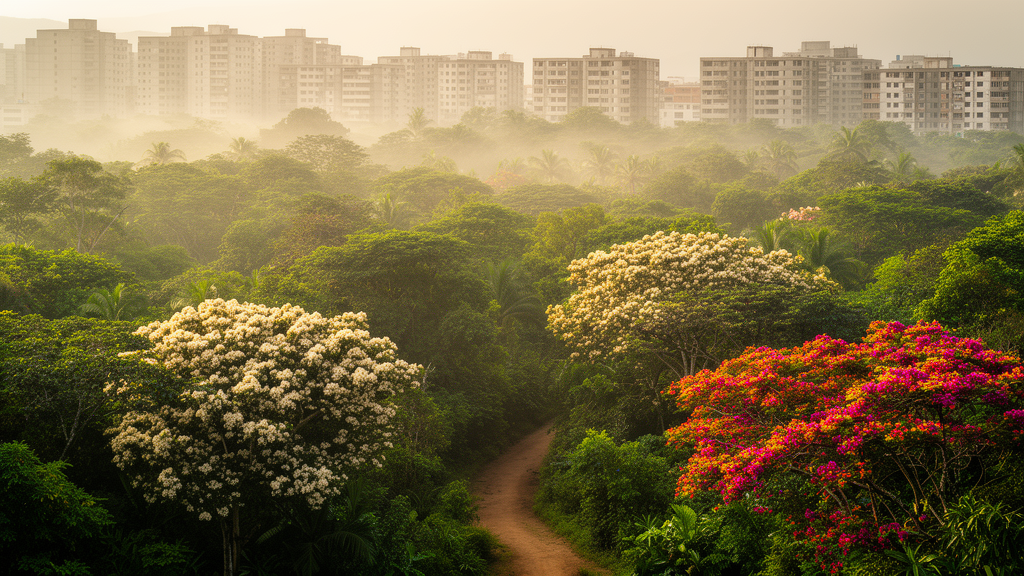
On the outskirts of Popayán, in the Cauca Department of southwestern Colombia, a small patch of forest is quietly doing outsized ecological work. Spread across just 2.96 hectares in the Village of La Claridad, wedged between pastures, farm fields and the expanding urban footprint of the city itself, this peri-urban forest fragment has now been the subject of one of the first detailed inventories of its kind in the Colombian Andes. Researchers spent nine months walking its trails, cataloguing every flowering plant they could find and recording exactly when each species bloomed and bore fruit. What they discovered is a story of surprising resilience, subtle climate signals and a handful of unsung plant species that appear to hold the entire ecosystem together.
The study, published in the journal Neotropical Biology and Conservation, set out to answer a deceptively simple question: what reproductive phenological events and floristic composition characterise the flowering plants of a peri-urban forest fragment in the Colombian Andes? Phenology, the study of the timing of biological events such as flowering and fruiting, is far more than botanical bookkeeping. In tropical ecosystems, the timing of these events determines when nectar, pollen and fruits become available, and that temporal availability sustains the plant–animal interactions on which entire communities depend. Roughly 90 percent of tropical woody plants rely on pollinators and seed dispersers to complete their reproductive cycles, so shifts in phenological timing can ripple through food webs in ways scientists are only beginning to understand.
The fieldwork was exhaustive in its own understated way. Between January and September 2025, the team conducted two monthly field walks covering every zone of the fragment, deliberately avoiding fixed plots or quadrats in order to maximise spatial coverage and capture as many reproductive events as possible. The focus fell on fertile individuals, those bearing flowers or fruits, because reproductive structures are essential for reliable taxonomic identification in many flowering plant groups. Sterile individuals were also recorded when vegetative characters allowed identification. For each species, between two and four fertile specimens were collected, pressed and processed at the CAUP Herbarium of the University of Cauca, where identification was confirmed through comparison with reference collections and taxonomic databases such as Plants of the World Online and Tropicos.
The inventory yielded 68 fertile species belonging to 31 angiosperm families. Of these, 28 species, or 41.17 percent, were identified to the species level, 38 to the genus level and two morphospecies only to the family level, a common constraint in taxonomically complex tropical groups. Three families dominated the richness rankings. Orchidaceae, the orchid family, led with 11 species, accounting for 16.18 percent of the recorded flora. Rubiaceae, the coffee family, followed with eight species, and Araceae, the arum family, contributed six. Together these three families made up more than a third of the fragment’s recorded floristic richness. The genera Palicourea and Anthurium each boasted five species, the highest generic diversity in the sample.
The growth-form profile of the forest tells its own story. Herbs were the dominant habit with 21 species, or 30.88 percent, closely followed by shrubs with 20 species at 29.41 percent. Epiphytes, plants that perch on trees without parasitising them, accounted for 17 species, a striking 25 percent of the total. Trees, by contrast, made up only 7.35 percent. This composition, rich in fast-growing herbs and shrubs but comparatively poor in large trees, suggests the fragment is in an intermediate stage of ecological succession, regenerating after past disturbance. The authors are careful to note that this interpretation rests on floristic composition rather than direct structural measurements such as trunk diameter or canopy density. Still, the pattern fits classical succession theory, in which disturbed systems are first colonised by short-lived pioneers that are gradually replaced by longer-lived, slower-growing species.
Perhaps the most consequential finding concerns conservation status. All 28 species identified to the species level were confirmed as native to Colombia, and 15 of the recorded species appear on national or global threat lists. The standout is Quercus humboldtii, the Andean oak, classified as Vulnerable at the national level under Colombia’s 2024 environmental resolution, although the IUCN considers it of Least Concern globally. The presence of this species in a peri-urban fragment is remarkable given that Andean oak forests have lost nearly 60 percent of their cover, largely to logging and agricultural expansion. Other notable residents include Alchornea latifolia and Aiouea montana, tree species of conserved environments, and Monotropa coccinea, an entirely mycoheterotrophic plant that depends on underground fungal networks linked to forest trees, a living indicator of shaded, relatively well-preserved forest conditions.
The phenological monitoring produced 197 recorded occurrences across 19 observation campaigns, and the statistical analysis revealed sharply different dynamics for flowering and fruiting. Flowering proved strongly seasonal. A Rayleigh test, a form of circular statistics used to detect whether events cluster in particular parts of an annual cycle, returned a highly significant result, indicating a non-uniform temporal distribution. A seasonality index of 0.347 confirmed moderate concentration, and a Kruskal–Wallis test found significant differences among months. Flowering peaked dramatically in March, when 34 species, half of the entire flora, were in bloom, followed by April with 25 species and September with 20. Fruiting told a different story: it lacked significant circular seasonality, with a lower index of 0.235, suggesting a more homogeneous spread through time, though it too fluctuated significantly by month and peaked in September, when 15 species, 22.1 percent of the flora, carried fruit.
Those temporal patterns map intriguingly onto the local climate. Data from a monitoring station 1.19 kilometres from the site, part of the IDEAM-ENANDES Community Monitoring project, recorded an average annual temperature of 18.4 degrees Celsius and total precipitation of 1,831.1 millimetres for 2025, with a bimodal rainfall regime typical of the Cauca River Basin. Flowering concentrated in March and April, months of relatively high precipitation, while fruiting clustered in September as conditions turned drier. The researchers interpret this cautiously: flowering may be associated with greater water availability, whereas fruiting during drier periods could favour dispersal and seedling establishment. Importantly, no formal correlation or regression analysis was performed to test the climate–phenology relationship, so the association remains descriptive rather than statistically demonstrated.
At the species level, the monitoring revealed a functional backbone for the ecosystem. Vismia baccifera, Besleria solanoides and Psychotria carthagenensis maintained prolonged flowering and fruiting across multiple months, providing a continuous supply of nectar and fruits for pollinators and frugivores. Vismia baccifera and Palicourea species sustain mutualistic relationships with bees, wasps, bumblebees and butterflies, while Siparuna aspera deploys floral adaptations that attract cecidomyiid flies as efficient pollinators. The steady resource supply these persistent species provide makes them key functional components of forest regeneration. By contrast, several species, including Xanthosoma, Comparettia and Pavonia schiedeana, recorded no flowering at all during the nine months, and most orchids, including Stelis, Oncidium, Lepanthes and Rodriguezia, showed no fruiting. Such absences may reflect non-annual reproductive cycles, pollination limitation, fertilisation failure or the abortion of reproductive structures, patterns well documented in Neotropical flora.
The broader message is that peri-urban forests are not passive remnants awaiting development but functional ecosystems actively sustaining ecological processes. The La Claridad fragment, with its sensitive epiphytic orchids serving as bioindicators of habitat quality, its vulnerable Andean oak, and its staggered reproductive calendar, functions as a biodiversity refuge, a biological corridor and a node of connectivity within Popayán’s urban matrix. The authors recommend that future work add structural measurements such as canopy cover and trunk diameter, extend monitoring over multiple years, and integrate data on pollinator and frugivore abundance to track how these communities respond to climate change and fragmentation. As Andean landscapes continue to be carved up by agriculture and urban growth, studies like this one make the case that even small forest fragments on the city’s edge deserve a central place in conservation planning, not as afterthoughts but as living infrastructure for the region’s ecological future.
Subject of Research: Reproductive phenology and floristic composition of a peri-urban Andean forest fragment in Popayán, Colombia
Article Title: Reproductive phenology and floristic composition of a peri-urban forest fragment in the Colombian Andes
Article References: Majin-Quiñonez, N., Luligo-Miranda, S., Zambrano-Gonzales, G., & Becoche-Mosquera, J. (2026). Reproductive phenology and floristic composition of a peri-urban forest fragment in the Colombian Andes. Neotropical Biology and Conservation, 21(2), 189-212. https://doi.org/10.3897/neotropical.21.e181931
Image Credits: AI Generated
DOI: 10.3897/neotropical.21.e181931
Keywords: phenology, peri-urban forest, Colombian Andes, floristic inventory, Orchidaceae, flowering, fruiting, ecological succession, biodiversity conservation, Quercus humboldtii, pollinators, climate seasonality
Cite Scienmag News
Gavin Prescott. (October 16, 2026). Hidden Forest on the Edge of a Colombian City Reveals Its Flowering Secrets. Scienmag. https://scienmag.com/hidden-forest-on-the-edge-of-a-colombian-city-reveals-its-flowering-secrets/
Gavin Prescott. "Hidden Forest on the Edge of a Colombian City Reveals Its Flowering Secrets." Scienmag, 16 October 2026, https://scienmag.com/hidden-forest-on-the-edge-of-a-colombian-city-reveals-its-flowering-secrets/. Accessed 16 October 2026.
Gavin Prescott. "Hidden Forest on the Edge of a Colombian City Reveals Its Flowering Secrets." Scienmag. October 16, 2026. https://scienmag.com/hidden-forest-on-the-edge-of-a-colombian-city-reveals-its-flowering-secrets/


