


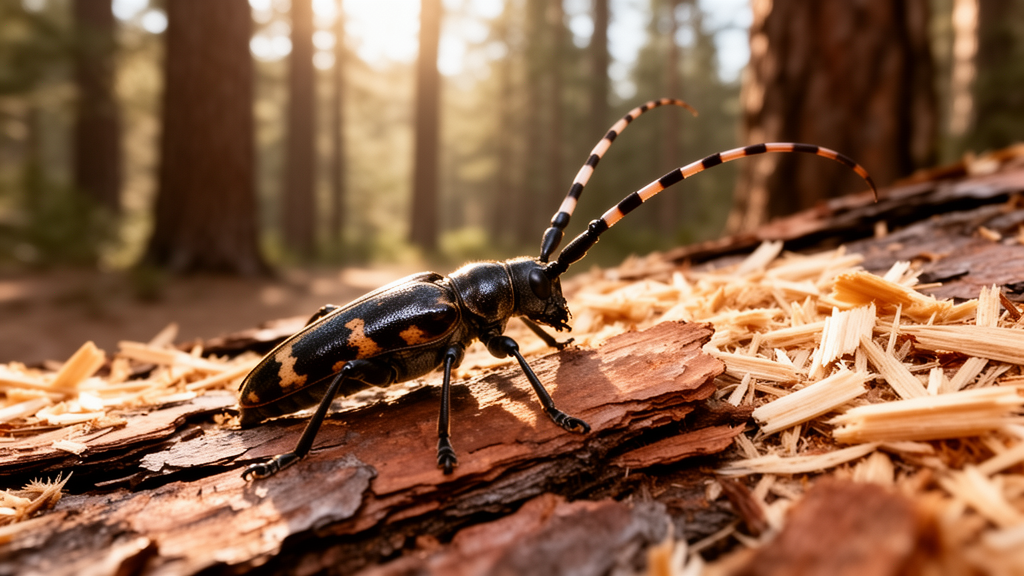
Two unassuming beetles from North America could soon become Europe’s next major forest headache. A newly published study in the journal NeoBiota has mapped, with unusual precision, where two longhorn beetle species — Saperda candida and Saperda tridentata — would most likely establish themselves if they ever hitched a ride across the Atlantic. The answer, according to an international team of researchers, is unsettling: vast swaths of central and western Europe offer exactly the conditions these wood-boring insects need to thrive, and the continent’s busiest shipping hubs sit uncomfortably close to the danger zones.
Both species belong to the longhorn beetle family Cerambycidae, a group infamous in biosecurity circles for containing some of the world’s most destructive tree pests. Unlike beetles that confine themselves to dead or dying wood, both Saperda species attack living trees, which makes them a primary phytosanitary concern. Saperda candida, commonly known as the roundheaded appletree borer, is primarily associated with hosts in the Rosaceae family — a botanical clan that includes apple, pear, cherry and hawthorn, and therefore overlaps directly with Europe’s orchards and ornamental plantings. Saperda tridentata, the elm borer, zeroes in on elm species, the very trees that European forests and cities have already struggled to defend against Dutch elm disease.
The research, led by Enrico Ruzzier and colleagues including Davide Rassati, Andrea Di Giulio, Giacomo Santoiemma, Deepa S. Pureswaran, Jon Sweeney and Luciano Bani, took on a challenge that has long frustrated invasion biologists: predicting where a species that has not yet arrived will succeed. Traditional species distribution models rely on occurrence records in the native range, but they often lump together two very different drivers of suitability — the broad brushstroke of climate and the fine-grained reality of what is actually growing on the ground. A region may have perfect temperatures for a beetle yet be useless if its host trees are absent, and vice versa.
To disentangle these forces, the team built ensemble models that separately quantified the effects of broad-scale climatic variables and fine-scale habitat factors, including land cover and host plant availability. Ensemble modelling, which combines the outputs of multiple algorithms, reduces the uncertainty that plagues any single method and produces more reliable maps. The researchers then merged the climatic and habitat layers into overall suitability maps for each beetle, effectively asking two independent questions — could the climate support the insects, and could the landscape feed them — before stacking the answers together.
But environmental suitability alone does not make an invasion. A pest must also get there, and for wood-boring insects that live hidden inside solid wood, the overwhelming majority of transcontinental introductions happen through human trade. Wooden packaging material, pallets, crates and dunnage shipped alongside consumer goods have repeatedly smuggled live longhorn beetles into new continents. The Asian longhorned beetle, a notorious relative, famously reached North America and Europe through exactly these routes, triggering eradication campaigns that cost hundreds of millions of dollars and required felling tens of thousands of trees.
To capture this human dimension, the researchers integrated their suitability maps with a proxy of propagule pressure derived from international shipping connectivity — essentially, a measure of how strongly each European location is linked to overseas ports through maritime trade. The logic is straightforward: the more ships and shipping routes flowing into a region, the greater the volume of potentially infested wood products arriving, and the more chances a beetle gets to slip through inspection and emerge into a hospitable landscape. By multiplying ecological suitability with this trade-driven arrival probability, the team produced spatially explicit invasion risk maps that show not just where the beetles could live, but where they are most likely to actually show up.
The results carry a clear geographic message. Both species showed strong model performance and high transferability — a technical way of saying the models were robust and could reliably project the beetles’ North American ecology onto European conditions. Large areas of Europe, particularly in the central and western parts of the continent, offer suitable environmental conditions for establishment. However, climatic constraints limit suitability at the southern and northern extremes, meaning the Mediterranean’s heat and dryness and Scandinavia’s cold may provide some natural buffering, at least under current conditions.
One of the study’s most important findings concerns the relative weight of the two ecological filters. Host plant availability emerged as a key determinant of habitat suitability — where the right trees grow, the beetles can make a living — while climate acted as the primary limiting factor across Europe. This distinction matters enormously for management. Climate change will gradually redraw the climatic envelope, potentially opening new territory to these insects, but the distribution of host plants is something land managers and policymakers can influence directly through planting decisions, orchard siting and urban forestry choices.
When the ecological and trade layers were finally combined, invasion risk was highest in central Europe, especially in regions that combine dense trade networks with high environmental suitability. The convergence is hardly accidental: fertile, temperate landscapes with abundant host trees are also exactly the landscapes where agriculture, forestry and commerce flourish, generating both the pathways for arrival and the resources for establishment. Ports and their hinterlands, connected inland by rivers, roads and rail, thus act as gateways through which pests can radiate outward into the surrounding countryside.
The authors argue that their findings highlight a crucial principle: invasion risk is driven by the interaction between environmental suitability and human-mediated pathways, and neither can be assessed in isolation. Their integrated framework, blending ecological modelling with real-world trade data, offers a practical template for biosecurity agencies. By identifying high-risk areas before an invasion begins, surveillance can be targeted where it will do the most good — inspecting the right shipments, monitoring the right forests and mobilizing eradication efforts the moment a suspect beetle turns up. For two beetles that have yet to reach European shores, that early warning may be the best defense the continent’s apple orchards and elm groves will ever get.
Subject of Research: Invasion risk assessment of two North American longhorn beetle species in Europe using joint bioclimatic-habitat species distribution models and maritime trade connectivity
Article Title: Assessing invasion risk of two North American Saperda species (Coleoptera, Cerambycidae) in Europe using joint bioclimatic-habitat species distribution models and maritime-inland connectivity
Article References: Assessing invasion risk of two North American Saperda species (Coleoptera, Cerambycidae) in Europe using joint bioclimatic-habitat species distribution models and maritime-inland connectivity. (n.d.). Original publication
Image Credits: AI Generated
DOI: Not provided
Keywords: invasive species, longhorn beetles, Saperda candida, Saperda tridentata, species distribution models, forest health, phytosanitary risk, maritime connectivity, host plants, biosecurity, wood-boring insects, Europe
Cite Scienmag News
Gavin Prescott. (October 16, 2026). North American Longhorn Beetles May Threaten Europe’s Forests as Trade Maps Reveal Hotspots. Scienmag. https://scienmag.com/north-american-longhorn-beetles-may-threaten-europes-forests-as-trade-maps-reveal-hotspots/
Gavin Prescott. "North American Longhorn Beetles May Threaten Europe’s Forests as Trade Maps Reveal Hotspots." Scienmag, 16 October 2026, https://scienmag.com/north-american-longhorn-beetles-may-threaten-europes-forests-as-trade-maps-reveal-hotspots/. Accessed 16 October 2026.
Gavin Prescott. "North American Longhorn Beetles May Threaten Europe’s Forests as Trade Maps Reveal Hotspots." Scienmag. October 16, 2026. https://scienmag.com/north-american-longhorn-beetles-may-threaten-europes-forests-as-trade-maps-reveal-hotspots/


