


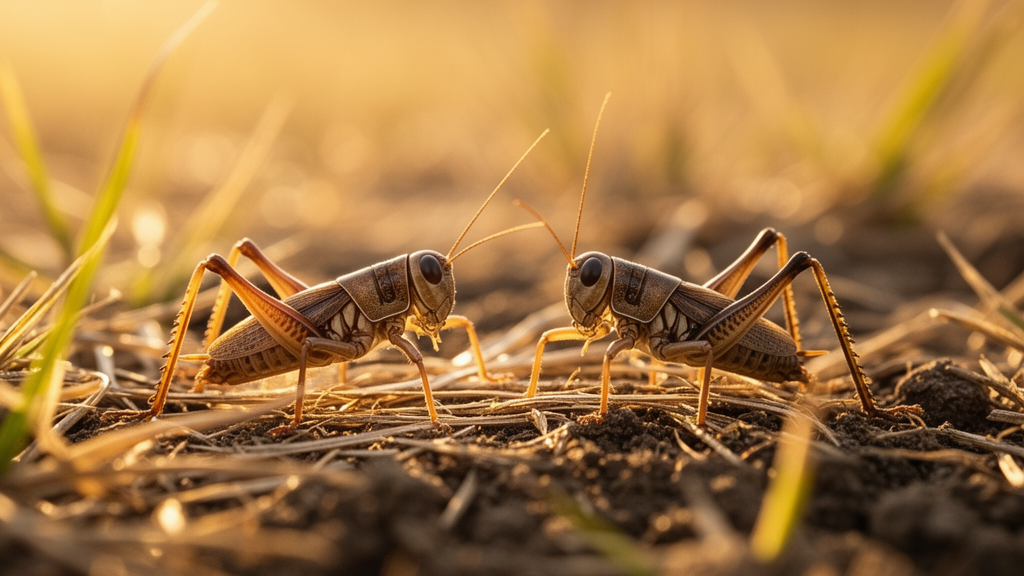
For small animals living in a world full of hungry predators, few survival strategies are as dramatic as autotomy, the ability to shed a body part on demand. Many crickets and other insects can sever a leg at a pre-fractured joint when a predator grabs hold, leaving the struggling appendage behind while the animal escapes to live another day. But this life-saving trick has hidden consequences, and a new study of the band-legged ground cricket, Dianemobius fascipes nigrofasciatus, reveals just how steep the reproductive price of losing a limb can be. Researchers found that females who lost both front legs suffered sharply reduced mating success and produced fewer viable offspring, painting a vivid picture of the trade-offs that shape survival and reproduction in the insect world.
The study, published in the Journal of Orthoptera Research, set out to answer two connected questions. First, how quickly can these tiny crickets autotomize different limbs, and does the position of a limb on the body affect how readily it is sacrificed? Second, what happens to a female’s reproductive prospects when she loses one or both of her forelimbs, which serve double duty as walking appendages and as the location of the cricket’s ears? The answers turned out to be surprising in both cases, challenging assumptions built from earlier work on larger cricket species.
Previous research on larger field crickets, such as the two-spotted cricket Gryllus bimaculatus, had suggested a hierarchy of sacrifice. Because forelimbs in many orthopterans house the tympanal hearing organs, and because a lost limb never regenerates in these species, scientists predicted that forelimbs would be shed more slowly and reluctantly than hind limbs, which are the largest and most likely to be seized by a predator. Hind limbs, the reasoning went, would be autotomized fastest, middle limbs at an intermediate speed, and forelimbs most slowly of all. That prediction made sense for animals that possess alternative defenses, such as powerful kicks and bites, which larger crickets deploy before resorting to losing a limb.
The band-legged ground cricket, however, is a very different animal. With a head width of only about 1.4 to 1.8 millimeters, it is a fraction of the size of its larger relatives, which measure nearly five times wider across the head. The researchers suspected that a species this small, lacking the physical strength to fight off a predator with kicks or bites, might rely overwhelmingly on rapid autotomy and would therefore be willing to shed any limb, including its precious forelimbs, almost instantly. To test this, they worked with the fourth laboratory generation of crickets descended from twelve wild females collected in Sakai, Osaka, Japan, ensuring a standardized population of 167 virgin adults.
The results of the autotomy speed test were striking. When the researchers grasped a limb at the femur with tweezers, autotomy occurred so fast that a stopwatch could not reliably capture the delay. Forelimbs, middle limbs, and hind limbs all detached essentially instantaneously, within roughly one second of being seized, in every one of the 167 individuals tested. Even more remarkably, when females that had already lost one forelimb were tested on the remaining one, that second forelimb was shed just as readily as the first. No detectable hesitation, no lingering reluctance to sacrifice the hearing limb, appeared anywhere in the data.
This total readiness to abandon even functionally critical limbs, the authors argue, likely reflects the species’ small body size. Larger cricket species, which can resist predators through physical defenses, show less willingness to autotomize, and similar patterns appear across the animal kingdom. Porcelain crabs of the genus Petrolisthes become less dependent on shedding a single claw as body size increases, and large starfish such as Asterias rubens take longer to drop an arm than smaller individuals. For a tiny ground cricket with few alternatives, speed of escape is everything, and the fastest route to escape is to let go of whatever the predator is holding, whether it is a hind leg or an ear.
The second half of the study examined the consequences of forelimb loss for reproduction, and here the costs became unmistakable. Female crickets were divided into three groups: an intact control group, a group with the right forelimb autotomized, and a group with both forelimbs removed. Each female was paired with an intact male, and the researchers tracked egg laying and hatching over 21 days, defining mating success as whether any eggs hatched, since hatching confirms that fertilization occurred. The differences among groups were substantial. In the intact group, three of fifteen pairs produced no hatched eggs; in the single-autotomy group, five of seventeen pairs failed; but in the double-autotomy group, ten of fourteen pairs, more than seventy percent, produced no offspring at all.
Statistical analysis confirmed the pattern. Females that had lost both forelimbs had significantly lower mating success than intact females, and when the analysis was restricted to females that produced at least one hatched egg, the double-autotomy group also showed a significantly lower hatching ratio than both the intact and single-autotomy groups. The number of eggs laid did not differ significantly among treatments, although the estimated mean was highest in the single-autotomy group and lowest in the double-autotomy group. Intriguingly, the elevated egg count in singly autotomized females hints at a possible compensatory response, a phenomenon previously suggested in another cricket species under simulated predation risk, though the authors caution that this interpretation remains speculative.
Why would losing forelimbs sabotage reproduction so severely? The researchers point to two overlapping mechanisms. The first is mechanical: in orthopteran mating, the female must climb onto the male’s dorsum and hold her position, with the forelimbs and middle limbs gripping the male while the hind limbs steady her on the ground. A female missing both forelimbs would struggle to maintain this posture, and the difficulty would be amplified in the confined spaces of the experimental containers. The second mechanism is sensory: because cricket forelimbs bear the ears, and directional hearing depends on comparing sound between two ears, a female with one or no forelimbs may be unable to localize a calling male. In close-quarters laboratory conditions the auditory deficit likely mattered less, but under natural conditions, where females must track down singing males across distance, losing an ear could be devastating.
The findings carry broader implications for understanding evolutionary trade-offs. Autotomy is a genuine bargain struck in the moment of mortal danger: escape now, pay later. For the band-legged ground cricket, the willingness to shed even the limbs it needs for hearing and mating suggests that, in the calculus of natural selection, surviving a predation attempt outweighs the reproductive costs that may follow. Yet the study also demonstrates that those costs are real and measurable, reducing mating success and offspring viability, and they likely shape behavior and population dynamics in ways that laboratory work is only beginning to reveal. The authors emphasize that field studies under natural conditions are needed to confirm how these laboratory findings translate to the wild, where the distances between mates are greater and the sensory role of the forelimbs may loom even larger.
Subject of Research: The effects of forelimb autotomy on escape behavior and female mating success in the band-legged ground cricket
Article Title: Effects of female forelimb autotomy on mating success in the band-legged ground cricket, Dianemobius fascipes nigrofasciatus
Article References: Matsuoka, N., Miyakawa, M., & Ishihara, M. (2026). Effects of female forelimb autotomy on mating success in the band-legged ground cricket, Dianemobius fascipes nigrofasciatus. Journal of Orthoptera Research, 35(2), 277-282. https://doi.org/10.3897/jor.35.159323
Image Credits: AI Generated
Keywords: autotomy, crickets, Dianemobius fascipes nigrofasciatus, predator escape, mating success, orthoptera, reproductive cost, forelimb loss, hearing organs, insect behavior, egg hatching, escape strategy
Cite Scienmag News
Gavin Prescott. (October 15, 2026). Losing a Leg to Survive Costs Female Crickets Their Mating Success. Scienmag. https://scienmag.com/losing-a-leg-to-survive-costs-female-crickets-their-mating-success/
Gavin Prescott. "Losing a Leg to Survive Costs Female Crickets Their Mating Success." Scienmag, 15 October 2026, https://scienmag.com/losing-a-leg-to-survive-costs-female-crickets-their-mating-success/. Accessed 16 October 2026.
Gavin Prescott. "Losing a Leg to Survive Costs Female Crickets Their Mating Success." Scienmag. October 15, 2026. https://scienmag.com/losing-a-leg-to-survive-costs-female-crickets-their-mating-success/


