


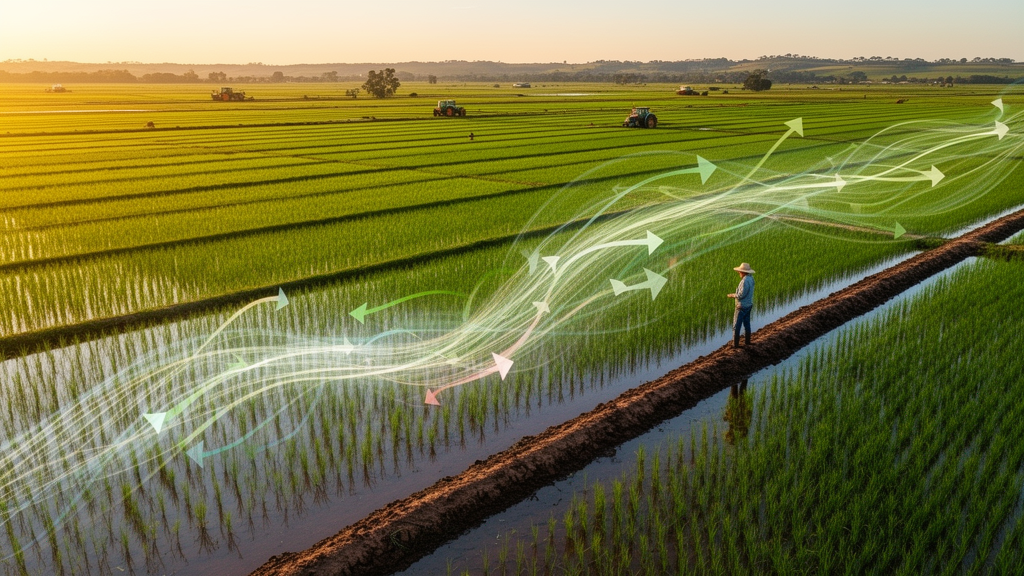
Rice farming in southern Brazil feeds the nation and anchors the regional economy, yet a new energy-based model has put the numbers to a suspicion long held by ecologists: the dominant production system runs almost entirely on borrowed resources. The study, published in the Food and Ecological Systems Modelling Journal, applied a rigorous accounting method called emergy synthesis to irrigated rice in Rio Grande do Sul and Santa Catarina, the two states that together produce more than 70 percent of Brazil’s rice. The verdict was stark. On the standard scoreboard of agricultural sustainability, the conventional system scored so low that researchers placed it firmly in the unsustainable category.
Emergy synthesis, developed by the ecologist Howard Odum, works by converting every input into a farming system — sunlight, rain, fuel, fertilizer, labor, machinery — into a single common currency: solar emergy joules, abbreviated seJ. The idea is that every product or service carries with it the total solar energy required, directly and indirectly, to make it. This allows dissimilar inputs, from potassium fertilizer to irrigation water, to be compared on one scale rather than judged only by market price or agronomic yield. For the rice analysis, the team built a model of a representative one-hectare paddy over a single October-to-March production cycle, drawing on technical recommendations from extension services Emater/Ascar and Epagri, national statistics, climate data from Brazilian research agencies, and soil-loss estimates from the Universal Soil Loss Equation.
The accounting revealed a system overwhelmingly powered by external and non-renewable inputs. Local renewable flows — rainfall, wind, transpiration, and solar radiation — contributed 2.93E+15 seJ per hectare per year, a sliver of the total. Purchased inputs, dominated by potassium fertilizer, electricity and diesel fuel, totaled 1.29E+16 seJ, more than four times the renewable contribution. Water drawn for continuous flood irrigation registered 3.49E+15 seJ, classified as a local non-renewable flow because its intensive, consumptive use within the production cycle effectively outpaces renewal. Converted into economic terms using Brazil’s emergy-to-money ratio, potassium emerged as the most expensive input at roughly 3,670 emdollars per hectare, followed by electricity and irrigation water.
From these flows the researchers calculated the indicators that define emergy analysis. The renewable percentage, %R, came out at just 0.15, meaning only about fifteen percent of the system’s total emergy derives from local renewable sources. The emergy yield ratio, which measures how much output the system generates for each unit of economic feedback, was 1.49 — low, and a sign the paddy leans heavily on purchased inputs rather than free local resources. The environmental loading ratio, which expresses pressure on the local environment, hit 5.73, placing the system in a transitional zone between sustainable and degraded. Combining yield and loading, the emergy sustainability index landed at 0.26, far below the threshold of 1 that marks a sustainable system.
The footprint ratio told a similar story: at 6.73, the system generates nearly seven times more emergy than local renewable flows alone could support, a textbook signature of ecological overshoot. By comparison, agroecological rice systems in Asia report footprint values below 3. The study is careful to note that cross-study comparisons in emergy research carry uncertainties — transformity values themselves can vary by 30 to 50 percent — but the gap is wide enough that the qualitative conclusion stands: input-intensive conventional rice in southern Brazil imposes far more environmental stress than its organic counterparts.
What makes the finding more provocative is the contrast between what the rice landscape is and what it could be. The researchers identified twelve potential co-benefits that conventional management largely suppresses: flood mitigation, groundwater recharge, water purification, biodiversity conservation, microclimate regulation, environmental education, tourism and recreation, reduced urban drainage costs, and even higher property values in surrounding areas. The flat, water-engineered lowlands, laced with dikes, canals and pumping stations, are physically ideal for regulating hydrology and providing habitat. Yet continuous flooding, agrochemical use and monoculture actively suppress these functions, leaving the landscape locked into a single purpose: maximizing grain output.
The study frames this untapped capacity through the lenses of Nature-Based Solutions and Green Urban Infrastructure — frameworks that treat working landscapes as providers of public goods, not just commodities. In Santa Catarina’s Araranguá Valley, rice paddies sit adjacent to towns and cities, creating socio-ecological interfaces where flood control and recreational value could be worth real money to urban populations. The researchers propose concrete mechanisms to activate this potential: payments for ecosystem services that compensate farmers for groundwater recharge and stormwater retention they currently provide free, formal recognition of peri-urban rice fields as green infrastructure, and diversified management models such as citizen agriculture, leisure farms, and biodiversity corridors alongside the paddies.
Policy levers already exist in Brazil, the authors argue, but they reward the wrong things. The federal Plano Safra allocated 516.2 billion reais to agriculture for the 2025/2026 cycle, directed primarily toward credit for large-scale producers, while the Arroz da Gente program, launched in 2024, offers reduced-interest credit and technical assistance to about 10,000 family rice farming households. Redirecting incentives toward bioinputs, water-efficient infrastructure, alternate wetting and drying irrigation, and organic certification, the study suggests, would shift the indicators in the right direction. Precision agriculture tools — drone-based multispectral imaging and robotic spot-spraying — could cut fertilizer and pesticide overuse without sacrificing yield.
The paper also points to living proof that alternatives work. The Landless Workers’ Movement, known as MST, runs organic rice operations in the region built on green manuring, biological pest control and collective land management, dramatically cutting dependence on external inputs. The study did not apply emergy analysis to those systems, so quantitative comparison remains a job for future research, but the authors note that such agroecological practices would, in theory, raise the renewable share and lower the environmental loading ratio — exactly the moves the sustainability math demands.
The deeper message goes beyond rice. Emergy synthesis offers a way to see agricultural systems whole, exposing hidden dependencies that yield statistics and market prices conceal. A crop that looks profitable on a spreadsheet can, when all flows are counted, be quietly consuming its own foundations — topsoil, groundwater, fossil energy. The southern Brazilian rice model remains essential for national food security and regional employment, and the researchers do not suggest abandoning it. Instead, they argue for a reconfiguration: treating the rice-field landscape as a multifunctional asset that produces grain, regulates floods, recharges aquifers and sustains communities, supported by policies that pay for the public goods rather than only the harvest. The numbers, they contend, provide the quantitative foundation to make that transformation real.
Subject of Research: Emergy-based sustainability assessment of irrigated rice farming in southern Brazil
Article Title: Energy modelling of the economic and environmental sustainability of rice farming in southern Brazil
Article References: Energy modelling of the economic and environmental sustainability of rice farming in southern Brazil. (n.d.). https://doi.org/10.3897/fmj.6.166845
Image Credits: AI Generated
DOI: 10.3897/fmj.6.166845
Keywords: emergy synthesis, rice farming, southern Brazil, sustainability indicators, ecosystem services, Nature-Based Solutions, agroecology, environmental loading, irrigated agriculture, green urban infrastructure, Rio Grande do Sul, payment for ecosystem services
Cite Scienmag News
Alan Morgan. (October 15, 2026). Brazil’s rice heartland fails the sustainability test, emergy model reveals. Scienmag. https://scienmag.com/brazils-rice-heartland-fails-the-sustainability-test-emergy-model-reveals/
Alan Morgan. "Brazil’s rice heartland fails the sustainability test, emergy model reveals." Scienmag, 15 October 2026, https://scienmag.com/brazils-rice-heartland-fails-the-sustainability-test-emergy-model-reveals/. Accessed 15 October 2026.
Alan Morgan. "Brazil’s rice heartland fails the sustainability test, emergy model reveals." Scienmag. October 15, 2026. https://scienmag.com/brazils-rice-heartland-fails-the-sustainability-test-emergy-model-reveals/


