


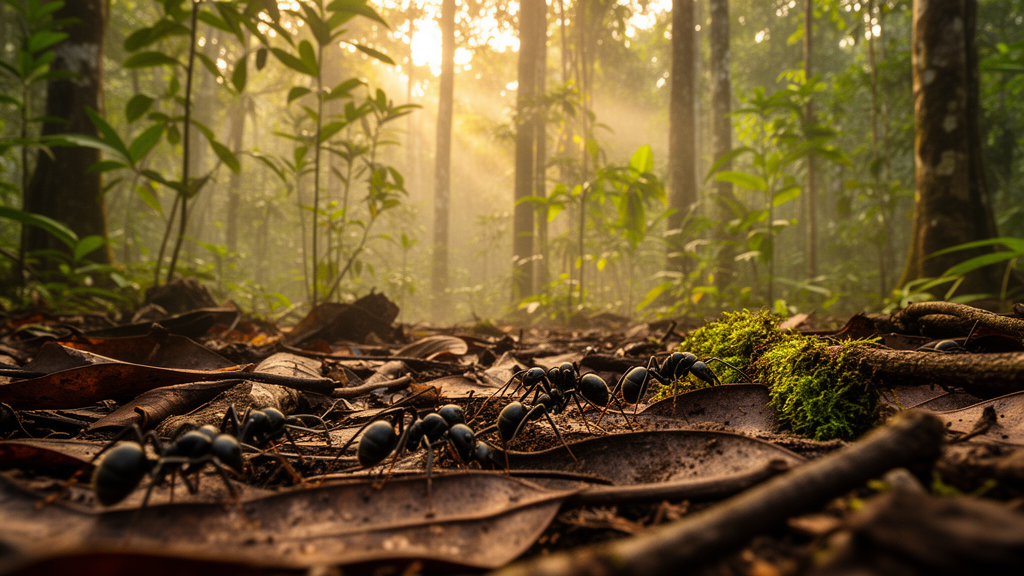
Deep in the Democratic Republic of the Congo, a humble insect is telling a remarkable story about the health of one of the world’s most important rainforests. In the sprawling Yangambi Biosphere Reserve, researchers have completed one of the most thorough surveys of ants ever undertaken in the region, and the results carry a powerful message: when forests are allowed to regenerate, the extraordinary diversity of life hidden in the leaf litter can bounce back. But when forest is cleared to fallow land, a large share of that diversity vanishes, and with it, the ecological services these tiny engineers provide.
The study, published in African Invertebrates, documented an astonishing 190 ant species belonging to 50 genera and eight subfamilies across the reserve. The team sampled six localities within the 6,297 square kilometre reserve, comparing three habitat types that represent a gradient of human disturbance: fallow land where forest was recently cleared, secondary forest that has regrown after disturbance, and primary forest that has remained largely untouched. The findings show a clear and statistically significant pattern: ant diversity is lowest in fallow land, intermediate in secondary forest, and highest in primary forest.
This gradient matters because the Yangambi Biosphere Reserve is under intense pressure. Deforestation in the DRC is accelerating, driven largely by a growing human population, and Yangambi is one of the most affected areas. Primary forests are progressively converted to fallow land, which may later regenerate into secondary forest if left alone. These novel plant formations are thought to contribute to local biodiversity erosion, yet until now, very little was known about how the region’s ant communities respond to this transformation. Ants are increasingly used in ecosystem management programmes worldwide as indicators of forest health, making this baseline data invaluable.
The researchers used two complementary sampling techniques over the course of four months, from November 2023 to February 2024. Pitfall traps, small pots filled with soapy water sunk into the ground, capture ants that walk across the soil surface. Winkler extractors, on the other hand, work like miniature sieves of the forest floor: leaf litter is collected from one square metre plots, sifted in the field, and suspended in mesh bags for 48 hours. As the litter dries, ants and other small arthropods migrate downward and drop into containers of ethanol. Each transect combined five of each trap type, and four transects were completed per study plot.
The comparison between the two methods produced some of the study’s most striking findings. Winkler extractors captured substantially more species than pitfall traps, with an estimated maximum richness of 168 species compared to 111 for pitfall traps, a difference of roughly 50 percent. The Winkler method also detected new species at a faster rate per unit of sampling effort across all three habitat types. This makes sense given the biology of the ants involved: the cryptic genus Strumigenys, tiny predators that nest and feed within leaf litter and rotting wood, was represented by 25 species in the study, and nearly all were caught exclusively by Winkler extraction. Every single species observed from the subfamilies Amblyoponinae and Proceratiinae, which nest in soil and rotten logs and rarely venture onto the surface, also came solely from Winkler samples.
Yet pitfall traps were far from redundant. Each method recovered species the other missed, and the researchers emphasize that the two techniques should be used in combination for leaf litter ant surveys. Pitfall traps appear to capture species active at different times, such as nocturnal foragers that are absent from the litter when it is collected during the day. This complementarity was most pronounced in the forests, where Winkler extractors dominated the catch, but even in species-poor fallow land, the two methods captured distinct subsets of the community with limited overlap.
Community composition analysis revealed that each habitat type supports a distinct assemblage of ants. Sixty species were shared across all three habitats, but the greatest overlap occurred between primary and secondary forests, while fallow land overlapped minimally with either. Primary forests harboured the largest number of exclusive species, and statistical tests confirmed that fallow land communities differ significantly from those in both forest types. Interestingly, primary and secondary forest ant communities did not differ significantly from each other, suggesting that regenerating forests can recover much of the original ant fauna, a hopeful sign for conservation.
The reasons behind the fallow land collapse are rooted in the physical structure of the habitat. Without leaf litter on the soil surface and with simplified woody vegetation, nesting sites and foraging opportunities become scarce. Annual fires burn the litter and dead wood above ground, forcing remaining ants to nest underground, and underground assemblages tend to be less species-rich than those living above. The species that persist in fallow land are largely generalists and disturbance-tolerant groups, particularly certain Formicinae and Dolichoderinae that prefer open spaces. Fallow land communities also varied far more from site to site than forest communities, indicating fragmented and heterogeneous remnants of the surrounding forest fauna rather than a coherent community of their own.
Rarefaction analysis added an important dimension of realism to the study. The overall community curve predicted a maximum richness of 197 species, meaning the 190 species actually recorded represent roughly 94 percent of what is out there. Reaching 99 percent detection would require sampling 29 sites rather than the 18 studied. These numbers suggest a significant portion of Yangambi’s ant fauna likely remains unrecorded, and the authors recommend adding arboreal traps, net sweeping and baiting to future surveys, since arboreal communities are known to harbour about a third of the tropical ant fauna.
For a region where tropical forests are being destroyed at an estimated 10 million hectares per year globally, and where a quarter of the world’s species may face extinction in coming decades, this study offers both a warning and a source of hope. The warning is that intensive land-use change drastically reduces ant biodiversity, and that fallow land, no matter how much it varies from site to site, cannot substitute for standing forest. The hope is that secondary forests showed ant richness approaching that of primary forest, meaning that allowing cleared land to regenerate with native plant species can meaningfully restore the invertebrate communities that make tropical forests function. Preserving the remaining primary forests of the Congo Basin, while sustainably managing the secondary forests that follow them, may be the key to limiting biodiversity erosion in one of Earth’s most vital ecosystems.
Subject of Research: Ant diversity across forest successional stages in the Yangambi Biosphere Reserve, Democratic Republic of the Congo
Article Title: Uncovering ant diversity across forest successional stages in the Yangambi Biosphere Reserve (DRC): Insights from Winkler and pitfall trap sampling
Article References: Ambakina, H., Gómez, K., Monzenga, J.-C., Sánchez-García, D., & Dekoninck, W. (2026). Uncovering ant diversity across forest successional stages in the Yangambi Biosphere Reserve (DRC): Insights from Winkler and pitfall trap sampling. African Invertebrates, 67(1), 65-91. https://doi.org/10.3897/afrinvertebr.67.180461
Image Credits: AI Generated
DOI: 10.3897/AfrInvertebr.67.180461
Keywords: ants, biodiversity, Congo Basin, Yangambi Biosphere Reserve, leaf litter, forest succession, Winkler extractors, pitfall traps, tropical ecology, Democratic Republic of the Congo, conservation, species richness
Cite Scienmag News
Margaret Porter. (October 15, 2026). Ants Reveal How Forest Recovery Rescues Biodiversity in the Congo Basin. Scienmag. https://scienmag.com/ants-reveal-how-forest-recovery-rescues-biodiversity-in-the-congo-basin/
Margaret Porter. "Ants Reveal How Forest Recovery Rescues Biodiversity in the Congo Basin." Scienmag, 15 October 2026, https://scienmag.com/ants-reveal-how-forest-recovery-rescues-biodiversity-in-the-congo-basin/. Accessed 15 October 2026.
Margaret Porter. "Ants Reveal How Forest Recovery Rescues Biodiversity in the Congo Basin." Scienmag. October 15, 2026. https://scienmag.com/ants-reveal-how-forest-recovery-rescues-biodiversity-in-the-congo-basin/


