When the COVID-19 pandemic forced science and engineering classrooms online almost overnight, educators around the world were confronted with a question that had been simmering for years: how do you keep students genuinely engaged when the lecture hall is replaced by a screen? A new systematic review published in SN Social Sciences offers one of the most comprehensive answers to date. Drawing on decades of research, the review concludes that blended and flipped learning approaches, when carefully designed, can substantially deepen student engagement in science and engineering education, but only if institutions confront persistent barriers of infrastructure, motivation, and teacher readiness.
The study, conducted by Musa Kallah Saidu and Md Abdullah Al Mamun of the Department of Technical and Vocational Education at the Islamic University of Technology in Gazipur, Bangladesh, set out to map the landscape of research on student engagement in flipped and blended learning environments. The authors performed a systematic search of the Scopus and Web of Science databases, two of the most comprehensive scholarly indices available, which together yielded 649 candidate publications. After removing duplicates and screening out studies that did not meet their eligibility criteria, the researchers settled on 45 articles published between 2007 and 2024 for detailed qualitative analysis. That span captures the full arc of the field, from the early experiments with inverted classrooms before the smartphone era to the pandemic-driven explosion of hybrid teaching models.
The methodological rigor of the review matters. Systematic reviews of this kind follow established protocols, and the authors anchored their search strategy in the widely recognized PRISMA framework, the preferred reporting standard for systematic reviews and meta-analyses. By restricting their databases to Scopus and Web of Science, they ensured strong journal coverage across science, technology, engineering, and mathematics education research, though the choice also means that relevant work indexed elsewhere may have been missed. The analysis examined each included study across several dimensions: the disciplinary scope, the theoretical frameworks used, the research methodologies employed, the technological tools deployed, the instructional strategies at the heart of each intervention, the dimensions of engagement measured, and the outcomes reported.
At the conceptual core of the review is the idea that student engagement is not a single thing. Building on the influential framework of Fredricks and colleagues, which distinguishes behavioral, emotional, and cognitive engagement, the review also considered more recent extensions, including agentic engagement, the extent to which students actively shape and contribute to their own learning activities. This multidimensional view matters because blended learning interventions often affect these dimensions differently. A student may dutifully watch a pre-recorded lecture, showing behavioral engagement, while remaining emotionally flat and cognitively passive. Conversely, a well-structured problem-solving session may ignite all three dimensions at once. The review’s findings suggest that the design of the learning environment, not the technology itself, determines which dimensions of engagement are activated.
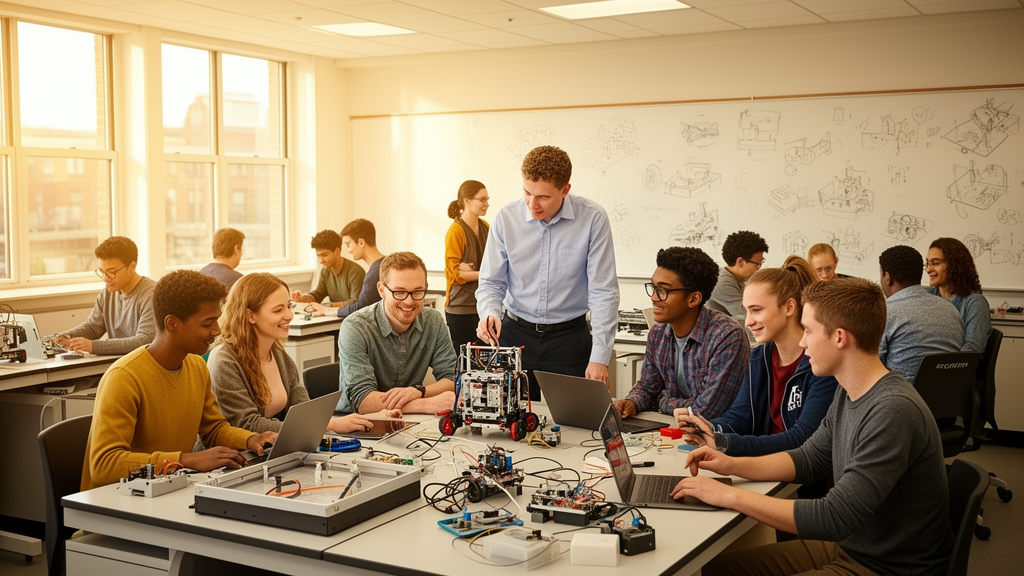
The technical findings are strikingly consistent. Across the 45 studies, three factors emerged as the strongest drivers of engagement: technology integration, pre-class preparation, and active classroom learning. The flipped classroom model, in which students encounter new content independently before class and use class time for collaborative problem-solving, exemplifies all three. In a typical flipped science or engineering course, students watch short instructional videos or work through online modules before the session, then arrive ready to tackle laboratory exercises, peer instruction, design challenges, or problem-based activities with the instructor present. The review found that when this cycle is executed well, students engage more deeply with the material and achieve higher academic performance than in traditional lecture-based formats.
Concrete examples from the reviewed literature illustrate how this plays out across disciplines. In general chemistry, combining pre-class preparation with collaborative in-class activities improved both engagement and success rates. In second-year science laboratory courses, flipping the laboratory itself, so students arrive having already studied the procedures and theory, freed precious bench time for genuine inquiry rather than step-following. In engineering programming courses, integrating the flipped model with problem-based learning and peer instruction helped students navigate notoriously difficult introductory material. In mathematics, longitudinal case studies of large flipped barrier courses documented sustained performance gains. The review also highlighted the role of emerging technologies, including adaptive learning platforms and even AI-assisted tools such as guided use of ChatGPT within blended environments, which studies have linked to improvements in self-regulated learning, higher-order thinking skills, and knowledge construction.
Yet the review is candid about the friction points. Inadequate facilities, low student motivation, and limited teacher readiness remain stubborn obstacles. Flipped learning places a heavy demand on students to prepare before class, and when that preparation does not happen, the entire model collapses into a traditional lecture with extra homework. Instructors, meanwhile, must invest considerable time in producing quality pre-class materials and redesigning class sessions around active learning, skills that many faculty members have never been formally trained in. Institutions in resource-constrained settings face additional hurdles, from unreliable internet access to inadequate devices and classroom layouts built for passive listening. These challenges echo findings from the broader literature on emergency remote teaching during the pandemic, which distinguished sharply between hastily improvised online instruction and deliberately designed blended pedagogy.
What distinguishes successful implementations, according to the review, is a cluster of strategies that work together. Collaborative learning puts students in groups where peer accountability and discussion drive engagement. Adaptive platforms tailor content difficulty and pacing to individual learners, reducing the frustration that causes disengagement. Problem-based activities give abstract scientific and engineering concepts immediate purpose, answering the perennial student question of why the material matters. Learning analytics add another layer: by monitoring students’ navigational patterns and participation within learning management systems, instructors can identify disengaging students early and intervene before failure becomes entrenched. The reviewed studies suggest these tools are most powerful when feedback loops are iterative, with course design adjusted continuously in response to what the data reveals about how students actually behave.
The authors argue that the evidence points toward a comprehensive model for sustaining engagement in science and engineering education, one that integrates four elements simultaneously: innovative pedagogy, accessible technology, iterative course design, and robust assessment practices. No single ingredient is sufficient on its own. A beautifully produced video library is worthless without active classroom sessions to use it. Cutting-edge technology is useless if students lack access or instructors lack confidence. And assessment must reward the deeper learning that these approaches aim to produce; if examinations still reward rote memorization, students will rationally revert to cramming. The review’s synthesis suggests that when all four elements align, flipped learning consistently fosters deeper learning and higher performance, whereas partial or superficial adoption yields inconsistent results.
For educators, administrators, and researchers, the implications are practical and immediate. Universities redesigning post-pandemic curricula should treat blended and flipped learning not as a temporary contingency but as a mature pedagogical strategy with a substantial evidence base, provided they invest in faculty development, infrastructure, and course design support. Future research, the authors note, should build on this foundation to refine and validate comprehensive engagement models across diverse institutional and cultural contexts. As science and engineering education continues to absorb new technologies, from learning analytics dashboards to generative artificial intelligence, the central lesson of this review remains clear: engagement is designed, not downloaded, and the classrooms that thrive will be those that treat technology as an enabler of active, student-centered learning rather than a substitute for it.
Subject of Research: Student engagement in flipped and blended learning environments in science and engineering education
Article Title: Student engagement in science and engineering education through blended learning: a review
Article References: Saidu, M. K., & Mamun, M. A. A. (2026). Student engagement in science and engineering education through blended learning: a review. SN Social Sciences, 6(9), Article 372. https://doi.org/10.1007/s43545-026-01669-1
Image Credits: AI Generated
DOI: 10.1007/s43545-026-01669-1
Keywords: blended learning, flipped classroom, student engagement, science education, engineering education, systematic review, technology integration, pedagogy, higher education, learning analytics, problem-based learning, active learning
Cite Scienmag News
Denise Maddox. (October 15, 2026). Flipped and Blended Learning Boost Student Engagement in Science and Engineering, Review Finds. Scienmag. https://scienmag.com/flipped-and-blended-learning-boost-student-engagement-in-science-and-engineering-review-finds/
Denise Maddox. "Flipped and Blended Learning Boost Student Engagement in Science and Engineering, Review Finds." Scienmag, 15 October 2026, https://scienmag.com/flipped-and-blended-learning-boost-student-engagement-in-science-and-engineering-review-finds/. Accessed 16 October 2026.
Denise Maddox. "Flipped and Blended Learning Boost Student Engagement in Science and Engineering, Review Finds." Scienmag. October 15, 2026. https://scienmag.com/flipped-and-blended-learning-boost-student-engagement-in-science-and-engineering-review-finds/