


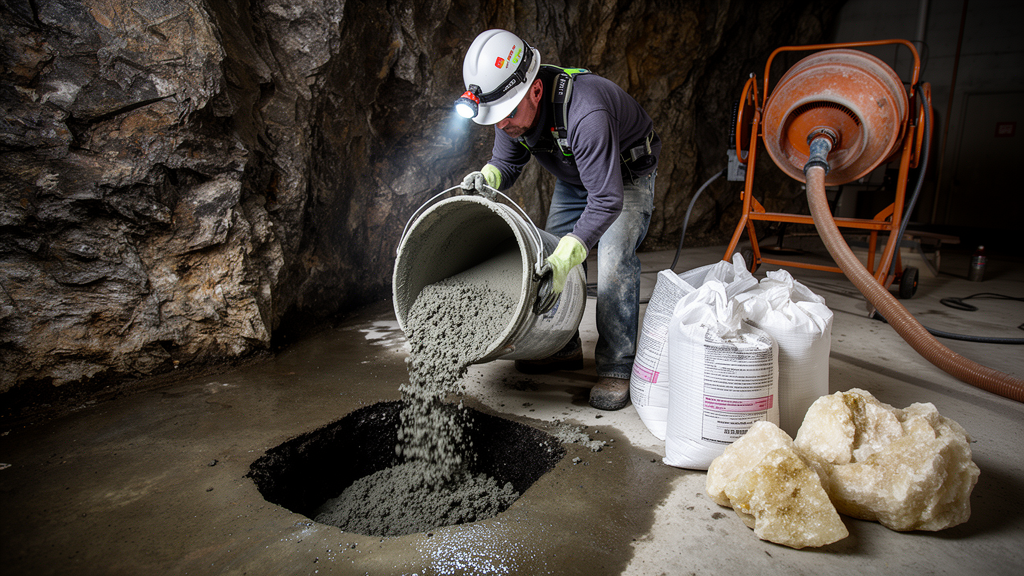
Deep beneath abandoned quarries, mines and karstic voids, an unglamorous but critical material is quietly at work: backfill grout, a cement-based slurry pumped or poured into underground cavities to stabilize the ground. A new laboratory study published in Results in Engineering shows how these highly diluted grouts can be reformulated with far less cement by combining three humble ingredients — bentonite clay, metakaolin and quicklime — without sacrificing the flow, stability or strength that field applications demand.
The challenge is deceptively simple to state but notoriously difficult to solve. Backfill grouts must remain fluid enough to be mixed, transported and placed into large voids, yet cohesive enough to avoid bleeding and segregating once in place, and strong enough after hardening to contribute to ground stabilization. In highly diluted systems, the large water content needed for placement promotes sedimentation of solid particles and water separation, while simply adding more cement to compensate increases resistance to flow and inflates both cost and the carbon footprint of filling operations that can consume enormous material volumes.
A research team led by Rachida Idir, Nourredine Goufi, Minh Trinh Quang, Bernard Husson and Martin Cyr approached the problem with a sequential formulation strategy. They first pinned down the right dose of bentonite, a sodium-rich clay whose swelling montmorillonite platelets trap water and hold cement particles in suspension. Then they pushed metakaolin — a reactive aluminosilicate made by calcining kaolinitic clay — as a partial cement replacement up to a remarkable 80 percent by mass. Finally, they added quicklime as an external calcium source and mapped the resulting three-component binder space using mixture-design interpolation.
The bentonite results reveal a classic engineering compromise. With no clay at all, a reference grout containing 150 kilograms of cement per cubic meter flowed through a Marsh cone in just 9 seconds but bled a catastrophic 30 percent of its water. At 2 percent bentonite, bleeding dropped to 4 percent with a flow time of 12 seconds; at 3 percent, bleeding fell to 2 percent while flow time hit the 15-second limit adopted as a practical flowability criterion. Beyond that, the suspension stiffened dramatically: 4 percent bentonite stretched the flow time to 24 seconds, and at 5 percent the grout would not discharge at all.
Rheological measurements on sand-free equivalents, performed with a Couette rheometer at a constant volumetric solid concentration of 0.258, confirmed the picture. All mixtures behaved as shear-thinning, yield-stress fluids, but increasing bentonite shifted the entire flow curve upward — the shear stress at 120 reciprocal seconds rose from roughly 6 pascals at 1 percent clay to about 28 pascals at 5 percent. The hysteresis-loop area, an index of thixotropic breakdown, jumped nearly twelvefold across the same range, signaling a strongly connected particle network that resists flow and rebuilds structure after shearing.
Mechanically, the story took an unexpected turn depending on cement chemistry. The clinker-rich CEM I 52.5 R grout started stronger, at 2.85 megapascals at 28 days versus 2.19 for the slag-rich CEM III/C, but collapsed to 1.10 megapascals with just 1 percent bentonite and fell to 0.67 at 3 percent. The slag cement, which contains roughly 82 percent ground granulated blast-furnace slag and only about 15 percent clinker, proved far more tolerant, holding above the 1.5-megapascal target across the entire bentonite range. The authors attribute this to the harsh, ion-rich pore solution of fast-hydrating CEM I, which promotes flocculation of montmorillonite platelets and disrupts hydration product distribution.
Metakaolin alone, meanwhile, proved a fresh-state friend but a mechanical disappointment. Across replacement levels from 10 to 80 percent, bleeding stayed below 2 percent and Marsh cone flow times hovered between 14 and 16 seconds for both cements. Yet compressive strength fell steeply: only the CEM III/C reference with no metakaolin exceeded the 1.5-megapascal target. The reason is calcium starvation. Metakaolin’s pozzolanic reaction consumes calcium hydroxide released by clinker hydration, and once the clinker fraction shrinks too far, there simply is not enough calcium to sustain the formation of additional calcium silicate and calcium aluminosilicate hydrates that bind the matrix together.
Quicklime changed the equation. When calcium oxide hydrates, it generates fresh calcium hydroxide, feeding the pozzolanic reaction directly. Among eight ternary compositions tested with 2 percent bentonite, one stood out: 40 percent CEM III/C, 40 percent metakaolin and 20 percent quicklime delivered a 28-day compressive strength of 1.56 megapascals — more than four times the 0.37 megapascals of the unactivated reference — while flowing in 13 seconds and bleeding just 4 percent. Notably, strength did not scale with lime content: cement-free mixes with 30 or 50 percent quicklime managed only 0.60 and 0.54 megapascals, proving that a residual clinker fraction remains essential.
Interpolating the strength data across the ternary composition space, the team identified a candidate region meeting all three criteria — flow time at or below 15 seconds, bleeding under 5 percent, and strength of at least 1.5 megapascals — spanning roughly 0 to 45 percent metakaolin, 0 to 40 percent quicklime and 20 to 100 percent CEM III/C, interpreted jointly rather than as independent limits. The authors stress this map is exploratory, derived from a limited experimental matrix, and that hydration products and pore structure were not directly characterized, so the proposed reaction mechanisms remain plausible interpretations rather than demonstrated facts.
The implications reach beyond the laboratory. The 1.5-megapascal threshold corresponds to the minimum requirement of France’s Inspection Générale des Carrières for filling mortars used in underground consolidation by injection, making the results directly relevant to stabilizing the voids left beneath cities built over old quarries and mines. Before field deployment, however, the formulations must survive real-world trials of pumping, injectability and placement under pressure, along with assessments of durability and dimensional stability — quicklime hydration is exothermic and can drive early-age expansion, a particular concern in large-volume fills restrained by surrounding ground. If those hurdles are cleared, the study offers a practical recipe for filling the underground voids of the built environment with dramatically less cement, at lower cost and with a smaller carbon footprint.
Subject of Research: Rheological and mechanical formulation of low-cement backfill grouts with bentonite, metakaolin and quicklime for underground cavity filling
Article Title: Rheological and mechanical design of low-cement backfill grouts for underground cavities incorporating bentonite and metakaolin with quicklime
Article References: Rheological and mechanical design of low-cement backfill grouts for underground cavities incorporating bentonite and metakaolin with quicklime. (n.d.). Original publication
Image Credits: AI Generated
DOI: Not provided
Keywords: backfill grout, bentonite, metakaolin, quicklime, rheology, compressive strength, underground cavities, cement replacement, bleeding, Marsh cone, ground stabilization, supplementary cementitious materials
Cite Scienmag News
Denise Maddox. (October 15, 2026). Bentonite, Metakaolin and Quicklime Unlock Low-Cement Grouts for Filling Underground Cavities. Scienmag. https://scienmag.com/bentonite-metakaolin-and-quicklime-unlock-low-cement-grouts-for-filling-underground-cavities/
Denise Maddox. "Bentonite, Metakaolin and Quicklime Unlock Low-Cement Grouts for Filling Underground Cavities." Scienmag, 15 October 2026, https://scienmag.com/bentonite-metakaolin-and-quicklime-unlock-low-cement-grouts-for-filling-underground-cavities/. Accessed 15 October 2026.
Denise Maddox. "Bentonite, Metakaolin and Quicklime Unlock Low-Cement Grouts for Filling Underground Cavities." Scienmag. October 15, 2026. https://scienmag.com/bentonite-metakaolin-and-quicklime-unlock-low-cement-grouts-for-filling-underground-cavities/


