


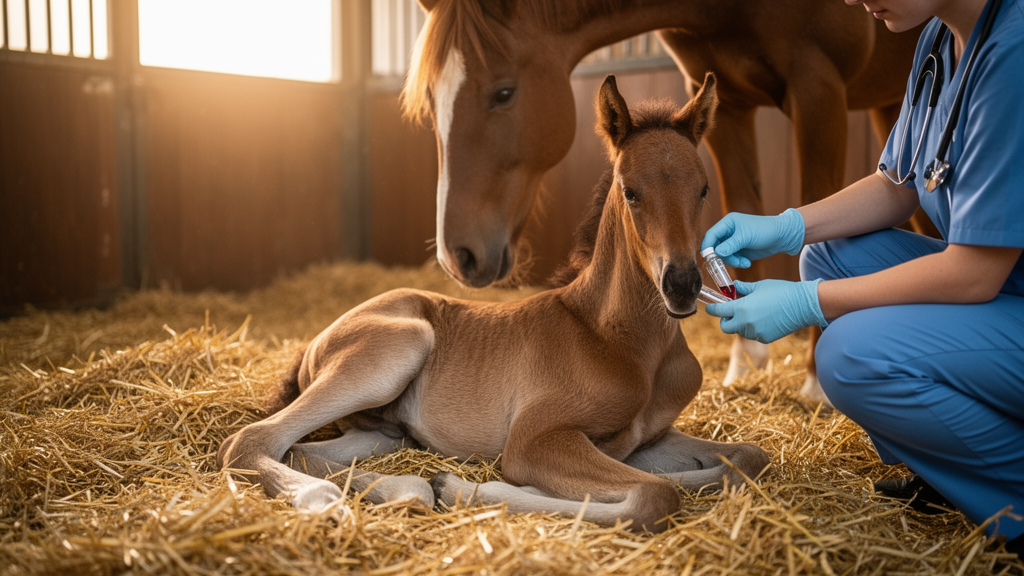
Every foaling season, veterinarians encounter a puzzling phenomenon: newborn foals that appear physically sound yet behave as if they are still asleep in the womb. These animals stumble, fail to nurse, wander away from their mothers, and in severe cases suffer seizures. The condition, known as neonatal maladjustment syndrome, affects roughly one to two percent of foals and has long defied explanation. Now, a prospective clinical study spanning four institutions in the United States has taken a significant step toward unraveling its biology by measuring a panel of brain injury biomarkers and neurosteroids in the blood of seventy-two neonatal foals, and the results suggest that the syndrome leaves a measurable molecular fingerprint that could one day guide diagnosis and prognosis.
The research team, whose findings appear in the Journal of Veterinary Internal Medicine, enrolled foals aged seven days or younger during two foaling seasons between January 2023 and July 2024. Fourteen healthy full-term foals served as controls, while fifty-eight hospitalized foals were divided into diagnostic groups. Nineteen of these met strict criteria for neonatal maladjustment syndrome, confirmed with an established neurobehavioral scoring system that evaluates mentation, response to stimuli, ability to stand and bond with the mare, suckling behavior, paroxysms, and ear position. Only foals scoring eight or higher on the twenty-point scale were classified as affected. The remaining thirty-nine hospitalized foals presented with other diseases, including sepsis and prematurity, providing a critical comparison group that allowed the researchers to distinguish changes specific to the syndrome from those attributable to general critical illness.
At the heart of the study lies a sophisticated biomarker strategy borrowed from human neonatal medicine. The investigators tracked three neuroproteins in the circulation: brain-derived neurotrophic factor, a molecule central to neuronal survival, growth, and plasticity; glial-fibrillary-acidic protein, an intermediate filament released when astrocytes are activated by injury or inflammation; and S100B, a calcium-binding protein produced primarily by astrocytes and Schwann cells that has proven valuable for assessing brain injury in human newborns. Alongside these markers, they measured two pregnane neurosteroids, progesterone and 17α-hydroxyprogesterone, which are believed to play a central role in the syndrome’s characteristic neurological signs. Blood samples were collected on admission, before any medication was given, and again on days one and two of hospitalization, allowing the team to follow the molecular trajectory of each animal through the critical first hours of life.
Measuring these proteins in foal blood posed a genuine technical challenge, because circulating concentrations proved extraordinarily low. The researchers validated human-specific enzyme-linked immunosorbent assays for GFAP and S100B in equine samples, demonstrating dilutional parallelism and linearity up to 1:16 with inter- and intra-assay coefficients of variation below fifteen percent. For BDNF, conventional methods were insufficient, so the team turned to single-molecule-array technology, an ultra-sensitive digital platform that captures individual analyte molecules on antibody-labeled beads loaded into a disc containing two hundred thousand microwells, each holding a single bead. This approach enables quantification at femtogram-per-milliliter concentrations, with a working range spanning 0.0026 to 60,000 pg/mL and a limit of detection of just 0.0042 pg/mL. Neurosteroids were quantified by radioimmunoassay previously validated for horses, with sensitivities of 0.02 and 0.03 ng/mL for progesterone and 17α-hydroxyprogesterone respectively.
The most striking findings emerged when the researchers compared septic foals with and without signs of maladjustment. On admission, septic foals with the syndrome showed markedly higher serum S100B concentrations, with marginal means of 435.3 ng/mL compared to 238.9 ng/mL in septic foals without neurological signs, a difference that reached statistical significance. Admission BDNF concentrations followed the same pattern, averaging 3.4 pg/mL in septic foals with the syndrome versus 2.05 pg/mL in those without. These results suggest that when systemic infection and neurological dysfunction coincide, astroglial activation and altered neuronal signaling converge, producing a biomarker signature that distinguishes these animals from septic foals whose brains remain clinically unaffected.
The neurosteroid data proved equally compelling. Foals with neonatal maladjustment syndrome exhibited significantly elevated concentrations of both progesterone and 17α-hydroxyprogesterone compared with healthy foals and foals with other diseases across all three sampling points. In healthy newborns, pregnane concentrations decline steeply over the first two days of life, falling from a baseline of 6.11 ng/mL to 1.64 ng/mL for progesterone, a physiological drop that facilitates the transition from the unconscious fetal state to wakefulness. In affected foals, this decline appears blunted or absent. The prevailing hypothesis holds that high in utero pregnane levels maintain the foal’s unconscious state, and failure to clear these sedating steroids after birth leaves the animal in a prolonged twilight state, explaining the impaired suckling, ataxia, and diminished responsiveness that define the syndrome.
Remarkably, the pregnane measurements also carried prognostic weight. Foals that did not survive hospitalization had significantly higher admission concentrations of both progesterone and 17α-hydroxyprogesterone than survivors. Non-survivors entered the hospital with progesterone levels of 10.8 ng/mL compared with 1.7 ng/mL in foals that recovered, and 17α-hydroxyprogesterone concentrations of 3.5 ng/mL versus 0.55 ng/mL. These differences were independent of baseline sepsis scores, which the researchers included as covariates in their mixed-effects models and found to have no significant effect on any biomarker concentration. The findings hint that pregnane dysregulation may not merely accompany neurological dysfunction but may track with disease severity in a way that conventional clinical scores cannot capture.
Not every marker behaved as expected. Plasma GFAP concentrations were consistently higher in healthy foals, around 3.3 ng/mL at baseline, than in critically ill foals of any category, including those with the syndrome, whose values hovered near 1.2 ng/mL. This pattern inverts the relationship observed in human neonates, where elevated GFAP signals astrocytic injury in conditions such as hypoxic-ischemic encephalopathy. The authors note that neonatal calves with perinatal asphyxia similarly show no meaningful GFAP differences, raising the possibility of developmental or functional differences in astrocyte biology among large-animal neonates. Rather than a marker of brain injury in foals, GFAP may instead reflect general critical illness or suppressed astrocytic activity in sick neonates, and the researchers conclude it lacks a significant association with the maladjustment syndrome itself.
The study’s design addressed several sources of confounding with care. Foals whose mothers received steroids during parturition, or that received steroids before admission, were excluded to prevent distortion of circulating neurosteroid measurements. Sepsis classification relied on an established scoring system requiring a score of twelve or higher, a positive blood culture, or both. Premature foals, defined as those born before 330 days of gestation, were identified by characteristic signs including tendon laxity, floppy ears, short silky hair coats, domed foreheads, and incomplete ossification of carpal and tarsal bones. Notably, nearly half of the premature foals, five of eleven, displayed clinical signs consistent with the maladjustment syndrome, and premature foals as a group showed elevated pregnane concentrations, reinforcing the link between neurosteroid dysregulation and neurological dysfunction across etiologies.
The authors acknowledge important limitations. Neonatal maladjustment syndrome remains a clinical diagnosis, and its signs can overlap with sepsis, prematurity, hypoxic-ischemic encephalopathy, and electrolyte abnormalities, creating potential for misclassification. The scoring systems used to categorize foals have inherent weaknesses, the sample of affected animals was relatively small, and only ten foals did not survive, constraining statistical power for outcome analyses. Blood-borne biomarkers also originate from non-neural tissues, including Schwann cells, gastrointestinal glia, and hepatic stellate cells, so peripheral concentrations cannot be interpreted exclusively as evidence of central nervous system injury. Cerebrospinal fluid sampling could refine interpretation, though it is rarely performed in neonatal foals in practice.
Even with these caveats, the study delivers a clear message: BDNF and S100B show genuine promise as biomarkers for studying neurological function in critically ill foals, while pregnane measurements offer both diagnostic and prognostic information that could transform how veterinarians assess these animals. Currently, diagnosis rests on subjective behavioral assessment, and advanced neuroimaging such as computed tomography and magnetic resonance imaging is not routinely performed in neonatal foals. A simple blood test that quantifies the molecular signature of brain dysfunction would represent a fundamental shift, enabling earlier intervention, more accurate prognosis, and ultimately a deeper understanding of why some foals fail to wake up. For a condition that has puzzled horse breeders and veterinarians for generations, the path forward may finally run through a few milliliters of blood.
Subject of Research: Neuroscience
Article Title: Biomarkers of brain injury in foals with neonatal maladjustment syndrome
Article References: Perez Quesada, J., Coley, K., Wong, D., Browne, N., Albrecht, M., & Dembek, K. (2026). Biomarkers of brain injury in foals with neonatal maladjustment syndrome. Journal of Veterinary Internal Medicine, 40(5), Article aalag228. https://doi.org/10.1093/jvimsj/aalag228
Image Credits: AI Generated
Keywords: Biomarkers, brain, injury, foals, neonatal, maladjustment, syndrome, scientific research
Cite Scienmag News
Harold Sullivan. (October 15, 2026). Blood Biomarkers Reveal Brain Injury Clues in Maladjusted Newborn Foals. Scienmag. https://scienmag.com/blood-biomarkers-reveal-brain-injury-clues-in-maladjusted-newborn-foals/
Harold Sullivan. "Blood Biomarkers Reveal Brain Injury Clues in Maladjusted Newborn Foals." Scienmag, 15 October 2026, https://scienmag.com/blood-biomarkers-reveal-brain-injury-clues-in-maladjusted-newborn-foals/. Accessed 15 October 2026.
Harold Sullivan. "Blood Biomarkers Reveal Brain Injury Clues in Maladjusted Newborn Foals." Scienmag. October 15, 2026. https://scienmag.com/blood-biomarkers-reveal-brain-injury-clues-in-maladjusted-newborn-foals/


