


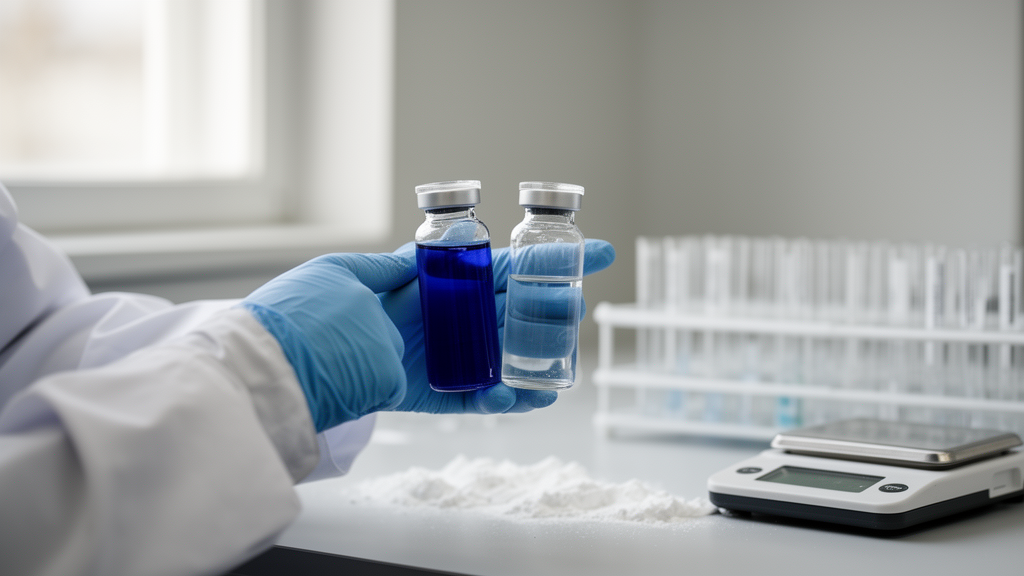
Methylene blue is one of the most stubborn stains on the modern world’s conscience. The deep-blue cationic dye, used everywhere from textile mills and paper plants to biological staining labs, resists biodegradation, survives sunlight, and lingers in aquatic ecosystems long after it leaves the factory floor. More than 15 percent of the dye applied in textile dyeing ends up in effluent streams, and prolonged exposure in humans has been linked to jaundice, cyanosis, methemoglobinemia, tissue necrosis, and even quadriplegia. Its degradation byproducts are potentially carcinogenic and mutagenic, and the dye disrupts plant growth by interfering with phosphate and lipid molecules in cell membranes. Now, a comprehensive review published in Discover Chemistry by Khaled A. Al-Zawahreh of the Hashemite University and Esam A. Wshah of the Southern Alberta Institute of Technology offers something the field has lacked: a practical, multidimensional framework for deciding which of the hundreds of proposed adsorbents actually deserve to leave the laboratory and enter real wastewater treatment plants.
The scale of research interest is striking. Between 2020 and 2026, more than 240 peer-reviewed articles indexed in Scopus and PubMed tackled methylene blue adsorption, with 85 papers appearing in 2024 alone. Yet the authors argue that this torrent of publications has produced a distorted picture. Performance is almost always judged by a single number, the maximum adsorption capacity, while the operational parameters that determine whether a material can function in an engineering context are routinely ignored. A material that binds enormous quantities of dye but requires ten grams of adsorbent per liter, six days of contact time, and continuous heating is not a practical solution, no matter how impressive its headline capacity looks in a table.
To correct this, the team systematically evaluated 83 adsorbents reported over the last five years across every major material class, from activated carbons and biochars to hydrogels, graphene oxide composites, alginate-based materials, metal-organic frameworks, and carbon quantum dots. Their screening framework rests on five practical indicators: a maximum adsorption capacity above 100 milligrams per gram, a low adsorbent dosage of no more than 1 gram per liter, rapid equilibration within 300 minutes, exothermic adsorption behavior, and, for hydrogels, a high swelling capacity. Of the 83 materials assessed, 55 passed the test, including 43 activated carbons or biochars and 12 hydrogel-based adsorbents. The framework, the authors say, is the first structured decision-making tool that bridges the gap between laboratory-scale adsorption performance and engineering applicability.
Hydrogels emerged as the standout class. These three-dimensional networks of crosslinked water-soluble polymers averaged an adsorption capacity of 1660 milligrams per gram at an average dosage of just 0.4 grams per liter, with swelling capacities around 90 grams of water per gram of gel and equilibration times averaging 160 minutes. The secret lies in their architecture: swelling draws the dye solution deep into the polymer network, where dense polar functional groups capture the cationic dye molecules. The poly(acrylic acid)/laponite hydrogel, synthesized by free-radical crosslinking copolymerization, reached a remarkable 3846.2 milligrams per gram with a swelling capacity of 181 grams per gram, while a sodium styrenesulfonate hydrogel crosslinked with gelatin methacryloyl swelled to 27,500 percent and captured 3861 milligrams per gram. Hydrogels also carry a practical bonus: their gelatinous consistency allows them to be separated from treated water by simple decantation rather than energy-hungry centrifugation.
The most balanced performers, according to the new criteria, were sodium alginate-multi-walled carbon nanotube (SA-MWCNT) and poly(acrylic acid)/laponite hydrogels. These materials combined capacities of 1370 to 1600 milligrams per gram with dosages of only 0.33 to 0.75 grams per liter, adsorption times of 30 to 50 minutes, and swelling capacities from 23 to 181 grams per gram. Not every hydrogel made the cut, however. The cassava-starch hydrogel, despite a capacity of 2500 milligrams per gram, needed 400 to 1500 minutes of treatment, and the sodium styrenesulfonate hydrogel demanded a dosage of 10 grams per liter while the uptake process was endothermic, disqualifying it on two counts at once.
Carbon-based adsorbents formed the largest and most cost-effective group. Activated carbons derived from potassium citrate, waste paper, palm branches, longan seeds, and papaya reached capacities between 990 and 1929 milligrams per gram, while biochars from lemon residues, soybean dreg, and sawdust achieved 770 to nearly 1960 milligrams per gram. The examined carbonaceous adsorbents showed median surface areas of 869 square meters per gram and mean pore diameters of about 4 nanometers, comfortably larger than the 1.43-nanometer molecular diameter of methylene blue. Intriguingly, the review found no linear relationship between surface area and performance. Some intensely porous carbons, such as those from Rumex abyssinicus and rubber seed, showed only modest dye uptake, while others with similar areas excelled. The authors conclude that methylene blue adsorption on carbonaceous materials is not purely physical; chemical forces involving surface functional groups such as hydroxyl, carbonyl, amine, and carboxyl moieties play a decisive role.
Cost and kinetics further separate the contenders. Estimated production costs run at roughly 1.3 dollars per kilogram for commercial activated carbon, 0.5 dollars per kilogram for biochar, and a striking 100 dollars per kilogram for graphene oxide, which requires aggressive oxidizing agents via Hummers’ method. Graphene oxide composites also typically demand high-speed centrifugation for recovery, and several, including a polyethylenimine-GO composite with a capacity of 3846 milligrams per gram, needed equilibration times as long as 6000 minutes, rendering them impractical despite spectacular capacities. Among GO-based materials, monolayer graphene oxide, a graphene oxide/hollow silica composite, and a persimmon tannins-GO composite survived screening with moderate capacities, low dosages of 0.1 to 0.3 grams per liter, and contact times of 30 to 250 minutes.
The operational chemistry of the dye itself shapes the selection. Because methylene blue carries a resonance-stabilized positive charge, adsorption is strongly pH-dependent. Across the surveyed literature, optimal removal occurred in basic media, with median and mean optimum pH values of 10.0 and 9.6, while the adsorbents’ points of zero charge averaged an acidic 4.5. When solution pH exceeds the point of zero charge, the adsorbent surface becomes negatively charged and electrostatic attraction pulls the cationic dye in, a mechanism the authors confirm by comparing optimum pH values with measured pH-ZPC data for a wide range of materials. Dosage statistics reinforced the practicality threshold: median and mean optimal dosages were 0.50 and 0.66 grams per liter, with some materials, including date-seed activated carbon and a magnesium-aluminum layered double hydroxide nanocomposite, functioning at dosages as low as 0.05 grams per liter.
Among the more surprising findings is the promise of an emerging class of materials. Carbon quantum dots derived from neem biomass, synthesized by a one-step ultrasonification method, achieved 714 milligrams per gram within only 30 minutes, with isotherms measured at remarkably low dye concentrations of 1 to 10 milligrams per liter. Other dark horses included activated starbons, which captured 890 milligrams per gram in just 5 minutes, and a coffee ground-calcium alginate composite that combined a capacity of 1600 milligrams per gram with confirmed activity in the presence of common wastewater ions, a critical property since many adsorbents lose performance in complex real matrices. Metal-organic frameworks showed moderate but thermodynamically favorable uptake, while materials such as natural clay and faujasite zeolite were undermined by their demand for 10 grams per liter of adsorbent.
The review is candid about its limits. Almost all the surveyed data come from batch experiments with synthetic dye solutions; performance under continuous-flow conditions and in genuinely complex wastewater was rarely examined, so real-world workability cannot yet be critically assessed. Even so, the framework’s logic is deliberately transferable. The same five indicators, capacity, dosage, equilibration time, thermodynamic favorability, and swelling behavior, can be retuned for adsorbents targeting pesticides, anionic dyes, heavy metals, and pharmaceutical micropollutants. For a field drowning in capacity records, the message is refreshingly sobering: the best adsorbent is not the one that binds the most dye on paper, but the one that binds enough dye, fast enough, cheaply enough, and at a low enough dose to matter when the effluent is real.
Subject of Research: Operational screening of high-performance adsorbents for methylene blue removal from wastewater
Article Title: Overview of operational factors for selecting high-performance methylene blue adsorbents: a structured screening guide
Article References: Al-Zawahreh, K. A., & Wshah, E. A. (2026). Overview of operational factors for selecting high-performance methylene blue adsorbents: a structured screening guide. Discover Chemistry, 3(1), Article 435. https://doi.org/10.1007/s44371-026-00888-y
Image Credits: AI Generated
DOI: 10.1007/s44371-026-00888-y
Keywords: methylene blue, adsorption, hydrogels, activated carbon, biochar, graphene oxide, alginate composites, wastewater treatment, adsorption capacity, adsorbent dosage, carbon quantum dots, water purification
Cite Scienmag News
Bethany Barker. (October 15, 2026). Beyond Capacity: New Screening Guide Ranks the Best Methylene Blue Adsorbents. Scienmag. https://scienmag.com/beyond-capacity-new-screening-guide-ranks-the-best-methylene-blue-adsorbents/
Bethany Barker. "Beyond Capacity: New Screening Guide Ranks the Best Methylene Blue Adsorbents." Scienmag, 15 October 2026, https://scienmag.com/beyond-capacity-new-screening-guide-ranks-the-best-methylene-blue-adsorbents/. Accessed 15 October 2026.
Bethany Barker. "Beyond Capacity: New Screening Guide Ranks the Best Methylene Blue Adsorbents." Scienmag. October 15, 2026. https://scienmag.com/beyond-capacity-new-screening-guide-ranks-the-best-methylene-blue-adsorbents/


