


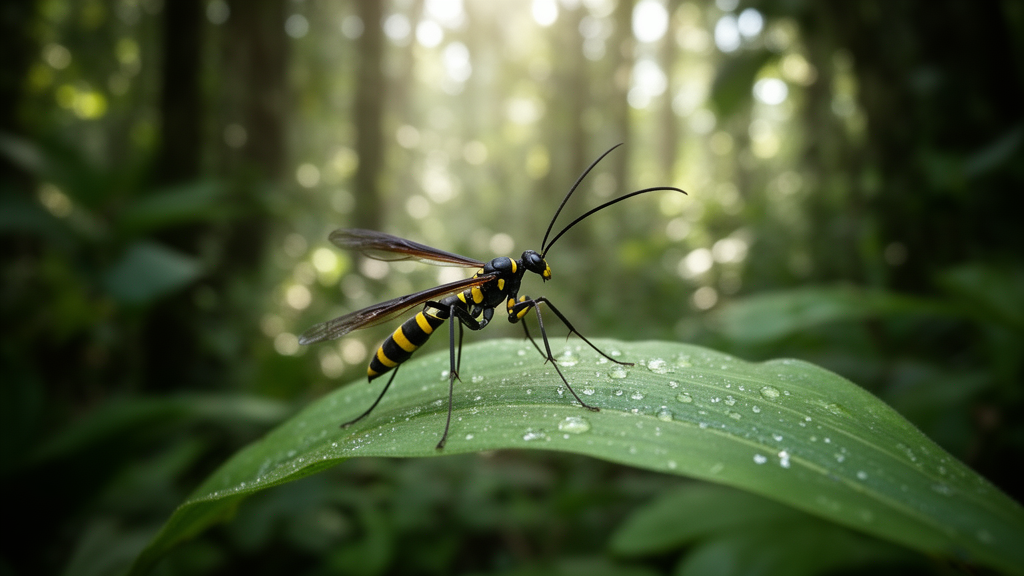
Deep in the forests of Uganda and the highlands of Côte d’Ivoire, a group of parasitoid wasps has been quietly evading the attention of entomologists for more than a century. A new taxonomic study published in the Biodiversity Data Journal has now lifted the veil on the African representatives of Acropimpla, a genus of Darwin wasps in the family Ichneumonidae, delivering the first-ever descriptions of males for two of the continent’s three known species and extending the genus’ range dramatically westward. The work, based on an intensive year-long Malaise trap campaign in Kibale National Park and supplementary sampling on Mont Tonkoui, resolves a long-standing gap in knowledge about a lineage whose African members have remained frustratingly incomplete in museum collections.
Acropimpla is a moderately large genus within the tribe Ephialtini of the subfamily Pimplinae, currently encompassing 48 described species worldwide. Its distribution is nearly cosmopolitan, with the notable exceptions of the Antarctic and the Neotropical Regions, and its greatest diversity clearly lies in the Oriental Region, where decades of taxonomic attention have documented dozens of species. The wasps are idiobiont parasitoids, meaning they paralyse or kill their hosts upon oviposition, and they attack mainly immature Lepidoptera, with a particular focus on tortricid and pyralid moths. Despite this broad ecological role and wide geographic spread, the African fauna of the genus had been known from only three species, all recorded exclusively from east Africa and Madagascar, and, remarkably, not a single male had ever been described for any of them.
One of the most intriguing features of the African species is a wing venation trait that sets them apart from almost all of their relatives elsewhere. All three African species possess an open areolet, meaning they lack the fore-wing vein 3rs-m, a small crossvein that forms a closed cell near the leading edge of the wing in the vast majority of non-African congeners. This shared, highly unusual character suggests that the African species may have inherited the open areolet from their last common ancestor, hinting at a single colonisation event of the continent followed by local diversification. Such geographic patterns in venation provide taxonomists with valuable clues about evolutionary history, and the new study reinforces the view that the genus’ species richness is concentrated in Asia rather than Africa.
The fieldwork underpinning the discoveries was anything but casual. In Uganda, the researchers deployed 34 Malaise traps across Kibale National Park, operating continuously for a full year between 2014 and 2015. The traps were positioned along a successional gradient that ranged from primary forest and swampy primary forest, through disturbed forest and clearcut former plantation land, to active farmland, yielding a total sampling effort of 382.4 trap months. In Côte d’Ivoire, a single Malaise trap ran for one and a half years, from April 2018 to November 2019, in highland forest on Mont Tonkoui, contributing 18.7 trap months of catch. This scale of site-specific sampling proved crucial: by capturing large numbers of specimens from the same locations, the team could confidently associate previously unknown males with their known females, a notoriously difficult task in parasitoid wasp taxonomy.
The first male described belongs to Acropimpla alboscutellaris, a species originally described by Szépligeti in 1908 from Tanzania and later recorded from Kenya. The new male, collected in Kibale National Park alongside a female, closely resembles the female in overall form but differs in several measurable respects. Its antenna carries 18 flagellomeres compared with 20 to 22 in females, and its fore-wing length is approximately 4.4 millimetres against about 6.0 millimetres in the examined females, making it significantly smaller. Its metasomal tergites bear extensive black areas, particularly on the basal and apical segments, whereas the female’s abdomen is fully orange apart from occasional black bands along the apical margins. The face carries only a faint vertical black stripe, weaker than the stronger marking seen in females.
Perhaps the most technically interesting feature of the new A. alboscutellaris male lies in a hind-wing structure called the nervellus, a vein whose pattern of interception by a crossvein is a standard diagnostic character in ichneumonid taxonomy. In the female of this species, the nervellus is intercepted below the middle, but in the male it is entirely unintercepted. The authors note that such sexual dimorphism in nervellus interception is uncommon in their experience, and they suggest a plausible mechanical explanation: males, being smaller, often express weaker characters, and the distal abscissa of the vein CU is quite thin in the female. Intriguingly, the male of the second species described, A. lutea, retains an intercepted nervellus despite a similarly thin vein in its female, so the possibility that larger males of A. alboscutellaris might show the intercepted state cannot be ruled out and remains to be confirmed with additional specimens.
The Côte d’Ivoire specimen of A. alboscutellaris, a single female captured on Mont Tonkoui between late September and early October 2018, carries particular biogeographic weight. It represents not only a new country record for the species but the very first record of the genus Acropimpla from West Africa. The specimen shows minimal variation compared with the Ugandan female and the type material, differing only in having a black band along the apical margins of tergites two to four, faint on the third and fourth segments. The authors point out that variation in apical black bands is common across Pimplinae, and that western Africa remains far less sampled for ichneumonids than central, eastern or southern Africa. Their ongoing sorting of Ivorian material already indicates the presence of further pimpline genera and other subfamilies that constitute new records for the region, suggesting that many taxa currently undocumented in West Africa may in fact be common there.
The second male described belongs to Acropimpla lutea, a species described as recently as 2026 and previously known only from Uganda. The Kibale samples yielded 56 specimens of this species, comprising 54 females, a single male and one individual of undetermined sex, an extraordinary imbalance that the authors interpret as most likely reflecting male swarming behaviour. The male differs from the female in having 16 flagellomeres against 18 to 19, a propodeum with weak rather than coarse punctures, a first metasomal tergite slightly longer than broad compared with the female’s broader segment, a whitish face with the mid-dorsal and posterior head regions black rather than fully orange, and extensively blackened tergites. Its fore-wing measures about 3.9 millimetres, notably smaller than the 4.8 to 6.7 millimetres seen in females. The species can be distinguished from its African relatives by a nervellus intercepted at or slightly above the middle and an entirely orange mesosoma.
Beyond the anatomical descriptions, the Ugandan dataset offers a rare ecological portrait of a poorly known parasitoid. Acropimpla lutea was caught in far greater numbers during the two dry seasons, December to February and June to August 2015, marking it as a dry-season-dominant forest species. Habitat comparisons within Kibale revealed noticeably higher catches in disturbed forest, which had been selectively logged 46 years before the study, than in other forest types, while none were captured in two farmland traps, although the authors caution that the significance of these habitat differences remains unclear. No host records exist for any of the African species, leaving the parasitoid biology of this entire continental fauna essentially undocumented and highlighting how much basic natural history remains to be discovered even in relatively well-studied East African forests.
The third African species, Acropimpla lucifugus, described by Seyrig in 1932 from mountain forest in Madagascar, remains known only from its female holotype, but the study consolidates its diagnosis. It is unique in the genus in having an unintercepted nervellus in the female, together with an entirely black face and a burgundy-red mesosoma marked with black and white. The authors predict that its male, when eventually found, should share the unintercepted state. Taken together, the new synoptic treatment, the male descriptions, the two new country records and the ecological data transform the picture of a genus once barely glimpsed in Africa, while the absence of any undescribed species among hundreds of sampled specimens underscores that Africa, for all its surprises, is not the centre of Acropimpla diversity. All specimen data, including high-resolution images, have been deposited in the Zenodo repository for future researchers.
Subject of Research: Taxonomy and biogeography of African Acropimpla Darwin wasps, including first male descriptions and new distribution records
Article Title: Synopsis of the African species of Acropimpla Townes, 1960 ( Hymenoptera , Ichneumonidae ), with new faunistic records and descriptions of males
Article References: Österman, E., Hopkins, T., Kaunisto, K., Braet, Y., & Sääksjärvi, I. (2026). Synopsis of the African species of Acropimpla Townes, 1960 (Hymenoptera, Ichneumonidae), with new faunistic records and descriptions of males. Biodiversity Data Journal, 14, Article e215045. https://doi.org/10.3897/bdj.14.e215045
Image Credits: AI Generated
Keywords: Acropimpla, Ichneumonidae, Pimplinae, Darwin wasps, parasitoid, Uganda, Côte d'Ivoire, Kibale National Park, Malaise trap, sexual dimorphism, nervellus, West Africa
Cite Scienmag News
Drew Townsend. (October 15, 2026). Male Darwin Wasps Unveiled: African Acropimpla Species Reveal Hidden Sexes and New Range Records. Scienmag. https://scienmag.com/male-darwin-wasps-unveiled-african-acropimpla-species-reveal-hidden-sexes-and-new-range-records/
Drew Townsend. "Male Darwin Wasps Unveiled: African Acropimpla Species Reveal Hidden Sexes and New Range Records." Scienmag, 15 October 2026, https://scienmag.com/male-darwin-wasps-unveiled-african-acropimpla-species-reveal-hidden-sexes-and-new-range-records/. Accessed 15 October 2026.
Drew Townsend. "Male Darwin Wasps Unveiled: African Acropimpla Species Reveal Hidden Sexes and New Range Records." Scienmag. October 15, 2026. https://scienmag.com/male-darwin-wasps-unveiled-african-acropimpla-species-reveal-hidden-sexes-and-new-range-records/


