


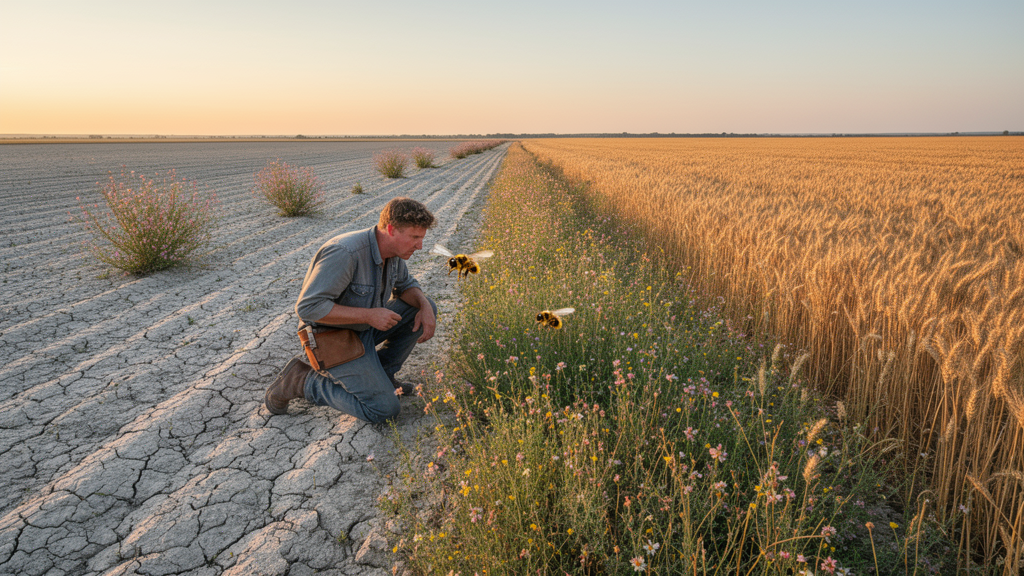
In the sun-scorched agroecosystems of southern Morocco, the fields still bloom, the bees still visit the flowers, and the harvests still come in. Yet according to a provocative new hypothesis published in Frontiers in Conservation Science, this apparent calm may be one of ecology’s most deceptive illusions. Ecologist Rachid Sabbahi of Ibn Zohr University in Laayoune has formalized a concept he calls the Arid Zone Pollinator Paradox, or AZPP: the idea that in dryland farming landscapes, the visible performance of pollination can remain stable even as the invisible architecture of plant–pollinator relationships quietly disintegrates beneath it. If the hypothesis survives testing, it could upend how scientists and farmers around the world judge the health of pollination services, suggesting that the metrics most commonly used—species counts and short-term yields—are precisely the ones least capable of detecting a slow-motion collapse.
The stakes are enormous. Insect pollinators sustain the reproduction of roughly 90 percent of wild flowering plants and nearly 75 percent of global food crops, and their economic contribution is especially large in low- and middle-income regions where rural livelihoods depend heavily on animal-mediated pollination. Pollinator communities worldwide face a punishing stack of interacting pressures: habitat loss, agricultural intensification, pesticide exposure, climate change, invasive species, and emerging pathogens. Conventional risk assessment treats declining species numbers as the alarm bell. But the new framework argues that the alarm may never ring in time, because ecosystems possess buffering mechanisms that keep functions running long after the underlying diversity has begun to fray.
The core of the paradox is a distinction between two dimensions of a pollination system that ecologists often measure separately: structure and function. Structure refers to the interaction network—the map of which pollinator species visit which plants, how often, and how evenly those partnerships are distributed across the community. Function refers to measurable outputs such as visitation rates, pollen deposition on stigmas, fruit set, and crop yield. These two dimensions are related, but they are not equivalent. Two fields can host similar numbers of species while having dramatically different interaction networks, and a network can lose many of its specialized, tightly matched partnerships while a handful of generalist pollinators—species that interact broadly with many plants—continue visiting flowers and moving pollen. In that scenario, function appears intact while structure has been hollowed out.
Sabbahi’s hypothesis goes a crucial step beyond the familiar idea of compensation. Ecologists have long known that functional redundancy and response diversity allow ecosystems to absorb losses: when one species disappears, similar species fill its role. AZPP does not dispute that. Its distinctive claim is that the compensatory phase itself consumes the system’s future options. Each time a functionally constrained interaction—say, a specialist bee perfectly timed to a particular flower’s brief bloom—is lost and a generalist steps in, the pool of ecologically viable alternative partnerships shrinks. The system may look identical on a harvest report while becoming progressively less capable of reorganizing after the next drought, heatwave, or habitat change. In the language of the hypothesis, current compensatory capacity and future interaction-option capacity are different things, and chronic stress erodes the second while masking the erosion with the first.
Why should this erosion be asymmetric—that is, why do some interactions vanish while others persist? The paper identifies four proximate pathways through which environmental filtering can selectively sever relationships. Temporal mismatch arises when shifting rainfall and warming desynchronize flowering from pollinator activity, stranding species with narrow phenological windows. Spatial mismatch occurs when fragmentation and habitat homogenization push partners out of foraging range of one another. Morphological mismatch disrupts the physical fit between floral traits and pollinator bodies, such as tongue length and flower depth. And attraction or cue mismatch occurs when altered floral scents, colors, or nectar chemistry impair the sensory recognition that guides pollinators to their partners. Crucially, these are not four independent theories but alternative routes to the same central mechanism: interaction loss that outpaces species loss, hitting narrowly specialized taxa hardest while broadly interacting species keep functioning.
Drylands, the framework argues, are where these dynamics should be most pronounced and most persistent—though not exclusive. Arid and semi-arid landscapes combine chronic water limitation, patchy floral resources, compressed flowering seasons, and high year-to-year climatic variability, all of which tighten dependence on precisely matched, temporally synchronized partnerships. The hypothesis is grounded in observations from Moroccan agroecosystems, where studies have documented specialist decline and network simplification alongside apparently persistent crop pollination, and where climatic aridification, agrochemical pressure, and declining connectivity are accelerating. Similar partial signatures appear across global drylands: in the Sahel, persistent visitation despite community turnover and parkland degradation; in the Australian arid zone, generalist dominance linked to reduced pollen-transfer efficiency; in the US Southwest, long-term species and interaction loss buffered by residual ecosystem functioning. Sabbahi is explicit, however, that none of these studies was designed to test AZPP, and none directly demonstrates the predicted sequence. The framework is offered as a falsifiable hypothesis, not an established trajectory.
That falsifiability is the framework’s most rigorous feature. AZPP generates three principal predictions. First, under chronic stress, selected structural indicators—specialist interaction persistence, interaction diversity, the diversity of functional traits represented in the network—should decline before comparable declines appear in functional measures such as fruit set or crop pollination efficiency. Second, and most distinctively, recovery should be history-dependent: among systems with similar current pollination function and similar post-stress conditions, those that experienced greater prior structural erosion should recover more slowly or less completely once stress is alleviated. This is the prediction that separates AZPP from a purely state-based view of resilience, in which recovery depends only on present conditions. Third, interaction loss should be asymmetric and compensatory rewiring increasingly constrained, with the pool of compatible alternatives contracting rather than remaining freely substitutable. If longitudinal studies instead show tight coupling between structural and functional change, or recovery independent of interaction history, the hypothesis would fail on its own terms.
The paper also anticipates a subtle statistical trap. Apparent interaction turnover between two sampling dates can arise merely from changes in species abundance or composition, without any genuine behavioral reorganization. To distinguish true compensatory rewiring from random replacement, the framework prescribes abundance- and co-occurrence-constrained null models—analytical benchmarks that specify what interaction patterns would be expected if surviving animals simply encountered partners in proportion to their numbers. If observed replacement exceeds or deviates from those expectations in compatibility-driven ways, that constitutes evidence for the constrained-rewiring mechanism; if turnover is fully explained by abundance alone, the hypothesis loses a key pillar. Testing additionally calls for longitudinal interaction-network monitoring, comparative analyses across stress gradients, and stress-release or restoration experiments in which systems with contrasting disturbance histories are brought to comparable conditions and tracked through recovery.
The paper is careful about what it does not claim. A rigidity trap—a degraded state in which a network becomes locked into dependence on a few dominant interactions with dwindling capacity to adapt—is presented only as a possible downstream outcome under persistent structural erosion, not as an inevitable endpoint. Multi-stressor amplification, such as the documented synergy between heat stress and agrochemical exposure in raising bee mortality, is treated as a context-dependent modifier rather than a required ingredient. And the framework is deliberately formulated for bee-dominated dryland systems, where phenological and trait-matching processes can be evaluated most directly; whether it extends to other pollinator guilds remains an open empirical question. Notably, the hypothesis makes no assumption that generalists are intrinsically tougher than specialists—a thermally specialized desert bee may tolerate heat extremes better than a broadly foraging generalist, while generalists may be more vulnerable to pesticides or pathogens.
If AZPP withstands comparative testing across arid and semi-arid agroecosystems, its practical implications could be transformative. Conservation monitoring would need to move beyond species counts and harvest data to track interaction-network structure, the availability of compatible partners, and recovery history. Management approaches with resource continuity and habitat heterogeneity—such as Morocco’s Farming with Alternative Pollinators strategy, which promotes diverse floral resources alongside crops, and traditional water infrastructure like khettaras that sustains vegetation corridors—could be evaluated as testable buffers against structural erosion, rather than as established prescriptions. Because recolonization and the re-establishment of compatible interactions can take multiple generations, management success would be judged on network recovery rather than immediate visitation. The deeper message is perhaps the most unsettling one in modern conservation science: an ecosystem that still delivers the goods may have already spent the capital that once guaranteed them. In the world’s drylands, where climate pressure is only intensifying, the quiet erosion of options may be the signal that matters most—and the hardest one to see until it is too late.
Subject of Research: Hidden structural erosion and history-dependent recovery in dryland plant–pollinator interaction networks
Article Title: The Arid Zone Pollinator Paradox: hidden resilience erosion and structural-functional decoupling in dryland pollination systems
Article References: Sabbahi, R. (2026). The Arid Zone Pollinator Paradox: hidden resilience erosion and structural-functional decoupling in dryland pollination systems. Frontiers in Conservation Science, 7, Article 1883949. https://doi.org/10.3389/fcosc.2026.1883949
Image Credits: AI Generated
DOI: 10.3389/fcosc.2026.1883949
Keywords: pollinators, dryland agroecosystems, plant-pollinator networks, ecological resilience, structural-functional decoupling, interaction rewiring, Morocco, bee conservation, climate stress, ecological memory, rigidity trap, biodiversity
Cite Scienmag News
Julie Wynn. (October 15, 2026). The Hidden Collapse: Why Stable Crop Yields in Drylands May Mask an Eroding Pollinator Safety Net. Scienmag. https://scienmag.com/the-hidden-collapse-why-stable-crop-yields-in-drylands-may-mask-an-eroding-pollinator-safety-net/
Julie Wynn. "The Hidden Collapse: Why Stable Crop Yields in Drylands May Mask an Eroding Pollinator Safety Net." Scienmag, 15 October 2026, https://scienmag.com/the-hidden-collapse-why-stable-crop-yields-in-drylands-may-mask-an-eroding-pollinator-safety-net/. Accessed 15 October 2026.
Julie Wynn. "The Hidden Collapse: Why Stable Crop Yields in Drylands May Mask an Eroding Pollinator Safety Net." Scienmag. October 15, 2026. https://scienmag.com/the-hidden-collapse-why-stable-crop-yields-in-drylands-may-mask-an-eroding-pollinator-safety-net/


