


Off the southwestern coast of Ulleung Island, a volcanic outpost in the East Sea, divers recovering a single dead fish have handed scientists a discovery with implications far beyond one small goby. The specimen, just 41.9 millimeters long, has been identified as Tomiyamichthys oni, a subtropical shrimpgoby never before recorded in Korean waters. The find, published in Acta Ichthyologica et Piscatoria, also pushes the species’ known northern limit more than two degrees of latitude beyond any previous record, a leap that researchers interpret as a possible fingerprint of ocean warming in one of the fastest-heating seas on the planet.
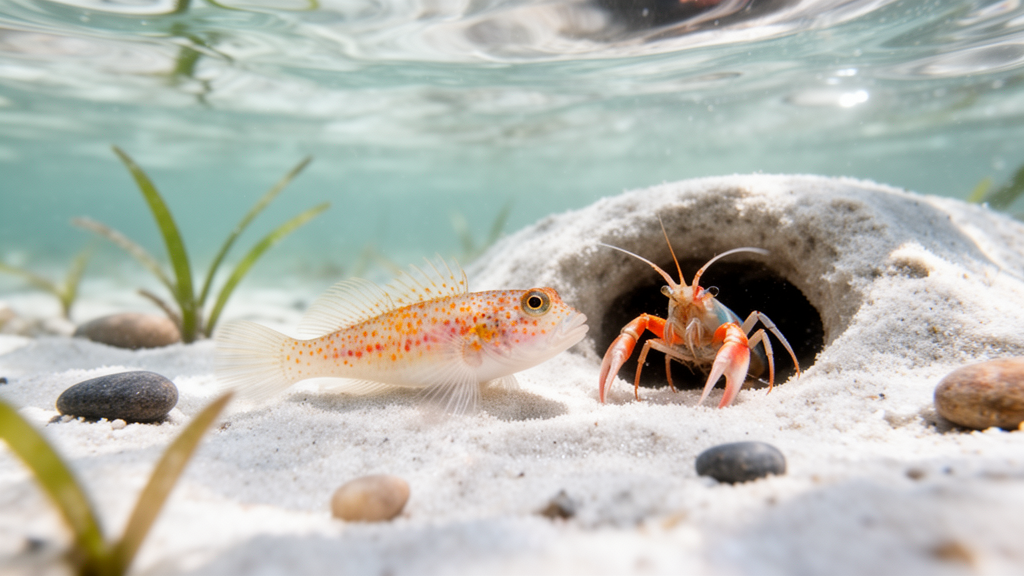
Shrimpgobies are among the ocean’s most charming collaborators. The genus Tomiyamichthys belongs to the Gobiidae, the largest fish family in the sea, with roughly 1,430 species spread across marine, brackish, and freshwater habitats from the tropics to temperate zones. Tomiyamichthys itself contains 22 valid species concentrated in the Indo-Pacific, and many of them live in an intimate mutualism with alpheid snapping shrimp: the shrimp excavates and maintains a burrow in the sandy seafloor while the goby perches at the entrance, acting as a sentry that darts inside at the first hint of danger. Members of the genus are diagnosed by a membrane closing half or most of the ventral part of the first gill slit, a well-developed longitudinal pattern of sensory papillae rows on the cheek, and a single transverse row of papillae behind the chin. Until now, seven Tomiyamichthys species were known from Japanese waters, but none had ever been documented around the Korean Peninsula.
Tomiyamichthys oni was first described in 1936 and has since been recorded across the eastern Indian and western Pacific Oceans, from the Andaman Sea and Malaysia to Papua New Guinea, New Caledonia, Fiji, Palau, the Philippines, and Japan, typically at depths of 5 to 35 meters. Because so little is known about its population status, the International Union for Conservation of Nature lists it as Least Concern. Its previously recognized northernmost occurrence sat at 35°00’N, a latitude roughly at the level of Japan’s southern coasts. The Ulleung Island specimen was recovered at 37°27’57″N, more than 2.5 degrees farther north.
The specimen came to light on 1 March 2025, during diurnal SCUBA surveys at approximately 25 meters depth over a mix of sandy and rocky substrate. The fish was already dead when collected, which raises questions the study’s authors are careful to acknowledge. It was transported to the laboratory, photographed, preserved in 99% ethanol, and deposited at the Fisheries Resources Research Center of Korea’s National Institute of Fisheries Science. There, researchers took seven meristic counts and twenty-five morphometric measurements to the nearest tenth of a millimeter using digital Vernier calipers and a stereomicroscope, following the standard protocol of Randall and Chen.
Morphologically, the fish matched the original description of T. oni on the decisive characters: grooved upper margins on the swollen postorbital cheeks, clusters of irregular brown spots covering the body, and a black band on the lower part of the opercle extending forward to the tip of the chin. The body is compressed and elongated, the head small with a large mouth whose posterior tip extends beyond the rear margin of the eye, and the cheek and operculum lack scales. Coloration is equally diagnostic, with large and small dark brown blotches along the sides, a black stripe beneath the eyes, five transverse black bands on the body, and a first dorsal fin with a light grey base scattered with orange spots. A handful of fin-ray counts differed slightly from the 1936 original description, with 12 dorsal and 10 anal soft rays instead of 11 for each, differences the authors attribute to intraspecific variation within the documented range.
To rule out its closest lookalike, the team turned to DNA barcoding. Total genomic DNA was extracted from muscle tissue, and a 546-base-pair segment of the mitochondrial cytochrome c oxidase subunit I gene, the standard COI barcode for fishes, was amplified with the VF2 and FishR2 primers and sequenced on an ABI 3730XL analyzer. The sequence, registered with NCBI under accession number PX427231, was aligned with reference sequences from GenBank, and genetic divergences were calculated under the Kimura 2-parameter model with neighbor-joining phylogenies bootstrapped 10,000 times. The result was unambiguous: the Ulleung fish sat just 0.026 genetic distance from a verified T. oni reference, while distances to the genus’s other valid species ranged from 0.191 to 0.240. The closest congener, Tomiyamichthys elliotensis, described in 2023, lacks the brown body spots entirely and differs in fin-ray counts, making the combined morphological and molecular case airtight.
Curiously, the species was not entirely unexpected in Korea. In early September 2021, volunteers from the citizen science group Fish Class Jeju observed a living T. oni during underwater surveys off Seopseom, a small island in the southern coastal waters of Jeju, at 33°N. The fish was photographed at 15 meters depth on a sandy bottom, cohabiting with a symbiotic shrimp at a fixed site, and was recorded monthly until early August 2022, when monitoring ceased around the passage of Typhoon Hinnamnor. Because shrimpgobies retreat into their burrows instantly at any disturbance, including approaching divers, only photographic records could be obtained, and no specimen was ever collected. The new Ulleung specimen therefore represents the first physical voucher of the species in Korean waters and the first to be confirmed with DNA barcoding.
The latitudinal jump is the story’s most provocative element. The species’ known range extends from 35°01’35″N in the north to 21°49’21″S in the south, and the Ulleung record at 37°27’57″N extends that envelope substantially poleward. The authors point to a well-documented driver: sea surface temperatures in Korean waters have risen steadily over recent decades, and the East Sea, influenced by the Tsushima Warm Current, has warmed faster than the seas south and west of the peninsula. In 2024, an intensified intrusion of warm currents produced prolonged periods of elevated sea temperature around Ulleung Island, and the following year the goby appeared there. Globally, a growing body of research documents marine species shifting poleward as waters warm and currents reorganize, and the authors suggest that T. oni may serve as an early indicator of climate-driven ecological change in temperate East Asian seas.
Yet caution tempers the headline. The Ulleung specimen was a single dead individual, with no evidence of living fish and none of the signature symbiosis with alpheid shrimp observed off Jeju. That leaves open two possibilities: an established population quietly colonizing new ground, or a transient individual carried north by the anomalous 2024 thermal conditions and doomed by winter mortality. Successful colonization by range-shifting marine taxa depends fundamentally on the thermal sensitivity of their physiology and their adaptive capacity, and studies of other shifting species show that persistence at a poleward frontier often hinges on whether overwintering survival can keep pace with warm-season recruitment. Distinguishing between a fleeting visitor and a foothold will require exactly the kind of long-term, continuous latitudinal monitoring the authors call for, particularly because a subtropical goby arriving in temperate waters could interact with native species in ways not yet understood.
For now, the little fish has earned itself a Korean name: Geom-eun-tti-nun-se-u-mang-dug, built from the Korean words for black, band, and eye in reference to the distinctive dark stripe below the eye, combined with the term for shrimpgoby that honors its shrimp-sharing lifestyle. The name captures the essence of a species defined by partnership, with shrimp below ground and now, perhaps, with a warming ocean above. Whether T. oni’s appearance at Ulleung Island proves to be a one-off or the leading edge of a subtropical advance into the East Sea, its documentation establishes a baseline that future surveys can test, and a reminder that even the smallest fishes can carry the signal of planetary change.
Subject of Research: First record of the shrimpgoby Tomiyamichthys oni in Korean waters and its climate-linked northward range expansion
Article Title: First record of Tomiyamichthys oni ( Actinopterygii , Gobiiformes , Gobiidae ) from Ulleung Island, Korea
Article References: Myoung, S. H., Choi, S.-W., Kim, B.-J., Woo, M.-S., Bae, C.-S., Gwon, M.-J., Kim, Y.-B., & Park, J. M. (2026). First record of Tomiyamichthys oni (Actinopterygii, Gobiiformes, Gobiidae) from Ulleung Island, Korea. Acta Ichthyologica et Piscatoria, 56, 371-378. https://doi.org/10.3897/aiep.56.200819
Image Credits: AI Generated
Keywords: Tomiyamichthys oni, Gobiidae, shrimpgoby, Ulleung Island, Korea, DNA barcoding, COI gene, range expansion, ocean warming, marine biogeography, symbiosis, East Sea
Cite Scienmag News
Juliet Wilcox. (October 15, 2026). Climate-Driven Range Shift? Shrimpgoby Surfaces Far North of Its Known Waters. Scienmag. https://scienmag.com/climate-driven-range-shift-shrimpgoby-surfaces-far-north-of-its-known-waters/
Juliet Wilcox. "Climate-Driven Range Shift? Shrimpgoby Surfaces Far North of Its Known Waters." Scienmag, 15 October 2026, https://scienmag.com/climate-driven-range-shift-shrimpgoby-surfaces-far-north-of-its-known-waters/. Accessed 15 October 2026.
Juliet Wilcox. "Climate-Driven Range Shift? Shrimpgoby Surfaces Far North of Its Known Waters." Scienmag. October 15, 2026. https://scienmag.com/climate-driven-range-shift-shrimpgoby-surfaces-far-north-of-its-known-waters/


