


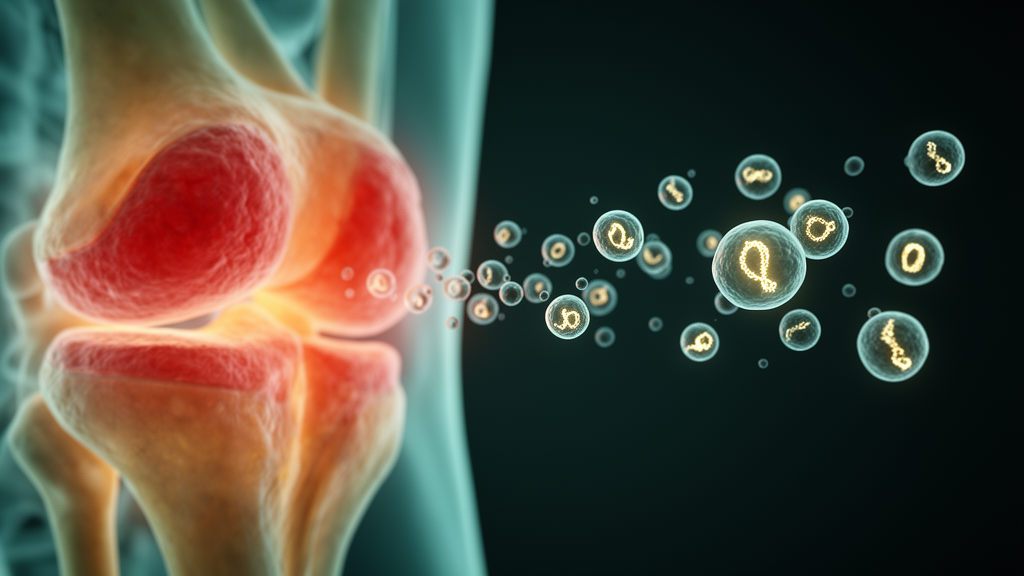
Rheumatoid arthritis has long been portrayed as a disease in which the immune system simply turns against the joints, but researchers are increasingly finding that the story is far more intricate. A new study published in Cancer Cell International suggests that tiny vesicles released by stem cells living inside the joint lining may actively feed the inflammatory fire, delivering a circular RNA molecule that appears to worsen the disease through a chain reaction involving innate immune receptors, neutrophil traps, and a powerful inflammatory messenger. The work, led by Rong Yang, Hui Tong, Yang Yang, and Xiaoyan Xu of Southeast University and Nanjing Medical University in China, adds a surprising twist to the reputation of mesenchymal stem cells, which are often celebrated for their calming, regenerative properties.
The vesicles at the center of the study are exosomes, nanometer-scale bubbles that cells release into their surroundings. Far from being inert packaging, exosomes carry a molecular cargo of proteins, lipids, and genetic material that can reprogram recipient cells. In this case, the researchers focused on synovial mesenchymal stem cells, a stem cell population residing in the synovial membrane that cushions and lines the joints. When these cells were stimulated with lipopolysaccharide, a bacterial molecule that mimics infection and provokes strong inflammatory responses, the exosomes they shed carried elevated levels of a circular RNA known as circRNF20. Circular RNAs are unusual genetic transcripts whose ends are joined together into a closed loop, making them remarkably resistant to degradation and allowing them to persist inside cells long after ordinary linear RNAs have been dismantled.
To characterize these vesicles, the team used electron microscopy to confirm their characteristic cup-shaped morphology and Western blotting to verify the presence of canonical exosomal marker proteins. With the vesicles authenticated, the researchers co-cultured them with fibroblast-like synoviocytes, the aggressive stromal cells of the joint lining that proliferate excessively in rheumatoid arthritis and contribute to the destruction of cartilage and bone. What they observed was striking: exosomes carrying circRNF20 increased both circRNF20 and toll-like receptor 4, or TLR4, expression inside the synoviocytes. TLR4 is a pattern-recognition receptor best known for detecting bacterial endotoxin, but in rheumatoid arthritis it has been implicated in sustaining chronic inflammation by trickling danger signals into the joint even when no pathogen is present.
The consequences did not stop at the synoviocytes. The study found that the exosome treatment also raised the levels of markers associated with neutrophil extracellular traps, the notorious webs of DNA studded with antimicrobial proteins that neutrophils cast into the extracellular space. Neutrophils normally use these traps to ensnare bacteria and fungi, but in autoimmune disease the traps can backfire, exposing the body’s own tissues to their toxic cargo and fueling autoimmunity. The researchers measured several markers of this process, including myeloperoxidase, citrullinated histone H3, and PAD4, the enzyme responsible for citrullinating histones and loosening chromatin so it can be released. All were elevated in neutrophils exposed to the circRNF20-laden exosomes, alongside increased production of interleukin-6, a cytokine that sits near the top of the inflammatory cascade and drives much of the tissue damage in rheumatoid arthritis.
To test whether circRNF20 was genuinely the driver of these effects rather than an innocent passenger, the researchers silenced it in the donor stem cells using a small interfering RNA. The results were telling. Exosomes harvested from circRNF20-depleted cells no longer provoked the same surge in TLR4 expression in synoviocytes, no longer ramped up the neutrophil trap markers, and no longer stimulated the same proliferative and inflammatory responses. In other words, removing the circular RNA from the vesicle cargo blunted much of the harmful signaling, pointing to circRNF20 as a functional component of the pathway rather than a byproduct of inflammation.
Digging deeper into the mechanism, the team turned to microRNA-921, a small regulatory RNA that circRNF20 is thought to interact with. Circular RNAs frequently act as molecular sponges, soaking up microRNAs that would otherwise restrain the expression of inflammatory genes. When the researchers overexpressed hsa-miR-921 in their human recipient-cell system, the increases in TLR4, the neutrophil trap markers, and interleukin-6 that the exosomes normally triggered were substantially reduced. This result supports a model in which circRNF20, once delivered into synoviocytes, mops up miR-921 and thereby lifts the brake that this microRNA would otherwise place on TLR4 signaling, allowing the inflammatory loop to spin faster.
The role of the neutrophil traps themselves was probed with an elegant intervention. When the researchers applied DNase I, an enzyme that chops up the DNA scaffolding of neutrophil extracellular traps, both TLR4 expression and interleukin-6 production declined. This finding supports the idea that the trap structures themselves contribute to sustaining the inflammatory signal, though the authors were careful to note that the experiment does not establish a complete feedback loop between the traps and TLR4. Even so, the observation aligns with a growing body of evidence that neutrophil extracellular traps act as amplifiers of autoimmunity in the rheumatoid joint, exposing citrullinated antigens that can stoke the production of the anti-citrullinated protein antibodies that are a hallmark of the disease.
Perhaps the most clinically resonant portion of the study came from experiments in living animals. The researchers established a collagen-induced arthritis model in rats, a widely used approximation of human rheumatoid arthritis in which immunization with collagen triggers autoimmune joint inflammation. When these animals received exosomes derived from synovial mesenchymal stem cells in which circRNF20 had been silenced, they showed reduced synovial inflammation and less histopathological damage to their joints compared with animals receiving the unsilenced vesicles. The result suggests that the circRNF20 cargo is not merely a laboratory curiosity but a contributor to tissue-level disease in a living system, and that intercepting it might one day ease the burden of joint destruction.
The findings complicate the prevailing enthusiasm for mesenchymal stem cell therapies in rheumatology. Stem cells from synovial tissue have been explored as a source of immunomodulatory treatment precisely because they reside in the affected tissue and are thought to secrete healing factors. Yet this study demonstrates that under inflammatory stimulation, the very same cells can package inflammatory instructions into their exosomes, essentially turning a potentially therapeutic cell type into a vehicle for disease amplification. Context, the research implies, may determine whether synovial mesenchymal stem cells soothe the joint or sabotage it, and any future cell-based therapy for rheumatoid arthritis may need to account for the genetic cargo that inflamed donor cells load into their vesicles.
For patients, the study remains at the level of cells and animal models, and no immediate treatment follows from it. But the pathway it maps out, from exosomal circRNF20 through miR-921 sponging, TLR4 activation, neutrophil trap formation, and interleukin-6 release, offers an unusually complete chain of molecular events connecting a single noncoding RNA to the tissue damage of autoimmune arthritis. Each link in that chain is now a potential point of intervention, whether through blocking exosome uptake, neutralizing circular RNAs, restoring microRNA function, disarming TLR4, or digesting neutrophil traps with enzymes like DNase I. As the molecular anatomy of rheumatoid arthritis becomes clearer, the disease that once seemed like a single misdirected immune response is revealing itself as a network of self-reinforcing loops, and this study has charted one more of them in detail.
Subject of Research: The role of synovial mesenchymal stem cell-derived exosomal circRNF20 in aggravating rheumatoid arthritis via the TLR4/NETs/IL-6 pathway
Article Title: Synovial mesenchymal stem cells derived exosomes circRNF20 aggravated rheumatoid arthritis via TLR4/NETs/IL-6 pathway
Article References: Yang, R., Tong, H., Yang, Y., & Xu, X. (2026). Synovial mesenchymal stem cells derived exosomes circRNF20 aggravated rheumatoid arthritis via TLR4/NETs/IL-6 pathway. Cancer Cell International. https://doi.org/10.1186/s12935-026-04477-y
Image Credits: AI Generated
DOI: 10.1186/s12935-026-04477-y
Keywords: rheumatoid arthritis, exosomes, circRNF20, synovial mesenchymal stem cells, TLR4, neutrophil extracellular traps, interleukin-6, microRNA-921, fibroblast-like synoviocytes, collagen-induced arthritis, inflammation, circular RNA
Cite Scienmag News
Drew Townsend. (October 15, 2026). Stem Cell Exosomes Carrying a Circular RNA May Worsen Rheumatoid Arthritis, Study Finds. Scienmag. https://scienmag.com/stem-cell-exosomes-carrying-a-circular-rna-may-worsen-rheumatoid-arthritis-study-finds/
Drew Townsend. "Stem Cell Exosomes Carrying a Circular RNA May Worsen Rheumatoid Arthritis, Study Finds." Scienmag, 15 October 2026, https://scienmag.com/stem-cell-exosomes-carrying-a-circular-rna-may-worsen-rheumatoid-arthritis-study-finds/. Accessed 15 October 2026.
Drew Townsend. "Stem Cell Exosomes Carrying a Circular RNA May Worsen Rheumatoid Arthritis, Study Finds." Scienmag. October 15, 2026. https://scienmag.com/stem-cell-exosomes-carrying-a-circular-rna-may-worsen-rheumatoid-arthritis-study-finds/


