


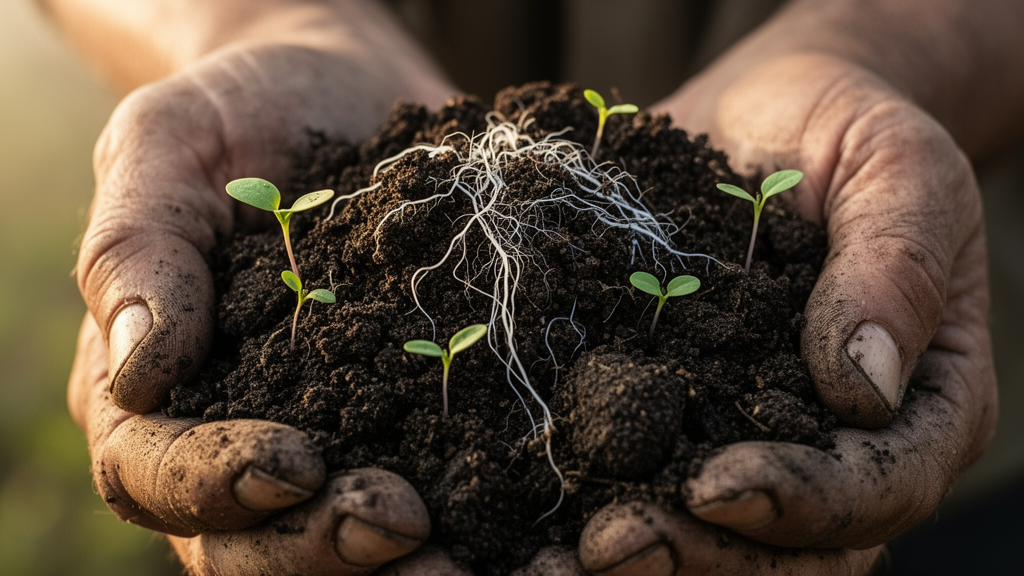
Beneath every agricultural field lies a bustling, invisible metropolis. Bacteria in the soil drive nutrient cycling, support plant health, and stabilize entire ecosystems, yet much of the research into these underground communities has remained stubbornly superficial. A recent editorial published in Frontiers in Bacteriology by Anil Raghavendra of the Elizabeth Macarthur Agricultural Institute in Australia and Samuel Bickel of Graz University of Technology in Austria argues that the field has reached an inflection point. After years of cataloguing which microbes live where, scientists are now beginning to explain how they work, and the difference could reshape the future of sustainable farming.
The editorial accompanies a special Research Topic in the journal collecting four studies that probe bacterial contributions to soil health at scales ranging from single genomes to entire farming landscapes. Together, they make a case that has been building in the microbiome literature for years: function, not diversity alone, is what determines whether a soil supports vigorous crops or merely hosts a long list of microbial names. The authors contend that many microbiome studies remain descriptive, focusing on cataloguing microbial diversity without elucidating the underlying mechanisms. Closing that gap, they argue, is essential if microbiome science is ever to deliver reliable tools for agriculture.
The first study in the collection offers a striking example of how much a single bacterial strain can accomplish. Researchers led by Zhang and colleagues isolated Stenotrophomonas rhizophila T3E from tomato rhizosphere soil, the narrow zone of soil directly influenced by plant roots. When they inoculated tomato plants with T3E, the effects rippled through both plant and soil. Root development improved markedly, the bacterium modulated plant hormones including indole-3-acetic acid and abscisic acid, antioxidant systems were strengthened, and multiple genes involved in root development were upregulated.
What makes this work technically notable is the breadth of evidence the researchers assembled. Beyond the plant responses, they documented changes in the soil environment itself: total nitrogen, total and available phosphorus, and available potassium all rose following inoculation. The activities of four soil enzymes, phosphatase, urease, catalase, and sucrase, were also significantly enhanced. These enzymes are workhorses of nutrient cycling and organic matter decomposition, so their elevation signals a genuine shift in soil biochemistry rather than a transient boost to one plant. By combining whole-genome sequencing with physiological and biochemical measurements, the team provided direct experimental backing for proposed mechanisms, moving beyond correlation into causation.
Phosphorus occupies a central place in this story because it remains one of the most persistent limits on global crop productivity. Most soil phosphorus exists in chemical forms that plants cannot access, and the standard remedy, overapplying phosphate fertilizers, carries steep environmental costs, from waterway eutrophication to the depletion of finite rock phosphate reserves. Shayanthan and colleagues attacked this problem by characterizing phosphate-solubilizing Paraburkholderia strains from agricultural soils and demonstrating their ability to enhance early soybean growth. These bacteria can unlock otherwise inaccessible phosphorus, potentially reducing dependence on synthetic fertilizers.
The genomic surprises in that study underline how little we still know about microbial metabolism in farm soils. When the researchers integrated plant growth-promotion assays with complete genome sequencing, they discovered a full Calvin-Benson-Bassham pathway, a carbon fixation route rarely associated with this bacterial taxon. Even more instructive was the substantial strain-level genomic and metabolic variation they uncovered within the genus. The lesson, the editorial authors stress, is that taxonomy alone rarely predicts function. Effective bioinoculants, they argue, should be locally adapted, identified at the strain level, and tested under realistic soil conditions rather than in generic laboratory media.
Scaling up from single strains, the collection includes a long-term field experiment by Cerecetto and colleagues in the Uruguayan Pampa that examined how farming system design shapes microbial communities. Spanning a gradient of land use intensities from continuous cropping to natural grassland, the study found that extended pasture phases sustain soil organic carbon, nitrogen pools, and microbial functional indicators. Intriguingly, microbial community composition, rather than alpha-diversity, the simple count of species present, emerged as the strong predictor of soil functionality and crop performance. Pasture-based systems preferentially enriched genera such as Streptomyces, Pseudomonas, Bacillus, and Microbacterium, many of which carry multiple plant-beneficial traits.
This work highlights a concept gaining traction in soil ecology: managed soil legacy, the long-lasting influence of past management on microbial community structure and function. Remarkably, the pasture-derived microbial legacy persisted years after the pasture was removed and continued to support subsequent crop performance. For mixed crop-livestock systems around the world, that finding suggests a practical strategy, rotating crops through pasture phases not just for the immediate nutrients they provide, but for the beneficial microbial communities they install and the resilience they leave behind.
The fourth study takes microbial engineering to its most ambitious level. Rigerte and colleagues constructed a drought-tolerant synthetic microbial community, dubbed DT-SynCom, to improve barley performance under water stress. Sixteen bacterial strains were isolated from barley rhizospheres exposed to simulated future climate conditions and selected on the basis of drought tolerance, rhizosphere enrichment, and plant growth-promoting characteristics. The resulting consortium, composed of Actinobacteria, Proteobacteria, and Firmicutes, reduced leaf wilting and improved barley performance under drought. Genome-resolved analyses combined with trait screening revealed complementary functional capacities distributed across the strains, including ACC deaminase activity, auxin biosynthesis, phosphate solubilisation, siderophore production, and osmoprotectant pathways. The design relied on ecological filters, selecting strains for environmental relevance and functional traits rather than arbitrary criteria, an approach the editorial authors single out as a model for bridging controlled experiments with field-relevant microbial selection.
Reading the four studies together, a consistent pattern emerges: bacterial contributions to soil health are stubbornly context dependent. Soil type, climate, cropping system, and management history all determine which microbial functions are expressed or suppressed. A strain that supercharges tomatoes in one field may do little in another, and a community assembled for Uruguayan pastures will not transfer cleanly to German barley fields. This context dependence argues strongly for locally sourced microbial strains over generalist inoculant mixes, and it explains why the editorial authors insist that genomic and phenotypic evidence must be integrated. Genome-resolved analyses reveal metabolic potential, what a bacterium could theoretically do, while realized function can only be determined through trait assays, plant responses, and soil measurements.
The gap between laboratory promise and field reliability remains the field’s central challenge, and the editorial does not shy away from it. Synthetic communities and single-strain inoculants alike must establish themselves and function within resident soil microbiomes, and benefits observed under controlled conditions often fail to translate to complex field environments. Regulatory frameworks for microbial biofertilizers continue to lag behind scientific advances in many jurisdictions, and questions of equitable access remain inadequately addressed. The authors point out that small-scale farmers, who stand to benefit most from reduced reliance on synthetic inputs, still face significant barriers to adoption and deserve greater attention from researchers and policymakers alike.
Looking ahead, the editorial lays out a research agenda. Long-term field trials and multi-environment experiments are essential to determine the persistence, robustness, and scalability of microbiome-mediated benefits under realistic conditions. Targeted exclusion and reassembly experiments within synthetic communities will help identify keystone taxa, quantify functional redundancy, and map the interaction networks that underpin system stability. And pasture-based rotations that sustain organic matter inputs and maintain microbial habitat continuity may help plants recruit beneficial microbiota and enhance overall system resilience.
The big picture emerging from this collection is that soil health is not a product of isolated microbes or short-term interventions, but of interacting traits, communities, and management legacies accumulated over years. A farmer’s decision to plant pasture today can echo through the microbial community for seasons afterward, quietly boosting the crops that follow. By championing function-driven, genome-informed, and ecologically contextualised research, the studies gathered here point toward a future in which the soil microbiome is treated not as an afterthought of agronomy, but as infrastructure, living infrastructure that, if managed wisely, could anchor sustainable and climate-resilient agriculture for decades to come.
Subject of Research: Bacterial contributions to soil health and plant microbiomes in sustainable agriculture
Article Title: Editorial: Bacteria’s role in soil health and microbiomes
Article References: Raghavendra, A., & Bickel, S. (2026). Editorial: Bacteria’s role in soil health and microbiomes. Frontiers in Bacteriology, 5, Article 1921131. https://doi.org/10.3389/fbrio.2026.1921131
Image Credits: AI Generated
DOI: 10.3389/fbrio.2026.1921131
Keywords: soil microbiome, bacteria, sustainable agriculture, synthetic microbial communities, phosphate solubilisation, soil legacy, plant growth-promoting rhizobacteria, drought tolerance, Stenotrophomonas rhizophila, Paraburkholderia, soil enzymes, crop resilience
Cite Scienmag News
Alan Morgan. (October 15, 2026). The Hidden Bacterial Networks That Could Rebuild Soil Health From the Ground Up. Scienmag. https://scienmag.com/the-hidden-bacterial-networks-that-could-rebuild-soil-health-from-the-ground-up/
Alan Morgan. "The Hidden Bacterial Networks That Could Rebuild Soil Health From the Ground Up." Scienmag, 15 October 2026, https://scienmag.com/the-hidden-bacterial-networks-that-could-rebuild-soil-health-from-the-ground-up/. Accessed 15 October 2026.
Alan Morgan. "The Hidden Bacterial Networks That Could Rebuild Soil Health From the Ground Up." Scienmag. October 15, 2026. https://scienmag.com/the-hidden-bacterial-networks-that-could-rebuild-soil-health-from-the-ground-up/


