


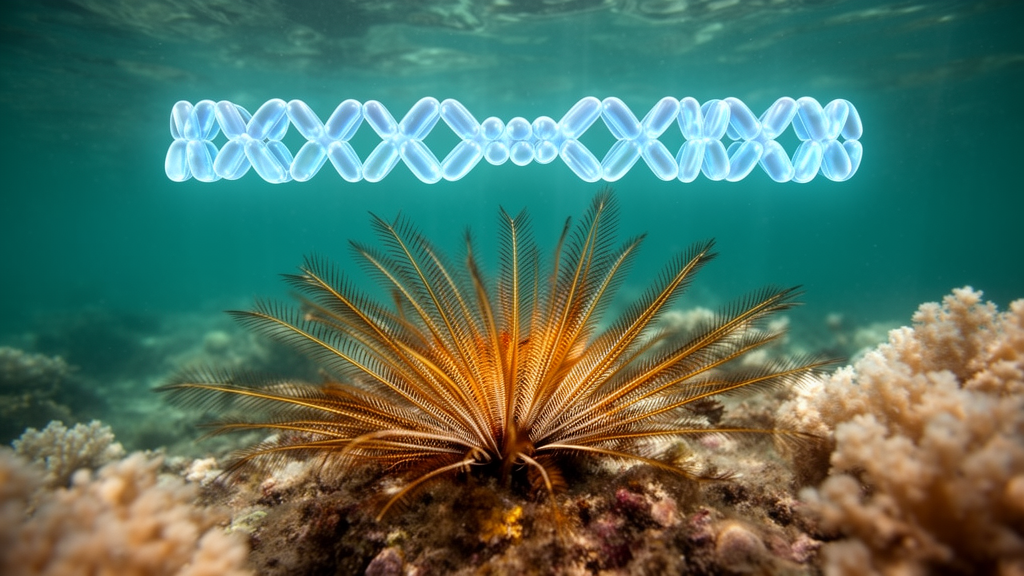
In the shallow, sun-blasted waters of the tropics, feather stars sway on delicate arms that look almost identical to fossils laid down hundreds of millions of years ago. Crinoids, the group to which these animals belong, are often described as living fossils: they have held on to ancient body plans since the early Ordovician period, changing little in morphology while entire dynasties of other marine animals rose and fell around them. Yet a new study, published in BMC Genomics, shows that beneath that conservative exterior, at least one feather star has been quietly rewriting its genome in ways never before seen in the echinoderm phylum.
A team led by Shao’e Sun, Min Hui, Jin Sun and Zhongli Sha has assembled the first near-telomere-to-telomere genome of the coral reef-dwelling feather star Cenometra bella, a crinoid that thrives in one of the most environmentally volatile habitats in the ocean. The genome spans 354.7 megabases organized into just 12 chromosomes, and it was built from long Pacific Biosciences HiFi reads scaffolded with Hi-C chromosome conformation capture data. The result is an assembly of remarkable quality: a contig N50 of 28.25 megabases, meaning half the genome resides in contiguous sequences longer than that, and a completeness score of 97.5 percent against the BUSCO set of universal single-copy genes. Using the Genome Continuity Inspector metric, the assembly achieved a GCI score of 75.0837, placing it well above all previously published crinoid genomes.
Telomere-to-telomere assemblies are the gold standard of genomics because they aim to read each chromosome end to end, resolving the repetitive telomeric caps, the dense centromeric cores, and everything in between. For crinoids, this level of resolution has been a long time coming. The group has historically lacked high-quality genomic resources, leaving a conspicuous gap in our understanding of how the earliest echinoderm lineages evolved at the DNA level. By precisely identifying the telomeric repeats and centromeric regions of C. bella, the researchers could anchor genes with confidence and highlight those sitting near these structurally critical regions. Many of these genes are involved in intracellular metabolism, signal transduction and the regulation of the nervous system, hinting that genomic architecture around centromeres and telomeres may carry functional significance beyond structural housekeeping.
The most striking finding, however, lies in how the 12 chromosomes of C. bella relate to the ancestral echinoderm blueprint. Earlier work on other echinoderms had inferred a set of 23 ancestral linkage groups, the hypothetical chromosome set from which modern sea stars, sea urchins, sea cucumbers and their relatives descend. Through macrosynteny analysis, a technique that tracks how blocks of genes stay together on chromosomes across hundreds of millions of years of evolution, the team uncovered nine chromosomal fusion events. Nine separate ancestral linkage groups had been stitched together in various combinations to compress the presumed 23 into the 12 chromosomes observed today. This is the highest degree of chromosomal fusion ever documented in an echinoderm, and the authors suggest it may represent a genuine evolutionary innovation within the phylum.
Fusions of this magnitude are not merely a curiosity of genome bookkeeping. When chromosomes merge, genes that were once regulated separately can come under shared chromosomal environments, and topological association domains, the self-interacting loops of chromatin that organize the genome inside the nucleus, can be rearranged. The researchers asked what kinds of genes ended up on the fused chromosomes and found a telling pattern: genes on these chromosomes were functionally enriched in attachment-related processes such as cell adhesion, energy metabolism, environmental sensing and immune response. For an animal that must anchor itself firmly to reef substrates while filtering food from moving water, and that must cope with the daily swings of a coral reef environment, that collection of functions reads almost like a survival toolkit.
Coral reefs are punishing places to live. Ultraviolet radiation near the surface can damage DNA and generate reactive oxygen species, temperatures can swing across a diurnal and seasonal range, and pathogens flourish in warm, nutrient-rich waters. The comparative genomic analysis of C. bella points to several molecular strategies that may underlie the species’ tolerance of these stresses. The team identified 28 expanded gene families, encompassing 455 genes, as well as 194 positively selected genes, detected through elevated ratios of non-synonymous to synonymous substitutions. The functions of these gene sets converge on three themes: lipid synthesis, DNA repair and membrane stability. Enhanced lipid production and membrane maintenance could help the animal keep its cell membranes fluid under thermal stress, while bolstered DNA repair machinery would counteract the mutational pressure of intense ultraviolet exposure in shallow reef waters.
What makes these findings conceptually important is the contrast they create with the traditional picture of crinoid evolution. Crinoids are famous for their exceptionally slow rates of morphological and molecular evolution, a conservatism so pronounced that they serve as a benchmark for studying evolutionary stasis. The C. bella genome does not overturn that reputation, but it complicates it. Stability in body form, it appears, does not preclude dramatic rearrangement of the genome itself. The nine fusion events show that while the animal’s arms, calyx and overall architecture have remained strikingly faithful to ancient designs, its chromosomes have undergone wholesale consolidation. Evolution, in other words, can be radical at one level of biological organization while remaining conservative at another.
Methodologically, the study also raises the bar for echinoderm genomics. Previous crinoid assemblies were fragmentary, leaving genes scattered across thousands of small scaffolds and making it difficult to study chromosome-scale evolution. The near-T2T assembly of C. bella, with its long contigs, resolved centromeres and identified telomeric repeats, provides the kind of reference genome against which other echinoderm genomes can be compared chromosome by chromosome. Because synteny is such a powerful lens for reconstructing deep evolutionary history, having a crinoid genome of this quality matters for the entire phylum: it helps clarify which chromosome-scale features are ancestral to all echinoderms and which, like the fusions seen here, are innovations of particular lineages.
The adaptive story remains, as the authors are careful to note, a suggestion rather than a demonstration. Expanded gene families and positively selected genes associated with lipid synthesis, DNA repair and membrane stability are consistent with life in a fluctuating reef environment, but confirming those roles will require functional work, perhaps gene expression studies across environmental gradients or experiments exposing the animals to controlled UV, thermal and pathogen challenges. Still, the correlation between the fused chromosomes and genes governing attachment, metabolism, sensing and immunity offers a compelling hypothesis: that genome restructuring itself may have been part of how this lineage carved out a niche in the dynamic coral reef ecosystem.
For a phylum that has survived four hundred and eighty million years of planetary upheaval, the feather star has now offered up one of its deepest secrets at the highest resolution yet achieved. Cenometra bella, swaying gracefully above the reef, carries in its 12 compact chromosomes a record of both extraordinary stability and extraordinary change. As telomere-to-telomere technology spreads through comparative genomics, more living fossils are likely to yield similar surprises, and the textbook image of crinoids as frozen in time may give way to something far more interesting: organisms whose outward stillness conceals genomes that have never stopped moving.
Subject of Research: Near-telomere-to-telomere genome assembly and chromosome evolution of the feather star Cenometra bella
Article Title: The near-T2T genome of the feather star Cenometra bella suggests potential evolutionary innovations and coral reef habitat tolerance
Article References: The near-T2T genome of the feather star Cenometra bella suggests potential evolutionary innovations and coral reef habitat tolerance. (n.d.). https://doi.org/10.1186/s12864-026-13458-4
Image Credits: AI Generated
DOI: 10.1186/s12864-026-13458-4
Keywords: crinoids, feather star, Cenometra bella, telomere-to-telomere genome, genome assembly, chromosome fusion, macrosynteny, echinoderm, coral reef, gene family expansion, positive selection, DNA repair
Cite Scienmag News
Juliet Wilcox. (October 15, 2026). Feather star’s near-complete genome reveals extreme chromosome fusion and coral reef survival tricks. Scienmag. https://scienmag.com/feather-stars-near-complete-genome-reveals-extreme-chromosome-fusion-and-coral-reef-survival-tricks/
Juliet Wilcox. "Feather star’s near-complete genome reveals extreme chromosome fusion and coral reef survival tricks." Scienmag, 15 October 2026, https://scienmag.com/feather-stars-near-complete-genome-reveals-extreme-chromosome-fusion-and-coral-reef-survival-tricks/. Accessed 15 October 2026.
Juliet Wilcox. "Feather star’s near-complete genome reveals extreme chromosome fusion and coral reef survival tricks." Scienmag. October 15, 2026. https://scienmag.com/feather-stars-near-complete-genome-reveals-extreme-chromosome-fusion-and-coral-reef-survival-tricks/


