


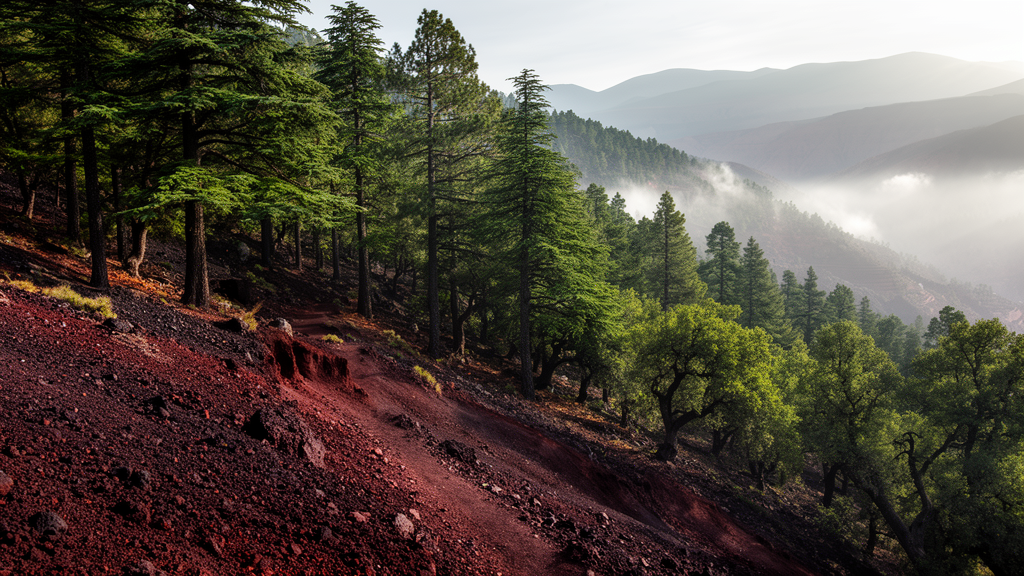
Beneath the cedar and oak forests of Morocco’s mountains lies an invisible carbon reservoir that may prove decisive in the race to slow climate change. A new comparative study of two of the country’s most important protected areas reveals that soil organic carbon stocks in Mediterranean mountain forests can differ by more than a factor of two between neighboring landscapes, and that the hidden architecture of the rocks beneath the trees may matter nearly as much as the trees themselves. The findings, published in Frontiers in Soil Science, carry immediate consequences for how carbon is counted, how forests are restored, and how conservation budgets are spent across the Mediterranean Basin.
The research team, led by Mohamed El Mderssa of Sultan Moulay Slimane University together with colleagues from the National School of Forest Engineering and Moulay Ismail University, compared Ifrane National Park in the Middle Atlas with Talassemtane National Park in the Rif Mountains. These two parks form a natural experiment: Ifrane’s forests grow on a patchwork of basaltic volcanic rock and dolomitic carbonate, while Talassemtane sits almost entirely on limestone. Because both parks harbor similar numbers of forest ecosystem types, any divergence in their soil carbon profiles points toward geology and ecological differentiation rather than simple species counts.
The researchers assembled a harmonized dataset of 67 field observations collected during the summer of 2022, drawing on 48 sampling points in Ifrane and 19 in Talassemtane. All measurements targeted the upper 30 centimeters of mineral soil, a depth consistent with Intergovernmental Panel on Climate Change reporting guidance and one that captures the biologically active horizon where litter inputs, root exudates and fine-root turnover concentrate. Carbon concentrations were determined by Walkley–Black wet oxidation, and stocks were calculated using bulk density measured with the core method, ensuring that both datasets could be compared on identical footing.
The headline result is striking. Mean soil organic carbon stock reached 173.99 tonnes of carbon per hectare in Ifrane, roughly two and a half times the 69.44 tonnes per hectare recorded in Talassemtane. Welch’s t-test confirmed the difference was highly significant. Just as telling was the spread: individual values in Ifrane ranged from 36.10 to 437.92 tonnes per hectare, with a coefficient of variation of nearly 54 percent, while Talassemtane’s values spanned only 44.64 to 107.74 tonnes per hectare with a variation coefficient of just over 22 percent. In ecological terms, the Middle Atlas landscape behaves like a mosaic of carbon banks of very different sizes, whereas the Rif landscape stores carbon more uniformly and, on average, far less of it.
Forest ecosystem type significantly shaped these patterns in both parks. In Ifrane, zeen oak forests topped the table with a mean of 251.54 tonnes of carbon per hectare, followed by holm oak at 219.62 and cedar at 169.47. Mixed cedar–holm oak and holm oak–zeen oak stands, along with maritime pine plantations, stored considerably less. In Talassemtane, Mediterranean matorral showed the highest mean at 101.41 tonnes per hectare, ahead of cork oak and the endemic Moroccan fir, though the authors caution that matorral and fir were each represented by only two observations, making those means indicative rather than statistically robust. The spread between ecosystem means, a simple measure of carbon differentiation, was 142.52 tonnes per hectare in Ifrane against just 41.72 in Talassemtane.
Geology emerged as the study’s most provocative variable. Within Ifrane, soils derived from basalt averaged 200.84 tonnes of carbon per hectare, about 37 percent more than the 147.14 tonnes on dolomite. A general linear model identified geological substrate as the strongest determinant of soil carbon variability once ecosystem type was adjusted for, and a linear mixed-effects model estimated that limestone soils in Talassemtane hold roughly 139 tonnes per hectare less carbon than basaltic ones. The mechanistic explanation lies in soil chemistry: basalt weathers into clay-rich soils packed with reactive iron and aluminum oxides that bind organic matter into stable organo-mineral associations, shielding it from microbial decomposition, whereas calcareous and dolomitic substrates tend to produce shallower, sandier soils with weaker mineral protection.
Yet the authors are refreshingly careful not to oversell this geology story. Because four of Ifrane’s six ecosystem types occur exclusively on a single substrate, ecosystem identity and rock type are heavily entangled in the data. The cleanest available test comes from cedar and holm oak forests, the only ecosystems sampled on both basalt and dolomite. Within each of these, the basalt–dolomite difference was not statistically significant, with P values of 0.680 and 0.143 respectively. The holm oak comparison did show a large numerical gap, 264.7 against 174.5 tonnes per hectare, but with only six replicates per group the test was likely underpowered. The team explicitly frames the substrate effect as suggestive rather than confirmed, an unusually candid position that highlights how difficult it is to separate vegetation from parent material in real landscapes, echoing the classic pedological framework of soil formation in which climate, organisms, relief, parent material and time act inseparably.
Perhaps the study’s most conceptually important contribution is its redefinition of biodiversity. Instead of counting tree species within plots, the researchers treated forest ecosystem diversity as the diversity and spatial heterogeneity of ecosystem types across the landscape, integrating differences in vegetation structure, litter chemistry, rooting depth and microclimate. Both parks showed nearly identical richness and evenness indices for their sampled ecosystems, yet their carbon behavior diverged dramatically. This suggests that for carbon accounting purposes, biodiversity should be read as landscape heterogeneity rather than species richness, since what drives soil carbon is the patchwork of contrasting ecological engines, not the number of names on a plant list.
The practical implications ripple outward from Moroccan park boundaries. Carbon inventories that prioritize aboveground biomass while treating soil as a uniform black box risk mispricing these landscapes: a holm oak forest on basalt in Ifrane may hold more than four times the soil carbon of a holm oak forest on limestone in Talassemtane, even though the vegetation looks broadly similar. The authors argue that pedological information, including substrate type and mineralogy, should be built into national carbon accounting and that basalt-derived oak forests deserve priority in restoration and protection schemes as disproportionately valuable carbon reservoirs. At the same time, they caution against dismissing limestone ecosystems as low value, since they deliver unique biodiversity and hydrological services that carbon metrics alone cannot capture.
The team also lays out its own limitations with unusual transparency: uneven sampling between parks, the near-perfect confounding of substrate and ecosystem within Ifrane, the absence of climate, topographic and mineralogical covariates, and a 30-centimeter sampling depth that may underestimate total profile carbon in deeper soils. Future work, they suggest, should employ balanced designs in which the same ecosystem types are sampled across multiple substrates, and should extend to remote sensing and digital soil mapping for spatial prediction. For now, the message stands: if the world wants Mediterranean mountain forests to keep banking carbon, it must learn to read the rocks as carefully as it reads the trees.
Subject of Research: Soil organic carbon storage in Mediterranean mountain forests as shaped by forest ecosystem diversity and geological substrate in Morocco
Article Title: Soil organic carbon storage across Mediterranean mountain forests: a comparative assessment of forest ecosystem diversity and geological substrate in Ifrane and Talassemtane National Parks, Morocco
Article References: El Mderssa, M., ELMALKI, M., Malki, F., Abdelhakim, T., Abbas, Y., & Ibijbijen, J. (2026). Soil organic carbon storage across Mediterranean mountain forests: a comparative assessment of forest ecosystem diversity and geological substrate in Ifrane and Talassemtane National Parks, Morocco. Frontiers in Soil Science, 6, Article 1959268. https://doi.org/10.3389/fsoil.2026.1959268
Image Credits: AI Generated
DOI: 10.3389/fsoil.2026.1959268
Keywords: soil organic carbon, Mediterranean forests, Morocco, Ifrane National Park, Talassemtane National Park, geological substrate, basalt, limestone, carbon sequestration, forest ecosystems, Middle Atlas, Rif Mountains
Cite Scienmag News
Violet Maxwell. (October 15, 2026). Volcanic Soils Turn Moroccan Atlas Forests into Carbon Hotspots. Scienmag. https://scienmag.com/volcanic-soils-turn-moroccan-atlas-forests-into-carbon-hotspots/
Violet Maxwell. "Volcanic Soils Turn Moroccan Atlas Forests into Carbon Hotspots." Scienmag, 15 October 2026, https://scienmag.com/volcanic-soils-turn-moroccan-atlas-forests-into-carbon-hotspots/. Accessed 15 October 2026.
Violet Maxwell. "Volcanic Soils Turn Moroccan Atlas Forests into Carbon Hotspots." Scienmag. October 15, 2026. https://scienmag.com/volcanic-soils-turn-moroccan-atlas-forests-into-carbon-hotspots/


