


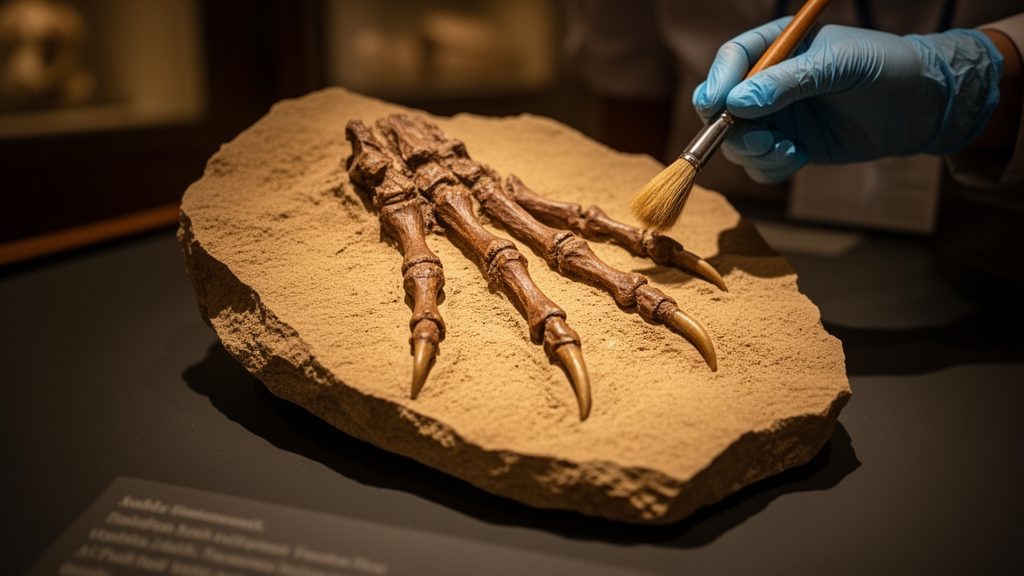
A remarkably complete fossilized foot from the Early Cretaceous rocks of western Liaoning, China, is rewriting what scientists know about the earliest days of one of the most bird-like dinosaur groups ever discovered. The specimen, catalogued as PMOL-AD00126 and housed at the Paleontological Museum of Liaoning, preserves a nearly entire left pes, the hind foot, of a caudipterid, an early-diverging member of Oviraptorosauria. Described in a new study published in the Swiss Journal of Palaeontology, the find combines cutting-edge computed tomography with bone microstructure analysis to unlock anatomical details that slabs of stone had hidden for more than 120 million years.
Oviraptorosaurs are among the most intriguing of all non-avian theropod dinosaurs. Fossils from this group, known chiefly from the Cretaceous of Asia and North America, display a startling array of bird-like features: pennaceous feathers, a pygostyle-like tail structure, and even evidence of brooding behavior atop their nests. These similarities make oviraptorosaurs pivotal to understanding the dinosaur-bird transition. Yet the earliest chapters of their evolutionary story are known almost exclusively from the celebrated Jehol Biota of western Liaoning, where seven species across six genera of early-diverging oviraptorosaurs have been unearthed. Four of these, Caudipteryx zoui, Caudipteryx dongi, Similicaudipteryx yixianensis and Xingtianosaurus ganqi, belong to the family Caudipteridae.
The problem has always been preservation. Most Jehol oviraptorosaur fossils are flattened in slabs, a mode of burial that obscures or distorts precisely the features paleontologists most want to study, such as the three-dimensional arrangement of the metatarsals in the foot. Compounding this gap, bone histology research on oviraptorosaurs has focused overwhelmingly on their more derived relatives, the caenagnathids and oviraptorids, leaving early-diverging taxa nearly unexamined. Before this study, histological data for Jehol oviraptorosaurs came only from limited descriptions of a Caudipteryx zoui femur and a Similicaudipteryx fibula. The new specimen directly addresses both shortcomings at once.
To reveal what the compressed fossil concealed, the team scanned PMOL-AD00126 with a GE Phoenix v|tome|x micro-CT scanner at the Institute of Vertebrate Paleontology and Paleoanthropology in Beijing, operating at 180 kV and 130 microamperes and achieving a resolution of roughly 58.5 micrometers per pixel. Individual bones were then segmented slice by slice in commercial software and rendered as three-dimensional models, with data deposited openly in ScienceDB. The terminal phalanges of digits two through four were missing, but their impressions survived in the matrix, and epoxy-resin casts prepared by earlier preparators allowed the team to reconstruct the phalangeal formula as 2-3-4-5, the standard count for the group.
The three-dimensional reconstruction exposed a suite of features never before documented in a caudipterid. Most striking is the metatarsus itself: metatarsal III is strongly pinched along its shaft, yet its proximal end remains fully exposed on the front of the foot, producing what paleontologists call a subarctometatarsalian condition. This is the first unambiguous evidence of such an arrangement anywhere in Oviraptorosauria. The arctometatarsus, in which the central metatarsal is tightly clamped between its neighbors, is interpreted as a mechanically reinforced structure adapted for fast, terrestrial running, so the discovery hints that some early oviraptorosaurs were evolving toward enhanced cursorial ability, while later members of the group took locomotor evolution in more complex directions.
Other novelties abound. Metatarsal I carries pronounced dorsal and plantar prominences on its mid-shaft, structures comparable to those seen in the caenagnathids Chirostenotes and Anzu but absent in dromaeosaurids and troodontids. Metatarsals II and III bear distinct longitudinal ridges on their plantar surfaces, a feature previously recorded only in caenagnathids among coelurosaurs with an arctometatarsus. Metatarsal III also shows an elongated depression running from its dorsal mid-shaft toward the distal end, likely the insertion site of the muscle that extends the third digit, and every preserved distal phalanx displays well-developed extensor ligament pits. Together these characters paint a far richer picture of the caudipterid foot than flattened slabs ever allowed.
Taxonomically, no single feature stamps the specimen as a caudipterid, but the overall combination fits the family closely. The length ratio of metatarsal I to metatarsal II is 0.19, near Similicaudipteryx at 0.17 and well below derived oviraptorids such as Khaan at 0.26 and Ganzhousaurus at 0.29. The ratio of phalanx III-1 to metatarsal III length falls at 0.25, squarely within the caudipterid range of 0.21 to 0.30, and the proximal end of metatarsal I attaches near the distal third of metatarsal II, echoing Similicaudipteryx. The metatarsals and distal tarsals are unfused, ruling out affinities with Avimimus, Yuanyanglong and some caenagnathids, in which these elements fuse in adults. The authors therefore refer the specimen provisionally to Caudipteridae while stopping short of naming a new species.
The histological half of the study is equally revealing. Because metatarsal II alone retains an intact diaphyseal wall through its mid-distal portion, the researchers sectioned it transversely, embedding the sample in resin and grinding it to optical quality for examination under normal and polarized light. The cortex reaches a maximum thickness of about 1.6 millimeters dorsally and is lined by a thin layer of endosteal bone, indicating that expansion of the medullary cavity was largely complete. The vascular canals run predominantly lengthwise along the bone, secondary osteons are scarce, and the matrix组织 more closely resembles crossed parallel-fibered bone than either fibrolamellar or typical parallel-fibered tissue.
Crucially, the section records two single lines of arrested growth, annual pauses in bone deposition, with a double line between them. Spacing between these lines narrows toward the outer surface and vascular density declines, both signs of slowing growth. Yet the outermost cortex lacks an external fundamental system, the dense bony signal of full skeletal maturity, and retains abundant vascularity. The individual, in other words, was still growing when it died. This matters because the foot, at 216.4 millimeters in total length, exceeds that of most known caudipterid specimens yet falls far short of Similicaudipteryx, and the authors explicitly caution against assigning the specimen to any named species on size alone while the maturity of comparative fossils remains unknown.
The implications reach well beyond one fossil. Many diagnostic traits of Jehol oviraptorosaur species rest on skeletal proportions that may shift with growth, so pairing fine-grained anatomy with osteohistology offers a way to test whether named species truly differ or simply represent different life stages. The subarctometatarsalian foot, meanwhile, slots into a broader evolutionary spectrum stretching from the plesiomorphic metatarsus of Protarchaeopteryx and most oviraptorids to the fully arctometatarsalian condition of Avimimus and most caenagnathids, suggesting that running adaptations evolved repeatedly and unevenly across the group. As open CT data and thin sections circulate, this single 120-million-year-old foot promises to keep informing studies of gait, digit extension, foot stabilization and postural control in some of the most bird-like dinosaurs that ever walked the Earth.
Subject of Research: Pedal anatomy and bone histology of an early Cretaceous caudipterid oviraptorosaur from the Jehol Biota
Article Title: A near-complete caudipterid pes from the Early Cretaceous Jehol Biota reveals insights into pedal anatomy and osteohistology of early oviraptorosaurs
Article References: Han, M., Duan, M., Song, J., Hao, M., Liu, Y., Shao, S., Kubo, K., Li, Y., Wu, Q., Rummy, P., & Wang, S. (2026). A near-complete caudipterid pes from the Early Cretaceous Jehol Biota reveals insights into pedal anatomy and osteohistology of early oviraptorosaurs. Swiss Journal of Palaeontology, 145, 943-956. https://doi.org/10.3897/sjp.145.207461
Image Credits: AI Generated
Keywords: oviraptorosaur, Caudipteridae, Jehol Biota, Early Cretaceous, paleontology, osteohistology, arctometatarsus, metatarsal, Liaoning, dinosaur evolution, CT scanning, growth lines
Cite Scienmag News
Gavin Prescott. (October 15, 2026). Exquisitely Preserved Dinosaur Foot From China Reveals Secrets of Early Oviraptorosaur Evolution. Scienmag. https://scienmag.com/exquisitely-preserved-dinosaur-foot-from-china-reveals-secrets-of-early-oviraptorosaur-evolution/
Gavin Prescott. "Exquisitely Preserved Dinosaur Foot From China Reveals Secrets of Early Oviraptorosaur Evolution." Scienmag, 15 October 2026, https://scienmag.com/exquisitely-preserved-dinosaur-foot-from-china-reveals-secrets-of-early-oviraptorosaur-evolution/. Accessed 15 October 2026.
Gavin Prescott. "Exquisitely Preserved Dinosaur Foot From China Reveals Secrets of Early Oviraptorosaur Evolution." Scienmag. October 15, 2026. https://scienmag.com/exquisitely-preserved-dinosaur-foot-from-china-reveals-secrets-of-early-oviraptorosaur-evolution/


