


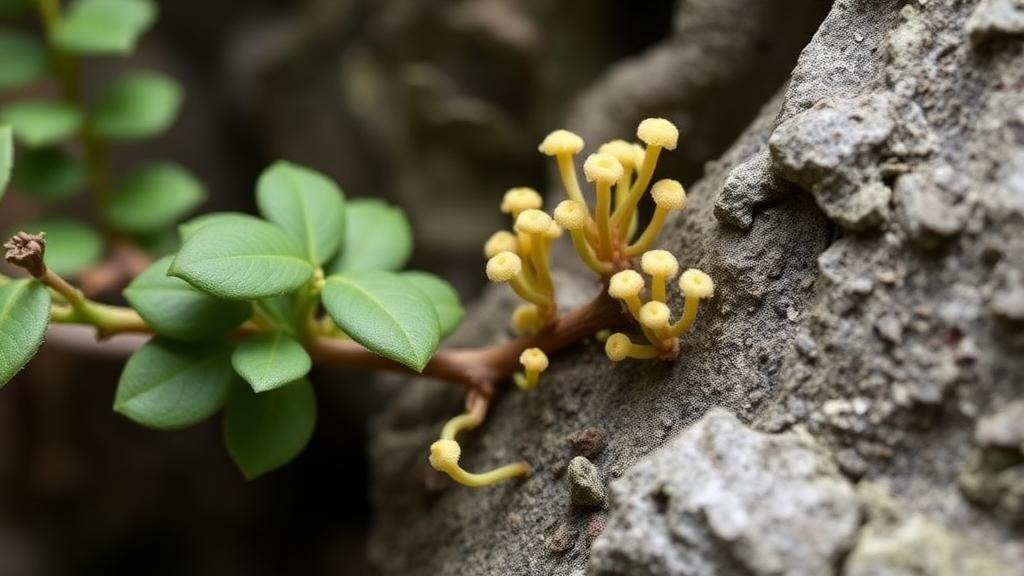
Deep in the limestone karst hills of southern China, a climbing shrub with golden-yellow flowers has been hiding in plain sight for decades. Botanists conducting a long-term revision of the genus Mussaenda have confirmed that populations long filed away in herbarium cabinets under another species’ name actually belong to an entirely new species, now formally described as Mussaenda saxatilis in the journal PhytoKeys. The name saxatilis, meaning rock-dwelling, is a direct nod to the plant’s strict confinement to the rugged limestone formations of Guangxi, one of the world’s most spectacular and biologically distinctive karst landscapes.
Mussaenda is the largest genus in the tribe Mussaendeae of the coffee family, Rubiaceae, encompassing roughly 135 species distributed across Africa and Asia, with Asia serving as the center of its diversity. Around 30 species have been recorded in China. The genus is instantly recognizable to anyone who has seen ornamental Mussaendas in tropical gardens: several species produce enlarged, petal-like structures called calycophylls, which are modified sepals that mimic petals and attract pollinators to the true flowers. Species such as M. erythrophylla and M. philippica are widely cultivated for horticulture, while others, including M. pubescens and M. erosa, serve as traditional herbal medicines. Growth forms range from small trees and shrubs to twining climbers, typically found at the edges of secondary forests.
The road to the new species’ recognition began in the herbarium, not the field. While sorting specimens collected from Guangxi for a comprehensive taxonomic revision, researchers encountered several individuals that looked subtly but persistently different from every previously known Mussaenda species. Some of these specimens had been labeled as M. hainanensis, a close relative from the region. Morphologically distinguishable from all known species yet most similar to that Hainan relative, the specimens demanded closer scrutiny. Extensive field investigations of flowering and fruiting plants, carried out during multiple surveys between August 2024 and May 2026, ultimately confirmed that the puzzling plant represented a species new to science.
The methodology behind the discovery combined classical botany with modern digital tools. Living plants were observed and measured directly in the field, and voucher specimens were deposited at the herbarium of the South China Botanical Garden. Digitized specimen images from online herbarium databases, including JSTOR Global Plants, the Chinese Virtual Herbarium, and the National Specimen Information Infrastructure, were quantified using the image-analysis software Fiji. Specimens from eight herbaria in China and the United States were examined to establish the full range of morphological variation and to distinguish the new species from its relatives. The holotype was collected in Longzhou County, Chongzuo City, at an elevation of 357 meters, in forest growing on limestone.
The technical diagnosis rests on a suite of stable characters that consistently separate M. saxatilis from M. hainanensis. Perhaps the most distinctive feature lies in the stipules, the small appendages at the base of each leaf. In the new species, stipules are lanceolate to triangular and only shallowly bifid or cleft to the middle, whereas M. hainanensis typically bears stipules that are entire or deeply two-lobed. The inflorescences of the new species are subsessile, with peduncles a mere 2 to 6 millimeters long, compared with the 1 to 3 centimeter peduncles of its relative. The corolla lobes are rotundate-ovate rather than triangular-ovate, and the white calycophylls are smaller, with blades of 1.0 to 2.0 centimeters supported on stipes of only 3 to 5 millimeters, against blades up to 4 centimeters on stipes reaching 16 millimeters in M. hainanensis.
The fruits provide perhaps the clearest separation of all. Berries of M. saxatilis are globose to subglobose, measuring 4 to 6 by 5 to 8 millimeters, with a pericarp entirely lacking lenticels, the small corky pores that dot the surfaces of many fruits. By contrast, M. hainanensis produces much larger, ellipsoid berries of 18 to 20 by 11 to 12 millimeters that are densely lenticellate. Leaf characteristics add further support: the new species has ovate to elliptic-oblong blades 1.5 to 9.5 centimeters long with 6 to 8 pairs of secondary veins and sparse velutinous to hirtellous hair cover on the lower surface, whereas its relative bears larger, denser-veined leaves clothed in villous or tomentulose pubescence. These differences hold across all examined populations, indicating a stable, independently evolving lineage.
The new species is a climbing shrub with terete, ferruginous-pubescent branches and paper-textured leaves that are dark green and sparsely strigillose above. Its flowers are salverform, yellow to orange-yellow, and densely strigose outside the corolla tube, which measures 20 to 33 millimeters depending on floral morph. Like many Rubiaceae, the species is heterostylous, producing both short-styled and long-styled flowers in which the relative positions of stamens and stigmas differ, an architectural arrangement that promotes cross-pollination. In each inflorescence, one or a few flowers bear an expanded calyx lobe transformed into the showy calycophyll. Flowering runs from April to June, followed by fruiting from June to November. Locally, the plant carries the Chinese name shí shān yù yè jīn huā, evoking its rock-mountain home and golden flowers.
Currently, M. saxatilis is known only from southern Guangxi, where roughly eight populations have been documented, all restricted to forested limestone karst at elevations of 150 to 900 meters. Karst ecosystems, formed by the dissolution of soluble bedrock into towers, cliffs, and caves, are famously fragmented and harbor exceptional rates of plant endemism, yet they are among the most vulnerable habitats to human disturbance. The researchers assessed the species as Data Deficient under IUCN criteria, because quantitative data on population size and trends are lacking, and its possible occurrence in adjacent northern Vietnam remains uncertain. However, the combination of strict habitat specificity, restricted range, and fragmented karst forests means future surveys could well justify a threatened category. The team strongly recommends continued fieldwork.
What makes the discovery particularly striking is how long the species evaded detection. Multiple herbarium specimens, some collected as far back as 1979 by survey teams in the Nonggang region, had been misidentified as M. hainanensis, including several catalogued at major Chinese herbaria. This long history of misclassification underscores a persistent problem in tropical Asian botany: without careful revision of existing collections, genuinely distinct species can remain invisible, their ecological significance hidden behind outdated labels. Herbaria, far from being dusty archives, are in this sense frontier landscapes in their own right, and revisiting them with fresh eyes continues to reshape our understanding of plant diversity.
The description of M. saxatilis carries implications well beyond one species. Together with recent taxonomic advances in Mussaenda across Asia, it highlights the ongoing underestimation of species richness in southern China and the pressing need for both field exploration and herbarium revision in karst regions. As ornamental favorites and medicinal plants, Mussaendas already connect tropical botany to everyday life, and the new rock-dwelling climber reminds us that even in a genus familiar to gardeners worldwide, nature still keeps surprises tucked into crumbling limestone. For the flora of Guangxi, the golden flowers of shí shān yù yè jīn huā now have a name, and the karst hills hold one more documented treasure worth protecting.
Subject of Research: Taxonomic description of a new limestone karst plant species, Mussaenda saxatilis (Rubiaceae), from Guangxi, China
Article Title: Mussaenda saxatilis ( Rubiaceae ), a new limestone species from Guangxi, China
Article References: Li, J., Wei, X.-Y., & Duan, T.-T. (2026). Mussaenda saxatilis (Rubiaceae), a new limestone species from Guangxi, China. PhytoKeys, 280, 105-111. https://doi.org/10.3897/phytokeys.280.207010
Image Credits: AI Generated
DOI: 10.3897/phytokeys.280.207010
Keywords: Mussaenda saxatilis, Rubiaceae, new species, Guangxi, limestone karst, taxonomy, Mussaenda hainanensis, China, plant diversity, herbarium, karst endemism, PhytoKeys
Cite Scienmag News
Gavin Prescott. (October 15, 2026). Hidden Karst Climber: Botanists Unveil New Mussaenda Species from Guangxi’s Limestone Hills. Scienmag. https://scienmag.com/hidden-karst-climber-botanists-unveil-new-mussaenda-species-from-guangxis-limestone-hills/
Gavin Prescott. "Hidden Karst Climber: Botanists Unveil New Mussaenda Species from Guangxi’s Limestone Hills." Scienmag, 15 October 2026, https://scienmag.com/hidden-karst-climber-botanists-unveil-new-mussaenda-species-from-guangxis-limestone-hills/. Accessed 15 October 2026.
Gavin Prescott. "Hidden Karst Climber: Botanists Unveil New Mussaenda Species from Guangxi’s Limestone Hills." Scienmag. October 15, 2026. https://scienmag.com/hidden-karst-climber-botanists-unveil-new-mussaenda-species-from-guangxis-limestone-hills/


