


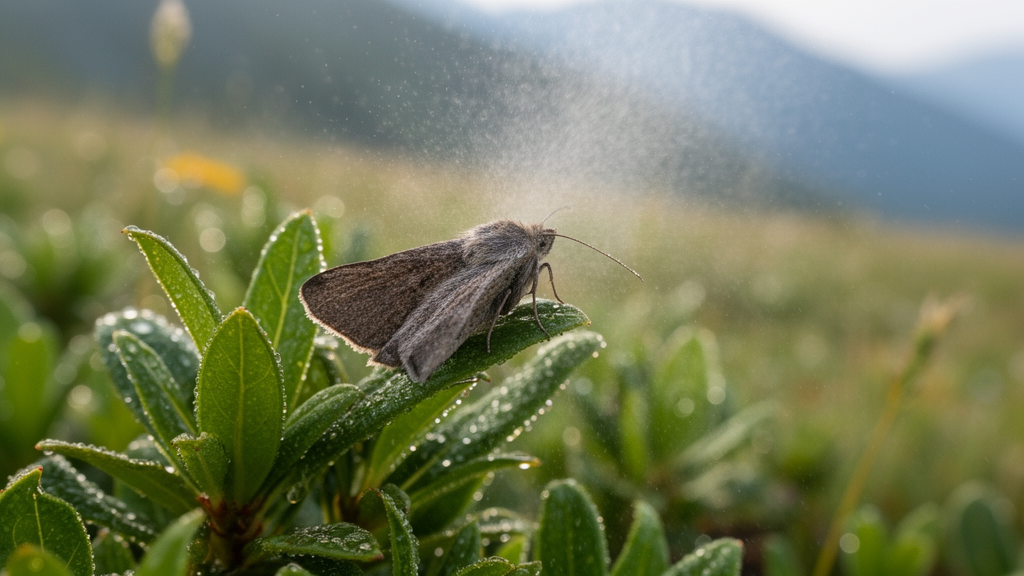
The diamondback moth, Plutella xylostella, is arguably the world’s most stubborn vegetable pest. A small, highly migratory lepidopteran that feeds almost exclusively on cruciferous crops such as cabbage, it has been chewing through harvests on every continent for decades, and its talent for evolving resistance is legendary. Since resistance to DDT was first documented in 1950, the moth has overcome nearly one hundred insecticides spanning organophosphates, amidinourea derivatives, oxadiazines and more. In China, resistance has been reported for more than ninety percent of the insecticides used against it, often accompanied by cross-resistance that renders entire chemical classes unreliable. Against this backdrop, a team of Chinese and Bahamian researchers has now taken a fresh look at an old idea: turning plants themselves into weapons. Their study, published in Acta Biochimica Polonica, screened ethanol extracts of fifteen plant species from the Qinling Mountains and advanced the two most promising candidates all the way into a field-ready formulation.
The research began with a systematic bioprospecting exercise. Fifteen species were selected from the Qinling Mountains on the basis of local abundance and regional representativeness, ranging from familiar solanaceous herbs to Allium species, legumes and Asteraceae shrubs. Plant material was rinsed, air-dried, oven-dried at 45 degrees Celsius, ground and sieved before being extracted with ninety-five percent ethanol at a solid-to-liquid ratio of one to four for forty-eight hours, with the process repeated twice on the residue. The combined filtrates were concentrated on a rotary evaporator to yield crude extracts, which were then dissolved into stock solutions and diluted to test concentrations. This simple but rigorous pipeline allowed the team to compare all fifteen species on an equal footing before committing resources to any single candidate.
Laboratory bioassays were built around three complementary measures of pest suppression: direct larvicidal toxicity, antifeedant activity and oviposition repellency. For the toxicity screen, five-centimeter cabbage leaf discs were dipped in each extract at fifty milligrams per milliliter, air-dried, and offered to twenty starved third-instar larvae per dish, with mortality scored at twenty-four, forty-eight and seventy-two hours. The results revealed striking interspecific differences and a clear time-dependent pattern. At twenty-four hours, Atropa belladonna extract already led the field with a corrected mortality of 58.87 percent, well ahead of Asparagus dauricus, Allium ochotense, Tupistra wattii and Blumea riparia var. megacephala. By seventy-two hours, A. belladonna had reached 83.11 percent, the only extract to break the eighty percent barrier, while B. riparia var. megacephala climbed to 73.53 percent. Ten of the fifteen extracts never exceeded fifty percent mortality, and Solanum nigrum was barely distinguishable from the ethanol control.
The behavioral assays told an equally compelling story. In the leaf-disc antifeedant test, smaller treated and untreated discs were offered to larvae, and consumed leaf area was measured after forty-eight hours. B. riparia var. megacephala and A. belladonna again dominated, with antifeedant rates of 87.45 and 89.46 percent respectively, meaning larvae ate only a small fraction of the foliage consumed by untreated controls. Extracts of A. ochotense, A. dauricus and Bauhinia championi also held rates above eighty percent, while several others faded over time. The oviposition assay extended the effect beyond feeding: potted Chinese cabbage plants sprayed with extract and caged with twenty adult moths received far fewer eggs than ethanol-treated controls. B. riparia var. megacephala reduced egg-laying by 82.14 percent, leaving just 1.25 eggs per plant, and A. belladonna achieved 78.57 percent repellency. Together, the data suggested these two plants attack the moth at multiple points in its life cycle.
With two standouts identified, the researchers asked whether combining them would improve performance. Eleven treatments were prepared in a volumetric series spanning pure A. belladonna to pure B. riparia var. megacephala, and the median lethal concentration of each was determined by probit analysis. Alone, A. belladonna showed an LC50 of 76.69 milligrams per milliliter against the more toxic B. riparia var. megacephala at 95.53. The critical result came from the eight-to-two mixture, which lowered the LC50 to 65.76 milligrams per milliliter, better than either single extract. Using the co-toxicity coefficient framework of Chinese pesticide standards, where values at or above 120 indicate synergism, at or below 80 indicate antagonism and values between indicate additivity, the eight-to-two blend scored 110. The authors are careful to call this an additive effect rather than true synergism, but the absence of any antagonistic combination, even at ratios where the weaker extract dominated, is a meaningful signal that the two extracts are chemically compatible partners.
Why might these particular plants be so potent? The team draws on phytochemical literature to build plausible, though deliberately tentative, mechanistic hypotheses. Atropa belladonna, the infamous deadly nightshade, is rich in tropane alkaloids including hyoscyamine, scopolamine and norhyoscyamine, compounds known to interact with insect muscarinic acetylcholine receptors and thereby disrupt cholinergic signaling and neural transmission. Blumea species, by contrast, produce sesquiterpene-rich volatile oils and diverse flavonoids, compound classes associated elsewhere with feeding deterrence, digestive enzyme inhibition and interference with detoxification enzymes. Allium ochotense owes its activity, if the pattern holds, to sulfur-containing compounds and steroidal saponins that can induce oxidative stress and permeate cell membranes. Because the study did not perform chemical profiling of the extracts, these explanations remain literature-supported hypotheses rather than demonstrated mechanisms, and the authors are explicit about that limitation.
Translating laboratory promise into a sprayable product required formulation chemistry. The combined eight-to-two extract was tested against four organic solvents, and ethanol was chosen over dimethyl sulfoxide and methanol for its lower toxicity and favorable stability, while petroleum ether failed solubility requirements outright. Four surfactant systems were then screened. Formulations containing pesticide emulsifier 500# combined with NP-2 remained homogeneous and transparent through high-temperature storage at 54 degrees Celsius for fourteen days, low-temperature storage near freezing for a week, and dilution testing, whereas OP-10 and emulsifier 601# showed precipitation under stress. Concentration optimization settled on five percent emulsifier 500# and eight percent NP-2. The final emulsifiable concentrate contained ten percent active ingredients, seventy-seven percent ethanol and the two emulsifiers, and it passed the physicochemical stability benchmarks, though the authors caution that these accelerated tests are not a substitute for a full shelf-life evaluation.
The decisive test came in the field. In a randomized complete block trial on cruciferous vegetables in Jingyang County, the ten percent botanical formulation diluted one hundred times was compared with emamectin benzoate, a widely used macrocyclic lactone insecticide, and a water-sprayed control across twelve plots. The pattern of action differed sharply between treatments. Emamectin benzoate, which paralyzes insects by acting on glutamate-gated chloride channels, showed faster knockdown in the first day. The botanical spray started slowly, delivering only 10.86 percent control at day one, but its performance climbed steadily as its toxic, antifeedant and reproductive effects accumulated. By seven days after application, the botanical formulation had achieved 58.35 percent control, statistically indistinguishable from the 60.58 percent achieved by emamectin benzoate. Meanwhile, the untreated plots saw larval populations surge by more than thirty percent, underscoring how much pressure the pest exerts when left alone.
The researchers and outside observers alike stress that 58.35 percent is moderate efficacy, not commercial-grade knockout, and the trial covered a single site and one growing season. But the trajectory is what makes the study noteworthy: a crude plant combination, formulated without synthetic active ingredients, matching a leading chemical insecticide within a week of application suggests genuine development potential rather than a laboratory curiosity. The authors outline the road ahead with commendable candor. Chemical profiling by LC-MS or GC-MS and bioassay-guided fractionation are needed to identify the actual active constituents. Safety evaluation is not optional, because natural origin does not equal safety: A. belladonna’s tropane alkaloids can pose risks to humans, livestock and beneficial insects at sufficient exposure, so mammalian toxicity, non-target effects, residues and environmental fate all require dedicated study. Resistance management potential, multi-location trials and dosage optimization round out the agenda. If those hurdles are cleared, the Qinling Mountains may have supplied an unlikely gift to cabbage growers worldwide: a plant-based spray that the diamondback moth has not yet learned to beat.
Subject of Research: Botanical insecticide screening and field evaluation against the diamondback moth Plutella xylostella
Article Title: Bioactivity screening of plant ethanol extracts against Plutella xylostella and field evaluation of an optimized botanical combination formulation
Article References: Bioactivity screening of plant ethanol extracts against Plutella xylostella and field evaluation of an optimized botanical combination formulation. (n.d.). https://doi.org/10.3389/abp.2026.16918
Image Credits: AI Generated
Keywords: Plutella xylostella, diamondback moth, botanical insecticide, Atropa belladonna, Blumea riparia, plant extracts, antifeedant activity, insecticide resistance, emulsifiable concentrate, integrated pest management, field trial, cruciferous vegetables
Cite Scienmag News
Alan Morgan. (October 15, 2026). Deadly Moth Meets Its Match in Mountain Plants as Botanical Spray Rivals Top Insecticide. Scienmag. https://scienmag.com/deadly-moth-meets-its-match-in-mountain-plants-as-botanical-spray-rivals-top-insecticide/
Alan Morgan. "Deadly Moth Meets Its Match in Mountain Plants as Botanical Spray Rivals Top Insecticide." Scienmag, 15 October 2026, https://scienmag.com/deadly-moth-meets-its-match-in-mountain-plants-as-botanical-spray-rivals-top-insecticide/. Accessed 15 October 2026.
Alan Morgan. "Deadly Moth Meets Its Match in Mountain Plants as Botanical Spray Rivals Top Insecticide." Scienmag. October 15, 2026. https://scienmag.com/deadly-moth-meets-its-match-in-mountain-plants-as-botanical-spray-rivals-top-insecticide/


