


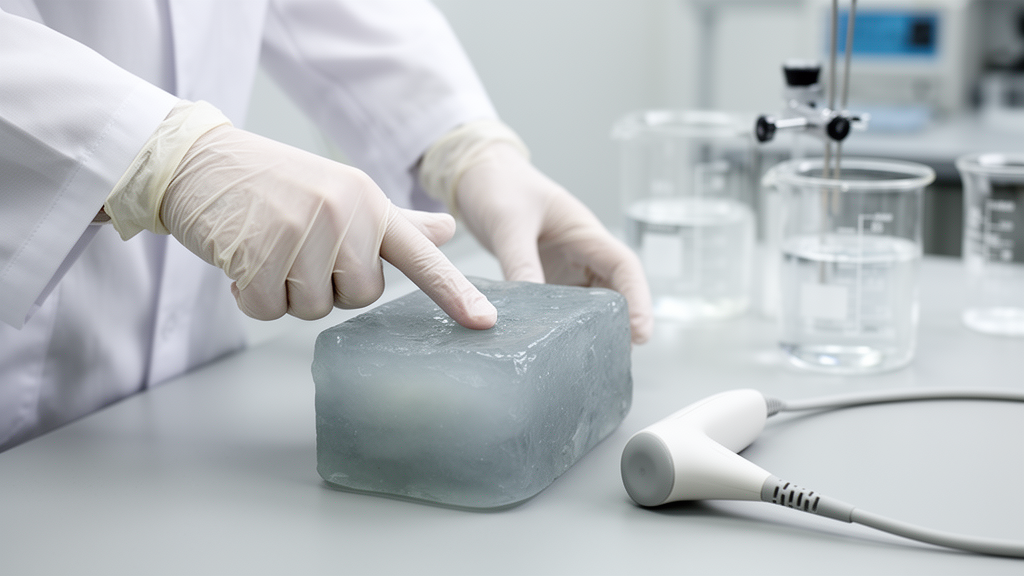
Every ultrasound machine that helps a doctor diagnose a stiff liver or a suspicious breast lesion has to be tested against something, and that something is usually a phantom, a laboratory-made block of material engineered to behave like living tissue. The problem is that making a good fake tissue is harder than it sounds. Researchers at the Indian Institute of Technology Gandhinagar have now shown that two of the most common additives used in polyvinyl alcohol (PVA) phantoms do far more than the jobs they were hired for, silently changing the very stiffness measurements that elastography machines are supposed to be calibrated against. The work, published in Frontiers in Acoustics, could reshape how laboratories around the world build their quality-control materials.
The team, led by Devyani Gupta, Akash Chandra, Jagruti M. Patil and Karla P. Mercado-Shekhar, systematically fabricated seventy-five phantoms from 10 percent PVA hydrogel, varying aluminum oxide from 0 to 10 percent by weight and two cryoprotectants, ethylene glycol and propylene glycol, from 0 to 20 percent by volume. For each formulation they measured density, longitudinal sound speed, acoustic attenuation, shear modulus and viscosity, and examined the microstructure with scanning electron microscopy. The question was deceptively simple: when you add an ingredient to tune one property, what happens to everything else?
Aluminum oxide has long been treated as a one-trick additive. Its job is to absorb and scatter ultrasound, mimicking the way real soft tissue attenuates sound waves as they travel through the body. The study confirmed that it does this beautifully. Attenuation climbed from 0.12 to 0.54 dB/cm/MHz across the concentration range, with a striking linear correlation of r = 0.98. But the surprise came when the researchers turned to shear wave viscoelastography, a technique that sends ripples of shear waves through a material and reads its stiffness from how fast those waves disperse. The shear modulus of the phantoms rose from 3.05 to 5.32 kilopascals, a 1.7-fold increase, correlated with aluminum oxide concentration at r = 0.79. Density rose in parallel from 1.03 to 1.14 g/cm3.
The physical explanation is elegant. Rigid ceramic particles embedded in a soft polymer matrix cannot deform when a shear wave passes through. They restrict the conformational freedom of the surrounding PVA chains, so the network as a whole requires more force to deform, registering as a stiffer material. Meanwhile, the longitudinal sound speed, hovering between 1576 and 1583 m/s, and the viscosity, between 1.58 and 2.15 Pa s, remained essentially unchanged. So a phantom designer who adds aluminum oxide to match tissue attenuation is, whether they realize it or not, also manufacturing a stiffer phantom, a confounding variable that could bias elastography benchmarks in ways nobody has previously accounted for.
The cryoprotectant story turned out to be stranger still. Ethylene glycol and propylene glycol are added to PVA because, during the freeze-thaw cycling that gives PVA hydrogels their strength, they suppress the growth of large ice crystals that would otherwise leave a porous, inhomogeneous structure. Electron microscopy confirmed the effect dramatically: without cryoprotectant, the hydrogel network was highly porous; with either glycol, even at modest concentrations, it became dense and non-porous, and stayed that way across the entire range.
But the mechanical response of the gels did not follow a simple trend. With ethylene glycol, the shear modulus fell from 6.94 kPa in the cryoprotectant-free gel to a minimum of 3.81 kPa at 15 percent concentration, and then rebounded sharply to 8.01 kPa at 20 percent, the stiffest formulation in the entire study. Propylene glycol behaved differently: the modulus decreased from the baseline through 10 percent and then plateaued at roughly 4 kPa through 20 percent. The authors attribute the initial softening to plasticization, with glycol molecules wedging themselves between PVA chains, breaking interchain hydrogen bonds and increasing free volume. The sudden stiffening at high ethylene glycol concentrations, by contrast, may mark a threshold at which the small glycol molecule, at 62.07 g/mol versus 76.09 g/mol for propylene glycol, draws water away from the polymer chains, allowing them to re-establish strong cross-links or form microcrystallites. The bulkier propylene glycol molecule apparently cannot pack efficiently enough to trigger this re-crystallization.
The acoustic measurements told a parallel tale. Sound speed rose almost perfectly linearly with cryoprotectant concentration, from 1535 to 1643 m/s for ethylene glycol and 1535 to 1666 m/s for propylene glycol, both with correlation coefficients of 0.99. Propylene glycol edged out its smaller cousin at the top end, possibly because its extra methyl group produces a tighter local arrangement within the hydrogel pores. Attenuation also increased with concentration for both glycols, from about 0.27 to 0.40 dB/cm/MHz, an effect the researchers link to the denser hydrogen-bonded fluid network that forms as the glycol fraction rises, increasing frictional losses for propagating waves.
Viscosity, the other half of the viscoelastic picture, showed a simpler pattern. Adding either cryoprotectant significantly lowered viscosity relative to the baseline, but beyond 5 percent concentration the values plateaued, remaining statistically indistinguishable from 5 to 20 percent. This saturation makes molecular sense: the first doses of glycol structure free water within the hydrogel pores through hydrogen bonding, but once the primary hydration sites are saturated, additional glycol simply pools into the already-structured fluid phase without changing the macroscopic resistance to shear flow. The takeaway for phantom builders is that the choice between ethylene glycol and propylene glycol, and the exact concentration, matter far more than a perusal of the standard literature would suggest.
Why does all this matter beyond the materials lab? Shear wave viscoelastography is an active clinical research area for assessing liver fibrosis, breast lesions and thyroid nodules, and recent work has shown that treating inherently viscoelastic tissues as purely elastic introduces substantial errors in modulus estimates. Phantoms sit at the foundation of this enterprise: they are how new reconstruction algorithms are validated, how machines are calibrated, and how measurements are compared across hospitals and studies. If the additive used to tune attenuation simultaneously shifts the shear modulus, or if the cryoprotectant chosen to smooth the microstructure also drives a nonlinear swing in stiffness, then phantom-based benchmarks inherit biases that propagate all the way to the clinic.
The Gandhinagar team frames its findings as a step toward standardizing phantom fabrication protocols and controlling confounding variables, and the contribution is genuinely novel in scope. Prior work had examined only the presence or absence of ethylene glycol, and propylene glycol had been used almost exclusively for sound-speed tuning without anyone checking its downstream effects. This study is the first direct head-to-head comparison of the two cryoprotectants under identical fabrication and measurement conditions, and the first to report aluminum oxide’s effect on PVA phantom mechanics. The authors acknowledge limitations: they did not test ethylene glycol above 20 percent, where the stiffening reversal might continue or reverse again; they did not assess long-term stability beyond two days; and they used the widely adopted Kelvin-Voigt model rather than exploring alternative rheological frameworks. Future work, they suggest, will incorporate shear wave attenuation corrections and monitor phantoms over six to twelve months. For now, the message to the field is clear: in tissue-mimicking materials, nothing acts alone, and every recipe must be read as a whole.
Subject of Research: Effects of aluminum oxide and cryoprotectant additives on the acoustic and viscoelastic properties of polyvinyl alcohol tissue-mimicking phantoms for shear wave viscoelastography
Article Title: Characterization of tissue-mimicking polyvinyl alcohol phantoms for shear wave viscoelastography: effects of aluminum oxide and cryoprotectant concentration
Article References: Characterization of tissue-mimicking polyvinyl alcohol phantoms for shear wave viscoelastography: effects of aluminum oxide and cryoprotectant concentration. (n.d.). https://doi.org/10.3389/facou.2026.1920457
Image Credits: AI Generated
DOI: 10.3389/facou.2026.1920457
Keywords: tissue-mimicking phantom, polyvinyl alcohol, aluminum oxide, ethylene glycol, propylene glycol, acoustic attenuation, shear wave viscoelastography, ultrasound elastography, viscoelasticity, cryoprotectant, sound speed, hydrogel
Cite Scienmag News
Carl Richardson. (October 15, 2026). Hidden Couplings in Fake Tissue: Additives Reshape Both Sound and Stiffness in Ultrasound Phantoms. Scienmag. https://scienmag.com/hidden-couplings-in-fake-tissue-additives-reshape-both-sound-and-stiffness-in-ultrasound-phantoms/
Carl Richardson. "Hidden Couplings in Fake Tissue: Additives Reshape Both Sound and Stiffness in Ultrasound Phantoms." Scienmag, 15 October 2026, https://scienmag.com/hidden-couplings-in-fake-tissue-additives-reshape-both-sound-and-stiffness-in-ultrasound-phantoms/. Accessed 15 October 2026.
Carl Richardson. "Hidden Couplings in Fake Tissue: Additives Reshape Both Sound and Stiffness in Ultrasound Phantoms." Scienmag. October 15, 2026. https://scienmag.com/hidden-couplings-in-fake-tissue-additives-reshape-both-sound-and-stiffness-in-ultrasound-phantoms/


