


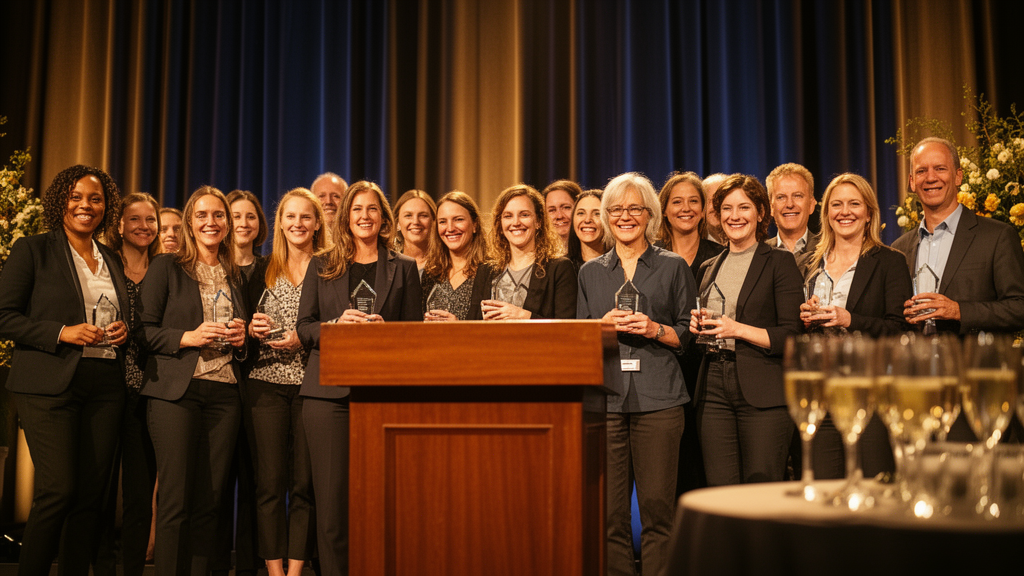
Springer Nature has announced the recipients of its 2026 Editor of Distinction Awards, an annual program that recognizes the academics who do much of the invisible work holding the scientific record together. Among the journals celebrating honorees this year is BMC Pharmacology and Toxicology, which published the announcement on its Springer Nature update page. The awards fall into two categories this cycle: the Springer Nature Editorial Contribution Award, given for meticulous assessment of submissions and rigorous management of peer review, and the Springer Nature Author Service Award, which honors exceptional service in improving the author experience and ensuring that peer review remains efficient, constructive, and fair.
The Editorial Contribution Award list for 2026 includes thirteen editors: Abdelwahab Omri, Anshuman Chandra, Catherine Sherwin, Giovanni Tarantino, Hualin Cai, Imran Khan, Jeffrey Raj, Josef Yayan, Koushik Debnath, Marcelo Arbo, Md Jakaria, Zhengwei Huang, and Zhenwei Yu. The citation attached to the award emphasizes two things that are easy to overlook when a paper appears cleanly on a journal website: the quality of the initial assessment of a submission and the rigor with which the peer review process is steered. Together, according to the publisher, these functions safeguard the scientific accuracy of the published record, which is the bedrock on which every downstream citation, replication attempt, and clinical decision ultimately rests.
The Author Service Award, by contrast, turns the spotlight on the researcher-facing side of editorial work. Its 2026 recipients are Anindya Bose, Josef Yayan, Simone Brogi, and Zhenwei Yu, with Yayan and Yu appearing on both lists, a dual recognition that suggests an unusually broad contribution spanning both review integrity and author support. The award language stresses that the peer review process should be efficient, constructive, and fair, three adjectives that encode a considerable amount of editorial craft. Efficiency means returning decisions on a timeline that does not stall careers or allow competing groups to scoop unpublished work. Constructiveness means reviews that tell authors how to fix a study rather than merely why it fails. Fairness means handling submissions without bias toward institutions, countries, or fashionable topics.
To understand why a major publisher devotes an entire awards program to editors, it helps to look at what an academic editor actually does for a journal like BMC Pharmacology and Toxicology. The journal publishes research spanning drug action, toxicological mechanisms, and therapeutic safety, fields where a flawed dose-response analysis or an overlooked confounder can have real consequences for how a compound is understood. When a manuscript arrives, an editor decides whether it falls within scope, whether it clears a minimal bar of methodological plausibility, and whether it is ready to be sent to external reviewers. That triage step filters out the submissions that would waste reviewer time and shapes the pool of expertise that will be drawn upon.
Once reviews come back, the editor becomes an interpreter and an arbiter. Reviewers frequently disagree: one may demand an additional animal cohort while another considers the existing data sufficient, or one may object to a statistical approach that a colleague endorses. The editor must weigh these positions, decide which objections are essential and which are matters of taste, and compose a decision letter that communicates a clear path forward. The Springer Nature citation for the Editorial Contribution Award describes this as rigorous management of the peer review process, and the wording is apt, because a poorly managed review cycle can swing between rubber-stamping weak papers and blocking sound ones through reviewer idiosyncrasy.
The announcement from BMC Pharmacology and Toxicology frames editorial contributions broadly, noting that editors develop networks for authors and peer reviewers, help authors improve their papers, and advocate for their journal communities. That advocacy component is often underrated. A journal’s reputation depends heavily on whether researchers in the field believe its editorial process is competent and honest. Editors who attend conferences, recruit strong reviewers, and encourage high-quality groups to submit are performing a form of community building that no metric of papers published per year captures. The publisher’s own description of its editorial teams working tirelessly to help advance discovery is promotional in tone, but it reflects a genuine structural reality: without motivated editors, the peer review system simply does not function.
Peer review has come under intense scrutiny in recent years, which gives awards like these added significance. Studies of the reviewing ecosystem have documented reviewer fatigue, difficulty recruiting qualified referees, and variability in review quality across and within journals. At the same time, the volume of submitted manuscripts keeps climbing, driven by growth in global research output and, increasingly, by machine-generated submissions that flood editorial inboxes. Editors sit at the front line of that pressure. An editor who conducts meticulous assessments of submissions is also, implicitly, a defense against paper mills, salami slicing, and the growing category of suspicious manuscripts that integrity officers must later chase. Recognizing that labor publicly is one of the few levers publishers have to encourage it.
The Author Service Award side of the program speaks to another live debate in scholarly publishing: how journals treat the people who submit to them. Authors, particularly early-career researchers and those from institutions outside the traditional publishing centers of North America and Europe, have long reported opaque decision processes, desk rejections without useful feedback, and review timelines that stretch for many months. An award that explicitly recognizes making peer review constructive and fair signals that publishers are treating author experience as a measurable dimension of journal quality rather than an afterthought. For a pharmacology and toxicology journal, where submissions may come from regulatory scientists, clinical pharmacologists, and basic researchers across many countries, consistent and courteous handling of manuscripts is not a luxury; it determines whether a journal can attract the strongest science in its field.
It is worth noting what the awards are not. They are not research prizes, and they carry no claim about the scientific findings published in the journals involved. They recognize service: the assessment, coordination, mentoring, and administrative work that converts a submitted manuscript into a published article. The BMC Pharmacology and Toxicology announcement expresses pride in its editors’ dedication to their journals and research communities, and the full honoree lists are published openly so that authors, reviewers, and readers can see who is being credited. That transparency matters, because editorial work is by design largely anonymous; authors rarely learn which editor shepherded their paper, and reviewers interact with the editorial office rather than with named decision-makers in most cases.
For the wider research community, the 2026 Editor of Distinction Awards serve as a reminder that the scholarly record is a human artifact, maintained by people whose names usually appear only in fine print. The thirteen Editorial Contribution Award recipients and the four Author Service Award recipients honored at BMC Pharmacology and Toxicology this year, including the two editors recognized in both categories, represent the standard that Springer Nature says it wants its editorial teams worldwide to meet. As debates over peer review reform, reviewer incentives, and publishing integrity continue, celebrating the editors who manage those processes rigorously and fairly is a small but meaningful acknowledgment of where much of the system’s actual quality control lives.
Subject of Research: Springer Nature's 2026 Editor of Distinction Awards recognizing editorial excellence at BMC Pharmacology and Toxicology
Article Title: Springer Nature Editor of Distinction Awards 2026
Article References: Springer Nature Editor of Distinction Awards 2026. (n.d.). Original publication
Image Credits: AI Generated
DOI: Not provided
Keywords: Springer Nature, Editor of Distinction Awards, BMC Pharmacology and Toxicology, peer review, academic publishing, editorial awards, scholarly communication, author experience, research integrity, pharmacology, toxicology, editorial service
Cite Scienmag News
Ophelia Keating. (October 15, 2026). Springer Nature Honors Standout Editors With 2026 Distinction Awards. Scienmag. https://scienmag.com/springer-nature-honors-standout-editors-with-2026-distinction-awards-11/
Ophelia Keating. "Springer Nature Honors Standout Editors With 2026 Distinction Awards." Scienmag, 15 October 2026, https://scienmag.com/springer-nature-honors-standout-editors-with-2026-distinction-awards-11/. Accessed 15 October 2026.
Ophelia Keating. "Springer Nature Honors Standout Editors With 2026 Distinction Awards." Scienmag. October 15, 2026. https://scienmag.com/springer-nature-honors-standout-editors-with-2026-distinction-awards-11/


