


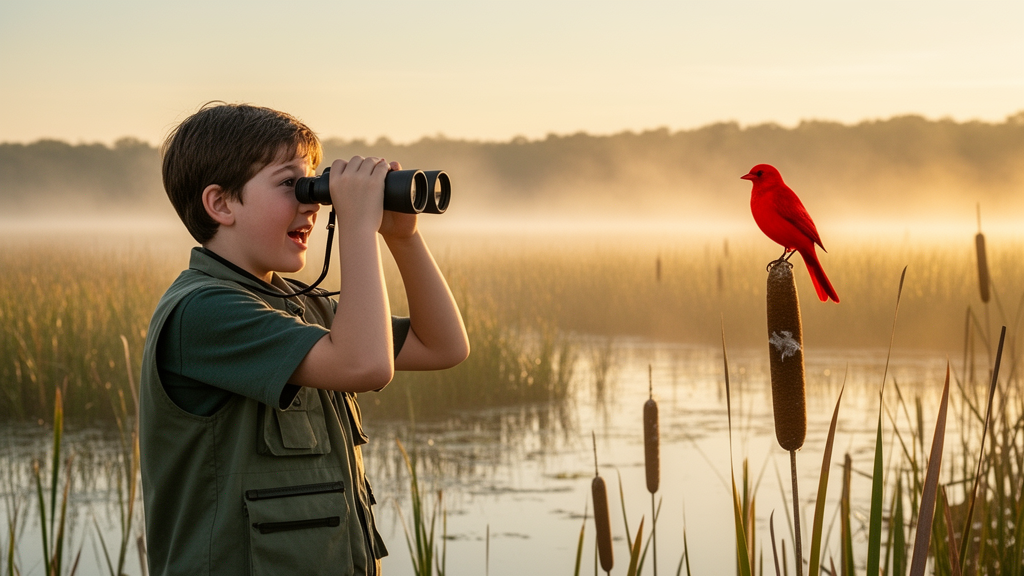
Every birder has a story about the moment it all began. For some, it was a flash of red at the kitchen window; for others, a heron standing impossibly still in a marsh at dawn. In the birding community, this pivotal encounter is known as a spark bird, and it is traded casually among enthusiasts the way musicians trade stories about the first record that changed their lives. Yet despite how central these stories are to birding culture, they have never been systematically studied. A new preliminary report published in Frontiers in Bird Science changes that. Drawing on 560 personal narratives collected by The Spark Bird Project, psychologist Jenn Lodi-Smith of Canisius University presents the first empirical portrait of how, when, and why people fall in love with birds, and the findings reveal a great deal about who birders are and who they might yet become.
The scale of the birding world makes the question more than an academic curiosity. According to the U.S. Fish and Wildlife Service, an estimated 96 million Americans aged 16 and older, roughly 37 percent of the adult population, watch birds, and about 43 million are serious enough to travel more than a mile specifically to do so. The economic footprint is enormous, exceeding 279 billion dollars annually in the United States alone. Globally, the Cornell Lab of Ornithology reported more than 1 million users of its eBird platform and nearly 30 million users of the Merlin identification app at the end of 2025, while market research values birdwatching tourism at roughly 70 billion dollars in 2025, with projections topping 117 billion dollars by 2033. Understanding what draws people into this community, therefore, has consequences for conservation funding, tourism, and the social fabric of one of the largest participatory science movements on Earth.
Lodi-Smith approached spark bird stories through the lens of narrative identity research, a field of personality science that treats the stories people tell about defining moments as windows into the self. Researchers in this tradition have long examined accounts of peak experiences, turning points, and self-defining memories, as well as culturally shared narratives such as coming out stories, stories of recovery from addiction, and collective memories of events like September 11 and the COVID-19 pandemic. The Spark Bird Project adapted established self-defining memory prompts to ask participants for a detailed, contextualized account of the bird, book, person, or moment that hooked them on birding, followed by ratings of the memory’s emotional character. The result is a corpus of what the researcher calls contextual self-defining narratives, gathered from everyday birders rather than the famous voices that dominate published spark bird anecdotes.
The sample itself offers a snapshot of the birding community’s current composition. The 560 stories came from 544 individuals aged 9 to 90, with an average age of about 45. Most participants identified as White, about 57 percent identified as female, and the vast majority were college-educated residents of the United States. Participants were recruited through community science outreach, bird festivals, podcasts, social media, and word of mouth, with data collected through a secure electronic platform and deidentified stories made openly available through the Open Science Framework. Notably, around 10 percent of respondents identified beyond the traditional gender binary, and the project deliberately allows open-ended gender responses, reflecting efforts to document a community that is more diverse than standard demographic categories often suggest.
One of the most striking findings concerns timing. On average, participants reported their spark bird experience occurring when they were about 25 years old, but the distribution was remarkably wide, ranging from age 0 to 77. The single most common age was 8, suggesting that childhood encounters hold a privileged place in birding origin stories. At the same time, the average recency of the reported memory was just under 21 years, and the most common recency was only 2 years, meaning many contributors described sparks that flew within the past few seasons. This bimodal pattern, with bursts of spark experiences in childhood and in recent years, mirrors the documented surge of interest in birding during and after the pandemic, when lockdowns turned backyard feeders and neighborhood trails into gateways for millions of new enthusiasts.
Linguistic analysis of the stories, conducted with the widely used LIWC-22 text analysis software, added a technical layer to the picture. Spark bird narratives averaged about 266 words and were compared against the program’s broad reference corpus of everyday texts. The stories came out rich in cognitive and perceptual language, especially words related to seeing, attention, space, sound, and motion, which fits the intensely observational character of birdwatching. They were also dense with past-focused and memory-related words, scored unusually high on authenticity metrics, and expressed a high degree of curiosity. Family, home, and affiliative words were significantly represented, underscoring how often these transformative moments are woven into relationships with parents, children, and friends. The most frequent words, aside from bird-related vocabulary itself, were time, see, day, years, started, life, nature, remember, and species, each appearing in at least a quarter of all stories.
Self-reported emotional ratings echoed the linguistic signals. Participants rated their spark bird memories as highly positive, vivid, interesting, and personally important, with common feelings including happiness, curiosity, surprise at unexpected avian behavior, and pride in moments of mastery such as identifying a bird by song. Not every story was joyous, however; some participants connected their spark to grief or to recovery from illness, showing that birds can anchor meaning even in difficult chapters of life. The stories also contained relatively little negative language compared with normative text data. Together, the quantitative profiles portray the spark bird experience as an emotionally intense, cognitively engaged, and deeply social event, one that functions less like a casual preference and more like a genuine transformative life experience in the psychological sense.
So which birds do the sparking? The Northern Cardinal topped the list, cited in 18 stories, followed closely by the Great Blue Heron with 16, then the Red-winged Blackbird, Scarlet Tanager, and Northern Flicker. These are all common, visually bold, or vocally striking North American species, a pattern shaped partly by the heavily U.S.-based sample. More than 200 species appeared overall, from the American Bittern to the Yellow-rumped Warbler, which suggests that almost any bird can become a spark under the right circumstances. Intriguingly, roughly 15 percent of participants reported non-bird sparks, most often people, such as a parent or mentor who opened the door, but also books, feeders, games, and films. The spark, in other words, is often interpersonal and mediated, not purely a private encounter with a single animal.
The report also sounds a cautionary note about whose stories get told. The archetypal spark bird narrative, popularized by Roger Tory Peterson’s famous childhood encounter with a seemingly dead flicker that exploded into golden wings in his hands, may set an expectation that sparks belong in childhood. Lodi-Smith warns that this could be self-fulfilling: birders who discovered birds later in life sometimes doubt that their stories count and hesitate to share them, and people without a single dramatic moment may assume they have nothing to contribute. Public programs associated with the project have already shown that simply prompting reflection often helps people recognize spark experiences they had never framed that way. Encouraging broader sharing matters, because the timing data show that sparks genuinely occur across the lifespan, and older newcomers need community pathways just as children do.
The Spark Bird Project is ongoing, with recruitment continuing toward a goal of 1,000 participants and annual longitudinal follow-ups planned to track how new birders’ passion evolves or fades. Future analyses will code the stories for themes such as connection to nature, mastery, redemption sequences, and interpersonal communion, and will link them to measures of personality, well-being, and birding behavior. The practical stakes are clear: if conservation organizations understand when and how people ignite, they can design outreach that sparks and sustains appreciation of birds across ages and communities. In a world where human activity remains the leading threat to birds yet humans are also their most devoted defenders, the humble spark bird story may turn out to be one of the most useful conservation tools yet, a reminder that the path to protecting nature often begins with a single unforgettable bird.
Subject of Research: Preliminary empirical findings on spark bird experiences from The Spark Bird Project
Article Title: Preliminary findings from The Spark Bird Project: learning about timing, emotions, and sparks through contextual self-defining narratives
Article References: Preliminary findings from The Spark Bird Project: learning about timing, emotions, and sparks through contextual self-defining narratives. (n.d.). https://doi.org/10.3389/fbirs.2026.1870756
Image Credits: AI Generated
DOI: 10.3389/fbirs.2026.1870756
Keywords: birding, spark birds, narrative identity, psychology, citizen science, bird conservation, Northern Cardinal, LIWC, emotions, lifespan development, birdwatching, Spark Bird Project
Cite Scienmag News
Glenn Wilkins. (October 15, 2026). Scientists Are Finally Studying the Birds That Turn People Into Birders for Life. Scienmag. https://scienmag.com/scientists-are-finally-studying-the-birds-that-turn-people-into-birders-for-life/
Glenn Wilkins. "Scientists Are Finally Studying the Birds That Turn People Into Birders for Life." Scienmag, 15 October 2026, https://scienmag.com/scientists-are-finally-studying-the-birds-that-turn-people-into-birders-for-life/. Accessed 15 October 2026.
Glenn Wilkins. "Scientists Are Finally Studying the Birds That Turn People Into Birders for Life." Scienmag. October 15, 2026. https://scienmag.com/scientists-are-finally-studying-the-birds-that-turn-people-into-birders-for-life/


