


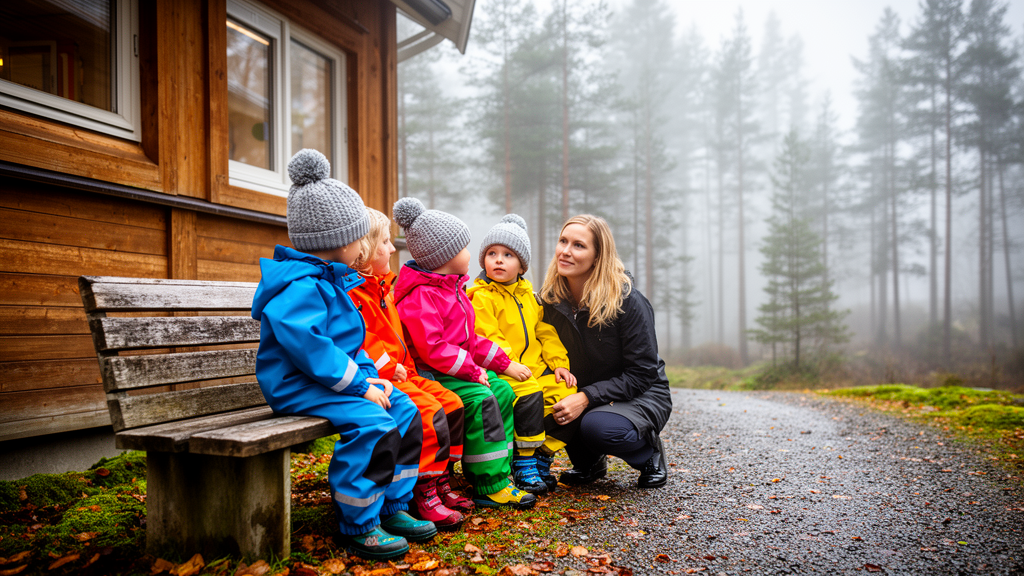
Deep in a snowy Norwegian forest, a group of preschoolers slogs through fresh powder while their kindergarten teacher encourages them to keep going, to help a friend who has slipped, and to notice how good the fire will feel afterward. Moments like these are so ordinary in Norway that they rarely attract attention. Yet a new theoretical paper argues that they are among the most emotionally loaded experiences in young children’s lives, quietly teaching them which feelings are expected, which expressions are rewarded, and which children will be recognized as emotionally competent.
The paper, published as a Perspective article in Frontiers in Developmental Psychology by researchers at Oslo Metropolitan University and the Norwegian Institute for Nature Research, examines friluftsliv, roughly translatable as open-air life, as a cultural setting of emotion socialization in early childhood. The authors propose that friluftsliv, as practiced in Norwegian kindergartens, functions as an institutional emotion niche: a recurring configuration of routines, material environments, social relationships, and normative expectations that makes certain emotional experiences more likely and makes certain expressions more readily recognized as competent.
The argument begins from a well-established shift in emotion research. Older theories often treated emotions as a small set of biologically hardwired, universal states. Contemporary approaches increasingly view emotions as processes that emerge through social interaction and culturally meaningful environments. If that is true, the authors contend, then emotional competence cannot be understood solely as an internal capacity for recognizing, expressing, understanding, and regulating feelings. It is also the ability to participate in culturally organized situations in ways that align with socially valued expectations.
To explain how such situations stabilize, the researchers draw on the concept of the emotion niche, developed by anthropologist Alan Fiske. Practices that reliably evoke valued emotional experiences tend to be repeated, shared, and transmitted across generations, becoming stabilized elements of cultural life. Relational models theory adds a mechanism: communal sharing relations, characterized by unity, belonging, and mutual care, often evoke kama muta, a positively felt social emotion experienced as being moved or touched. Because people want to repeat and share these feelings, the practices that evoke them become culturally durable, and over time they set the criteria for what counts as an appropriate emotion in a given context.
Friluftsliv fits this account with striking precision. The tradition emerged as a named practice in nineteenth-century Norway, with mixed roots in bourgeois exploration, rural harvesting customs, and shifting ideas about nature and national identity. Today it occupies a central place in Norwegian early childhood education, where 94.5 percent of children aged one to five attend kindergarten and spend substantial time outdoors throughout the year. The national Framework Plan requires kindergartens to give children outdoor experiences in all seasons and to foster wellbeing, joy, and achievement through physical activity in nature.
In practice, this means forest excursions, free play in woods and fields, meals eaten outdoors, and gatherings around fires, whatever the weather. The authors illustrate how emotion socialization unfolds within these routines. When children face slippery ground or cold hands, educators tend to frame the discomfort as temporary and manageable while encouraging persistence and mutual assistance. Through such framing, modeling, and response, children are guided not merely to cope with the immediate situation but to interpret bodily and emotional experiences in culturally valued ways. Over repeated participation, orientations such as endurance, calmness, mastery, enjoyment of nature, and collective engagement take shape, not as abstract rules but as expectations that are expressed, recognized, and affirmed in everyday interaction.
Shared outdoor challenges also generate the communal moments that emotion niche theory predicts. Moving together through difficult terrain, helping another child over an obstacle, or warming up around a fire can function as micro-events of intensified communal sharing, evoking feelings of closeness and belonging. These experiences of shared endurance and collective accomplishment can strengthen children’s connections with one another, with nature, and with the cultural practice of friluftsliv itself. The institutional reach of the tradition extends into the first years of school, where the physical education curriculum emphasizes play and exploration in local nature across seasons.
But the paper’s most provocative claim is that this same machinery of belonging can produce exclusion. The authors describe an inclusion-exclusion paradox. Norwegian kindergartens are formally committed to equity and responsiveness to children’s individual circumstances, yet inclusion is pursued through a culturally patterned practice whose signs of successful emotional participation are not neutral. Enjoyable participation in friluftsliv depends on suitable clothing and equipment, mobility, and access to particular locations, resources that are not equally available. Children arrive with different family routines, material resources, sensory or physical needs, and familiarity with Norwegian climates and landscapes.
As a result, a child who hesitates in cold weather, seeks distance from the group, or refuses an activity may be registering bodily limits and regulating exposure, yet be interpreted as lacking resilience, autonomy, or emotional competence. Drawing on Arlie Hochschild’s concept of feeling rules, the authors show how institutional settings define what individuals ought to feel and express. Norwegian ideals linking nature with freedom, independence, and healthy development can operate as a hidden curriculum, making enjoyment of outdoor life an implicit standard of a good childhood. The crucial distinction, the authors argue, is between children’s emotional capacities and their institutional recognition: the problem may lie not in missing capacities but in a mismatch between how they are expressed and how they are read.
The paper outlines three research directions: studying children’s embodied environmental experiences of cold, wetness, and exposure; distinguishing between display rules and feeling rules in outdoor settings; and examining how identity and belonging form, or fail to form, through shared practice. For educators, the practical message is concrete: treat discomfort as information about the relationship between a child and a situation, adapt pace, support, and material demands accordingly, and recognize multiple legitimate expressions of hesitation and enjoyment alike. The authors stress that friluftsliv is neither inherently inclusive nor exclusive; its emotional effects depend on how adults organize it. The broader question travels well beyond Norway: how do culturally valued institutional practices shape what children are expected to feel, and who gets recognized as emotionally competent?
Subject of Research: Friluftsliv in Norwegian early childhood education as a cultural setting of emotion socialization
Article Title: Friluftsliv (open-air life) as a cultural site of emotion socialization in early childhood in Norway
Article References: Petersen, E., Costa, N. M. S. D., & Broch, T. B. (2026). Friluftsliv (open-air life) as a cultural site of emotion socialization in early childhood in Norway. Frontiers in Developmental Psychology, 4, Article 1971416. https://doi.org/10.3389/fdpys.2026.1971416
Image Credits: AI Generated
DOI: 10.3389/fdpys.2026.1971416
Keywords: friluftsliv, emotion socialization, early childhood education, Norway, kindergarten, emotional competence, emotion niche, outdoor play, kama muta, feeling rules, inclusion, developmental psychology
Cite Scienmag News
Adam Burke. (October 15, 2026). Norwegian Outdoor Life Teaches Preschoolers Which Feelings Count. Scienmag. https://scienmag.com/norwegian-outdoor-life-teaches-preschoolers-which-feelings-count/
Adam Burke. "Norwegian Outdoor Life Teaches Preschoolers Which Feelings Count." Scienmag, 15 October 2026, https://scienmag.com/norwegian-outdoor-life-teaches-preschoolers-which-feelings-count/. Accessed 15 October 2026.
Adam Burke. "Norwegian Outdoor Life Teaches Preschoolers Which Feelings Count." Scienmag. October 15, 2026. https://scienmag.com/norwegian-outdoor-life-teaches-preschoolers-which-feelings-count/


