


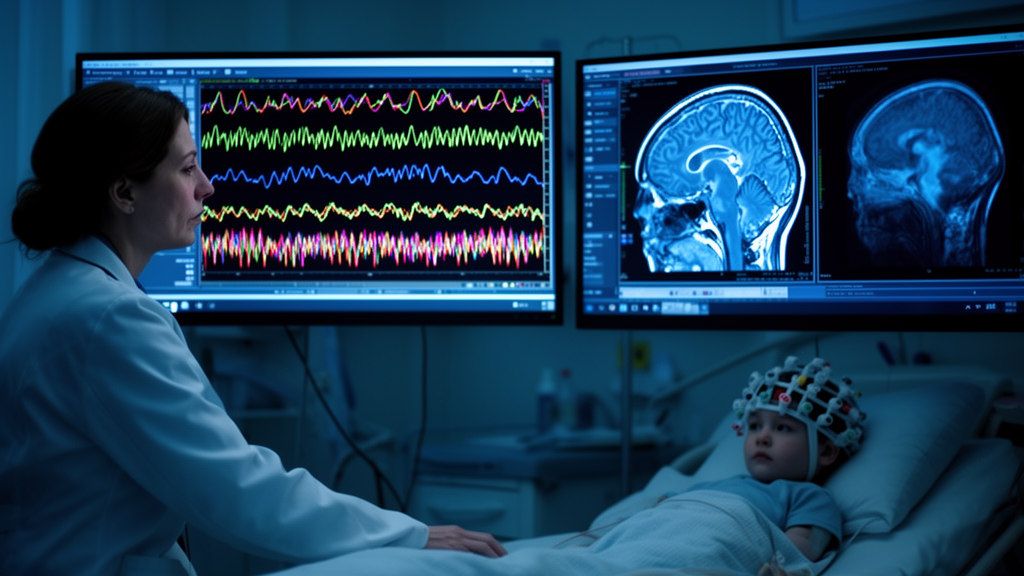
Pediatric epilepsy affects between 0.5 and 1 percent of children worldwide, and catching it early matters enormously. Uncontrolled seizures during critical developmental windows can leave lasting deficits in cognition and behavior, which makes the electroencephalogram, or EEG, one of the most important diagnostic tools in child neurology. Yet reading a child’s EEG is notoriously difficult. The developing cortex produces rhythms that change dramatically with age, movement and muscle artifacts contaminate the recording, and the morphological signatures of epileptic activity vary widely across syndromes and age groups. Even experienced electroencephalographers disagree when hunting for subtle interictal discharges, and visual inspection of hours of recording is slow and labor-intensive. A new computational study published in Frontiers in Neuroscience proposes a fresh way to help machines see what human readers might miss, and its central idea is elegantly simple: combine two complementary mathematical views of the brain signal before the computer tries to classify it.
The research team, led by Dan Feng and Zhengtao Li of the Central Hospital of Enshi Tujia and Miao Autonomous Prefecture in China, built what they call a representation-level wavelet–EMD fusion framework. The two ingredients are longstanding tools of signal processing. The wavelet transform decomposes a signal into nested frequency scales and is exceptionally good at localizing brief, sharp events such as the spikes and sharp waves that betray epileptic activity. The researchers chose the Daubechies-4 wavelet because its asymmetric profile resembles the shape of epileptiform transients. Empirical mode decomposition, or EMD, works differently: it is fully data-driven and splits a signal into intrinsic mode functions without assuming any mathematical basis, which lets it capture slow amplitude modulations that a fixed wavelet basis can isolate only imperfectly. Each method, in other words, is blind to part of the picture the other sees clearly.
Previous hybrid approaches have typically extracted statistical features separately from each transform and then stitched those features together before classification. The Chinese team argues that this feature-level fusion throws away crucial information. When features are computed independently from each representation, the cross-domain structure that lives in the joint time–frequency spectrum is discarded before the classifier ever sees it. Their solution is to fuse at the representation level: they compute the wavelet scalogram and the Hilbert spectrum of the EMD modes, resample both onto a common 64-bin frequency grid spanning 1 to 64 hertz, and then combine them pointwise through a weighted summation with weights of 0.6 for the wavelet component and 0.4 for the EMD component, optimized by grid search. Only then are eight spectral and temporal features extracted, including spectral entropy, spectral centroid, peak frequency, and instantaneous bandwidth, and fed into a soft-voting ensemble of a support vector machine, a random forest, and a small neural network.
Because the framework’s parameters were tuned by the same investigators who generated the test data, the team built their primary evaluation on a fully synthetic and deterministic pediatric EEG corpus of 2,000 ten-second segments, half epileptic and half normal, spanning five canonical epileptiform morphologies: sharp waves, spikes, spike-and-wave complexes, polyspikes, and slow waves. The background rhythms were modeled across the classic delta, theta, alpha, beta, and gamma bands, and noise was added at signal-to-noise ratios from 5 to 25 decibels, including Gaussian white noise, colored physiological noise mimicking muscle interference, and impulsive events representing movement. The full pipeline was evaluated with 10-fold stratified cross-validation repeated over 100 Monte Carlo replications, with hyperparameters frozen on a separate development partition to prevent data leakage.
The results were striking. The representation-level fusion framework achieved 94.6 percent accuracy, 93.7 percent sensitivity, 95.5 percent specificity, an F1 score of 0.943, and an area under the receiver operating characteristic curve of 0.971, with a bootstrap confidence interval of 0.962 to 0.978. Standalone baselines lagged far behind: wavelet analysis alone reached 84.7 percent accuracy, EMD alone 81.2 percent, and Welch-based Fourier analysis only 76.5 percent, all differences highly significant under paired McNemar’s tests with Bonferroni correction. The critical ablation came from the feature-level fusion variant, which used identical feature definitions, classifiers, and validation procedures but fused only after independent extraction. It reached 93.2 percent accuracy, 1.4 percentage points below representation-level fusion, with the largest gains appearing precisely for polyspike and slow-wave morphologies, the patterns whose discriminating information spans both time–frequency domains.
Robustness testing added further evidence that the fusion mechanism is more than a statistical fluke. Across signal-to-noise ratios down to 5 decibels and three distinct noise categories, the framework kept accuracy above 90 percent, while Fourier analysis collapsed below 60 percent and the wavelet and EMD baselines fell to roughly 70 and 65 percent respectively. Detection rates by pattern class were uniformly strong, from 97.1 percent for spike-and-wave complexes down to 91.8 percent for the hardest slow-wave discharges, with false-positive rates below 6 percent everywhere. A deliberate generator-shift experiment, in which the team trained on the original synthetic distribution and tested on six altered distributions, showed graceful rather than catastrophic degradation, suggesting the learned decision rule is anchored in transferable spectro-temporal structure rather than in idiosyncrasies of the generator.
Perhaps most importantly, the team confronted the obvious objection head-on: synthetic data are inherently well matched to wavelet and EMD analysis, because the simulated events were built from Gabor and band-limited components. So they ran an external feasibility validation on the CHB-MIT pediatric scalp EEG corpus, a publicly available real-data collection from PhysioNet. Fourteen subjects met the inclusion criteria, contributing 102 seizures and 12,480 analyzed ten-second epochs, evaluated under strict leave-one-subject-out cross-validation to prevent any within-subject information leakage. As expected, absolute performance dropped on real recordings, but representation-level fusion still achieved the highest results of every method tested, with an AUROC of 0.901 and accuracy of 86.7 percent, ahead of the feature-level ablation, of EEGNet, and of a one-dimensional convolutional network. The advantage held across subjects, with per-subject AUROCs ranging from 0.861 to 0.931.
The comparison with deep learning deserves careful reading. On the synthetic corpus, EEGNet and the 1D-CNN scored 93.5 and 94.0 percent accuracy, statistically indistinguishable from the fusion framework’s 94.6 percent given run-to-run variability. The authors are careful not to claim superiority; their point is that the interpretable pipeline matches the learned models while retaining a fully transparent, feature-based decision path, in which spectral entropy, spectral centroid, and peak frequency emerge as the dominant predictors in both model-independent and model-based importance analyses. The trade-off is computational: the proposed pipeline needs about 8.4 seconds per segment, with EMD accounting for nearly 80 percent of that cost, whereas the deep networks classify a segment in roughly 0.02 seconds. That makes the framework suitable for offline analysis but not yet for real-time or wearable deployment without algorithmic acceleration of the decomposition step.
The authors are equally candid about the limits of their evidence. Because the primary evaluation is synthetic and the external validation is a feasibility-scale demonstration on a single channel with a binary classification task, the reported figures should be read as evidence of methodological viability and external transportability, not as definitive clinical performance. Extension to multichannel recordings, transformer-based architectures, the Temple University Hospital EEG corpus, and prospective multi-center pediatric cohorts remains future work. Still, the study makes a methodological claim that is unusually clean for the machine-learning-for-EEG literature: through a controlled ablation that changes nothing but the fusion level, it demonstrates that merging wavelet and EMD spectra before feature extraction recovers cross-domain information that post-hoc fusion destroys. In a field often criticized for opaque black-box benchmarks, a transparent, fully reproducible framework whose advantage survives contact with real pediatric recordings is a genuinely useful baseline, and one that future clinical and deep-learning studies can now be measured against on equal terms.
Subject of Research: Representation-level wavelet–EMD fusion for detecting epileptiform patterns in pediatric EEG
Article Title: A representation-level wavelet–EMD fusion framework for spectral analysis and detection of epileptiform patterns in pediatric EEG: computational validation with a roadmap for external benchmarking
Article References: Feng, D., & Li, Z. (2026). A representation-level wavelet–EMD fusion framework for spectral analysis and detection of epileptiform patterns in pediatric EEG: computational validation with a roadmap for external benchmarking. Frontiers in Neuroscience, 20, Article 1884876. https://doi.org/10.3389/fnins.2026.1884876
Image Credits: AI Generated
DOI: 10.3389/fnins.2026.1884876
Keywords: pediatric epilepsy, EEG, wavelet transform, empirical mode decomposition, time-frequency analysis, seizure detection, machine learning, signal fusion, CHB-MIT, interpretability, spectral features, representation-level
Cite Scienmag News
Cassandra Pierce. (October 15, 2026). Fusing Two Signal Views Boosts Epilepsy Detection in Children’s Brain Recordings. Scienmag. https://scienmag.com/fusing-two-signal-views-boosts-epilepsy-detection-in-childrens-brain-recordings/
Cassandra Pierce. "Fusing Two Signal Views Boosts Epilepsy Detection in Children’s Brain Recordings." Scienmag, 15 October 2026, https://scienmag.com/fusing-two-signal-views-boosts-epilepsy-detection-in-childrens-brain-recordings/. Accessed 15 October 2026.
Cassandra Pierce. "Fusing Two Signal Views Boosts Epilepsy Detection in Children’s Brain Recordings." Scienmag. October 15, 2026. https://scienmag.com/fusing-two-signal-views-boosts-epilepsy-detection-in-childrens-brain-recordings/


