


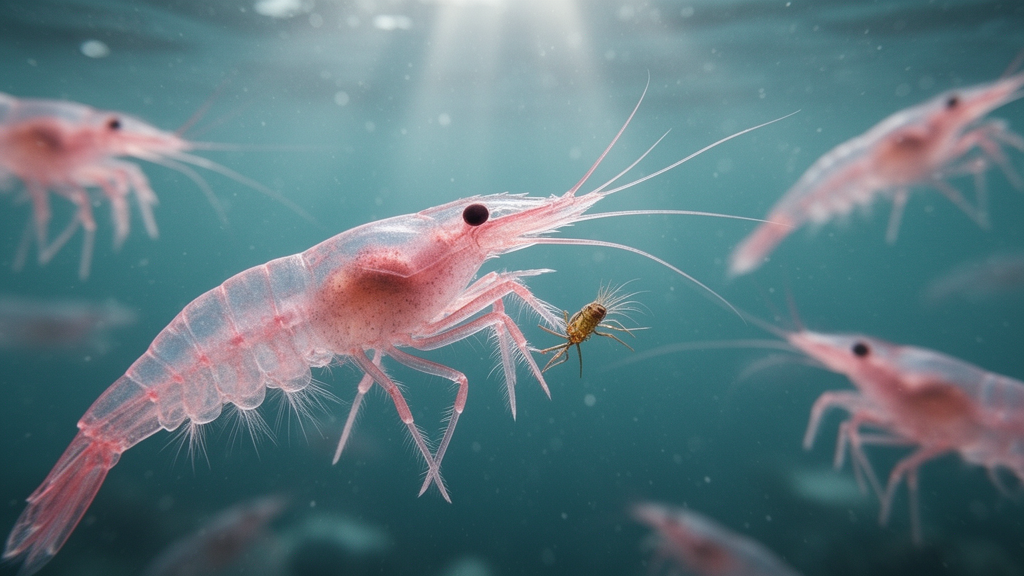
Krill, the swarming shrimp-like crustaceans that sustain whales, fish, and seabirds across the world’s oceans, have long been cast in a single ecological role: vegetarian shuttles that ferry energy from microscopic algae to larger animals. A new study of the Benguela upwelling system off Namibia and South Africa shatters that simple picture. Researchers identified fifteen krill species in this extraordinarily productive region and found that their feeding habits span the full spectrum from strict herbivory through omnivory to exclusive, pincer-wielding carnivory. The findings, published in Frontiers in Marine Science, suggest that food-web models treating krill as one homogeneous group may be seriously misleading.
The Benguela upwelling system is one of the four great eastern boundary upwelling systems of the world ocean. Winds drive cold, nutrient-rich deep water to the surface, fueling explosive phytoplankton growth that underpins some of the richest fisheries on Earth. The system is split near 26 degrees South by the powerful Lüderitz upwelling cell into two distinct subsystems. The northern Benguela experiences perennial upwelling peaking in austral spring, with strong gradients of temperature and oxygen, while the southern Benguela is governed by pulsed, seasonal upwelling centered on austral summer. Because the region is simultaneously pressured by overfishing, warming waters, and declining oxygen, understanding exactly where key species sit in the food web has become an urgent task for ecosystem management.
During austral spring 2021, aboard the research vessel Sonne as part of the international TRAFFIC project, a team from the University of Bremen, the Alfred Wegener Institute, and the Leibniz Centre for Tropical Marine Research sampled thirteen stations along transects in both subsystems. Using a MultiNet Maxi with 300-micrometer mesh, they collected krill from up to eight depth intervals at each station, reaching down to more than 500 meters. Individual animals were identified to species and developmental stage, measured, freeze-dried, and weighed on microbalances, while a subset was frozen at minus 80 degrees Celsius for lipid and isotope chemistry.
The spatial patterns were striking. Euphausia lucens dominated both subsystems in biomass and range, contributing more than ninety percent of total krill biomass at several coastal stations. The northern Benguela additionally hosted Hansarsia megalops and Euphausia hanseni, whereas Euphausia similis, a species carried in from the Indian Ocean with Agulhas Current water, characterized the southern subsystem. Offshore stations in both regions were dominated by Euphausia recurva, and species richness rose dramatically from the shelf, where only three species occurred, to oceanic waters, where fourteen species were recorded. Intriguingly, the Lüderitz upwelling cell appears to act as an effective barrier only for coastal species; offshore species such as E. similis apparently cross it, possibly transported northward within Agulhas rings.
To unravel what these animals actually eat, the team deployed two complementary chemical techniques. Fatty acid trophic markers reveal diet over weeks: certain fatty acids are produced by diatoms and flagellates, while the fatty acid 18:1(n-9) is characteristic of animal prey and carnivory. Stable nitrogen isotopes, which integrate diet over months and become enriched by roughly 3.4 per mille with each step up the food chain, provide an independent estimate of trophic position. Using the herbivorous copepod Nannocalanus minor as a baseline primary consumer, the researchers calculated trophic positions ranging from 1.9 for krill larvae to 3.8 for the most carnivorous adults, and a carnivory index spanning 1.7 to 19.5.
The results drew a remarkably nuanced portrait of krill nutrition. Furcilia larvae and small juveniles under ten millimeters were predominantly herbivorous, with low trophic positions of 1.9 to 2.2. Adults of Euphausia recurva and Euphausia lucens showed elevated proportions of the diatom marker fatty acid 18:1(n-7), between 2.7 and 4 percent of total fatty acids, classifying them as herbivorous to partially omnivorous grazers that can switch to animal prey when phytoplankton becomes scarce. Euphausia hanseni carried high levels of the carnivory marker 18:1(n-9), at 10.4 to 12.5 percent, indicating omnivory with a pronounced lean toward meat. Hansarsia megalops and Euphausia similis displayed trophic plasticity with a carnivorous tendency, and the genus Stylocheiron proved to be exclusively carnivorous, stalking prey with a prehensile pincer and an undeveloped filtering basket.
Only one species, Hansarsia megalops, contained fatty alcohols, signaling the production of wax esters as energy-storage lipids, an adaptation otherwise known from polar krill coping with seasonal food shortages. Notably, females of H. megalops were rich in the long-chain fatty alcohols 20:1 and 22:1, hinting at a link to egg production, although levels did not differ between egg-bearing and non-egg-bearing individuals. Its modified second thoracic leg, capable of grabbing prey as well as filtering, plausibly underpins this species’ predatory habit and its presence throughout the water column in the oxygen-depleted northern Benguela, where surface phytoplankton dependence would be a liability.
The ecological implications ripple upward. Swarming krill concentrate prey for predators, and the study notes that a previously unknown super-group of humpback whales now feeds on Euphausia lucens over the southern Benguela shelf, while commercially important cape horse mackerel rely on krill as primary prey. Because filter-feeding krill consume a broad range of prey sizes, they simplify food webs and channel a larger fraction of primary production to higher trophic levels, raising trophic transfer efficiency. If some krill species are actually carnivores feeding one level higher, energy flows through the ecosystem are more complex than standard models assume, and functional groups within the krill taxon need to be represented separately.
Climate change may amplify the importance of this dietary flexibility. Upwelling-favorable winds are projected to intensify in eastern boundary systems, altering nutrient supply, oxygen conditions, and the pulse of phytoplankton blooms. Species that can pivot between grazing algae and hunting copepods will likely buffer these fluctuations better than rigid specialists, potentially increasing krill’s role as prey and stabilizing energy supply to fish and whales. The authors call for long-term, spatially resolved monitoring, including acoustic surveys of krill swarms and closer study of the life cycle and nursery grounds of the dominant Euphausia lucens, to predict how these newly recognized carnivores, grazers, and omnivores will fare as the Benguela continues to change.
Subject of Research: Biodiversity and trophic ecology of euphausiid krill species in the Benguela upwelling system
Article Title: Biodiversity, trophic position, and nutritional ecology of euphausiid species in the Benguela upwelling system
Article References: Jordan, T., Schukat, A., Dudeck, T., Dorschner, S., & Auel, H. (2026). Biodiversity, trophic position, and nutritional ecology of euphausiid species in the Benguela upwelling system. Frontiers in Marine Science, 13, Article 1957151. https://doi.org/10.3389/fmars.2026.1957151
Image Credits: AI Generated
DOI: 10.3389/fmars.2026.1957151
Keywords: krill, Benguela upwelling system, euphausiids, trophic ecology, fatty acid biomarkers, stable isotopes, food web, zooplankton, marine ecology, carnivory, upwelling, Southern Africa
Cite Scienmag News
Gavin Prescott. (October 15, 2026). Krill in the Benguela Are Not All Vegetarians: Study Reveals Surprising Carnivores. Scienmag. https://scienmag.com/krill-in-the-benguela-are-not-all-vegetarians-study-reveals-surprising-carnivores/
Gavin Prescott. "Krill in the Benguela Are Not All Vegetarians: Study Reveals Surprising Carnivores." Scienmag, 15 October 2026, https://scienmag.com/krill-in-the-benguela-are-not-all-vegetarians-study-reveals-surprising-carnivores/. Accessed 15 October 2026.
Gavin Prescott. "Krill in the Benguela Are Not All Vegetarians: Study Reveals Surprising Carnivores." Scienmag. October 15, 2026. https://scienmag.com/krill-in-the-benguela-are-not-all-vegetarians-study-reveals-surprising-carnivores/


