


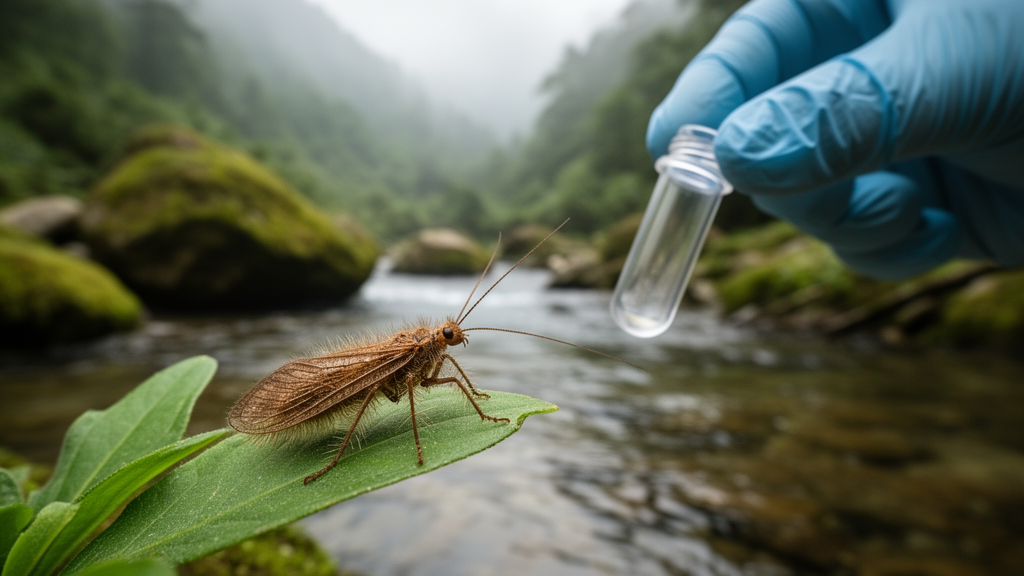
A quiet revolution is unfolding in the streams and rivers of China, and it is happening at the scale of a few millimetres. Researchers surveying aquatic insects across several provinces have described four species of net-spinning caddisfly that are entirely new to science, while also documenting four species never before recorded within Chinese borders. The discovery, published in the Deutsche Entomologische Zeitschrift, lifts the number of formally recognised species of the genus Hydropsyche in China to 90, and it does so using a combination of old-fashioned anatomical scrutiny and modern DNA barcoding that is rapidly becoming the gold standard for untangling look-alike insects.
The genus Hydropsyche belongs to the family Hydropsychidae, the largest family in the caddisfly suborder Annulipalpia, with more than 2,000 described species distributed across every major zoogeographical region except Antarctica. Within the subfamily Hydropsychinae, Hydropsyche itself is the heavyweight, boasting at least 651 known species worldwide, most of them concentrated in the Oriental and Palaearctic Regions. These insects matter far beyond the catalogue. Their larvae spin silken capture nets across flowing water and filter-feed on suspended particles, providing critical ecosystem services in freshwater food webs. Because they are abundant, sensitive to pollution and easy to sample, hydropsychid caddisflies are also workhorses of biological water-quality monitoring, which means that every species left unidentified is a potential blind spot in environmental assessment.
Identifying Hydropsyche species, however, has long been a taxonomist’s headache. The group is widely regarded as one of the most difficult in the entire order Trichoptera, chiefly because the genital structures that distinguish males are strikingly similar from one species to the next. Traditional morphology-based revisions often fail to draw clean boundaries between closely related taxa, and the genus has been subdivided into subgenera and species groups by different authors over decades without any unified classification. The current framework, synthesised by Oláh and Johanson in 2008, treats many former subgenera as species groups and assigns Oriental and Neotropical species to ten such groups on the basis of morphological characters. Chinese species currently fall into seven of these groups.
The new study, led by Xinyu Ge, took a deliberately integrative approach. Adult specimens were collected between 2021 and 2025 using ultraviolet light traps and Malaise traps, then preserved in 85 percent ethanol. For the microscopic work, male abdomens were cleared in a 10 percent sodium hydroxide solution heated to 80 degrees Celsius for twenty minutes to dissolve non-chitinous tissues, allowing the delicate genital architecture to be examined in lactic acid on depression slides. Structures were photographed with a Leica M205 C stereomicroscope, and final line drawings were digitally rendered from pencil sketches. All specimens are deposited in the Insect Collection at Tianjin Normal University.
The molecular half of the workflow centred on the mitochondrial cytochrome c oxidase I gene, the standard animal DNA barcode. DNA was extracted from the three left legs of six male individuals per species using a commercial genomic DNA kit, and the 658 base-pair barcode fragment was amplified with the classic Folmer primers LCO1490 and HCO2198 before sequencing at the Beijing Genomics Institute. The team then built a Neighbour-Joining tree in MEGA 12, applying the Kimura 2-parameter substitution model and assessing branch support with 1,000 bootstrap replicates, comparing the four new species against 31 previously recorded congeners. The resulting topology provided strong support for the validity of the new species and, crucially, agreed with the morphological classification, demonstrating that DNA barcoding and traditional anatomy are concordant in delineating these taxa.
Two of the new species come from Hainan Island, a tropical biodiversity hotspot whose unique natural environments keep yielding surprises. Hydropsyche bawanglingensis, named after its type locality near Bawangling in Changjiang Li Autonomous County, is a small insect of 4.5 to 5.5 millimetres assigned to the H. newae species group. Its phallic apparatus is double sinuate, and it carries a pair of nearly square quadrate structures near mid-length, dorsolateral membranous pale windows enclosing large blunt dark spines, and a pair of spine clusters on the membranous endotheca, a combination that cleanly separates it from its closest relative, H. gautamittra of Pakistan. Hydropsyche suni, honouring caddisfly taxonomist Dr. Changhai Sun, was collected at Zijing Waterfall in Jianfengling and belongs to the H. hamifera species group, distinguished among other features by sinuously curved harpagones and a dorsomedian membranous endothecal process bearing a stout spine.
The other two new species extend the survey across mainland China. Hydropsyche yangae, named for Professor Lianfang Yang in recognition of her contributions to Trichoptera taxonomy, was found in Pingbian Miao Autonomous County in Yunnan Province at nearly 1,500 metres elevation and joins the H. pluvialis species group, marked by a sclerotised, nearly digitiform endothecal process and claw-like, goose head-shaped phallotremal sclerites. Hydropsyche zhouzhiensis, from the Taiping River in Zhouzhi County, Shaanxi, is the largest of the four at roughly ten millimetres and also sits in the H. newae group; it is set apart from the similar H. suriel by reniform phallotremal sclerites and an asymmetric pattern of spikes at the end of a membranous structure, one stout spine on the right and three smaller ones on the left.
Beyond the new descriptions, the study reports four first records for China, each documented from a single province. Hydropsyche stimulans, previously known from Uzbekistan, Afghanistan, Kazakhstan and Kyrgyzstan, turned up in the Kurdenin Nature Reserve in Xinjiang. Hydropsyche binaria, known from Thailand, Nepal, Bhutan and India, was collected in Yunnan’s Cangyuan Va Autonomous County, as was Hydropsyche pallipenne, a widespread Southeast Asian species recorded from Malaysia to Pakistan. Hydropsyche battos, formerly known only from Thailand, appeared on Hainan’s Yingge Ling. Eight of the nine species highlighted in the study are Oriental in distribution, with only H. stimulans belonging to the Palaearctic fauna, reinforcing the message that the Oriental Region remains a biodiversity hotspot for caddisflies and that China, especially Hainan and Yunnan, still conceals numerous undescribed and unrecorded species.
The molecular results also carried a cautionary note. Although the barcode tree firmly supported each new species as distinct, none of the three species groups to which the new species belong was recovered as a monophyletic clade, meaning the group-level evolutionary relationships within Hydropsyche remain unresolved. The authors attribute this to the limits of inferring phylogeny from a small number of genes and argue that future work incorporating more taxa and richer molecular data, such as mitochondrial genomes or phylogenomic-scale datasets, will be needed to clarify how the species groups are actually related. In the meantime, the team has produced updated identification keys covering the H. newae, H. hamifera and H. pluvialis species groups in China, embedding the new species within a practical diagnostic framework.
The practical payoff of the work lies in freshwater monitoring. Because Hydropsyche larvae are among the most common insects in the samples used for biological assessment of water quality, accurate species-level identification directly improves the resolution of those programmes, and misidentifications can distort pollution indices. The study’s authors recommend increasing sampling frequency across the Oriental Region, particularly during winter and spring, when seasonal activity patterns may reveal species that summer-focused surveys miss. For a genus once considered taxonomically intractable, the pairing of cleared genital preparations with a 658 base-pair barcode is proving to be a powerful lens, and with China’s mountain streams still thinly sampled, the four species named this year are unlikely to be the last.
Subject of Research: Integrative taxonomy and DNA barcoding of the caddisfly genus Hydropsyche in China
Article Title: Integrative taxonomy revealed four new species and four new records of the genus Hydropsyche from China ( Trichoptera , Hydropsychidae )
Article References: Ge, X., Chai, L., Wang, N., Zhang, H., Zhang, N., Wang, J., & Yan, C. (2026). Integrative taxonomy revealed four new species and four new records of the genus Hydropsyche from China (Trichoptera, Hydropsychidae). Deutsche Entomologische Zeitschrift, 73(2), 489-501. https://doi.org/10.3897/dez.73.192129
Image Credits: AI Generated
Keywords: Hydropsyche, Trichoptera, caddisflies, integrative taxonomy, DNA barcoding, mtCOI, China, Hainan, Yunnan, biodiversity, freshwater monitoring, new species
Cite Scienmag News
Gavin Prescott. (October 15, 2026). Four New Caddisfly Species Uncovered in China Through DNA Barcoding and Genital Anatomy. Scienmag. https://scienmag.com/four-new-caddisfly-species-uncovered-in-china-through-dna-barcoding-and-genital-anatomy/
Gavin Prescott. "Four New Caddisfly Species Uncovered in China Through DNA Barcoding and Genital Anatomy." Scienmag, 15 October 2026, https://scienmag.com/four-new-caddisfly-species-uncovered-in-china-through-dna-barcoding-and-genital-anatomy/. Accessed 15 October 2026.
Gavin Prescott. "Four New Caddisfly Species Uncovered in China Through DNA Barcoding and Genital Anatomy." Scienmag. October 15, 2026. https://scienmag.com/four-new-caddisfly-species-uncovered-in-china-through-dna-barcoding-and-genital-anatomy/


