


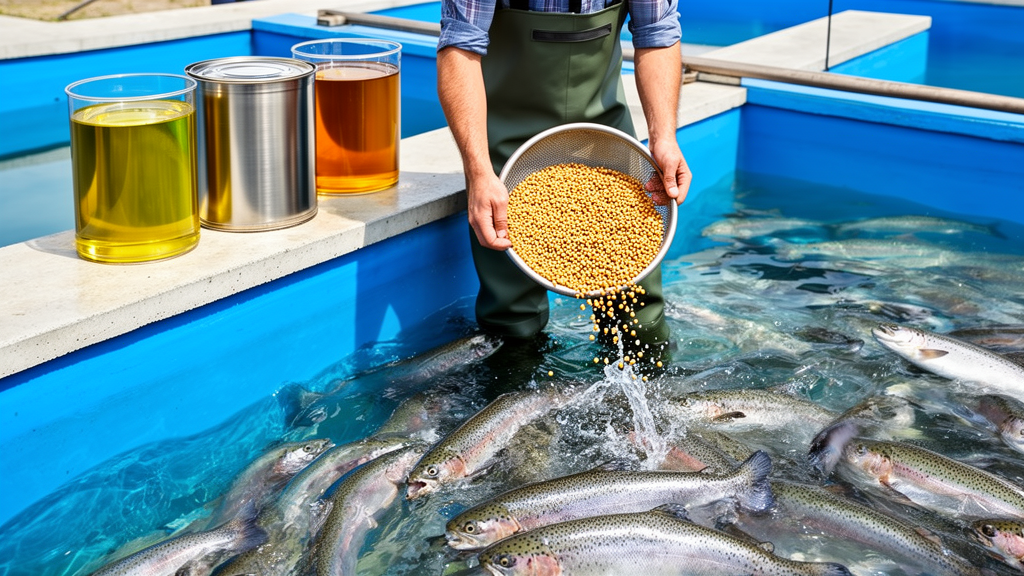
Fish oil, the golden liquid squeezed from forage fish such as anchovies, has long been the nutritional backbone of salmonid aquaculture. It delivers the omega-3 fatty acids EPA and DHA that farmed trout and salmon need for membrane function, immunity, and development, and it passes those same healthy fats on to the humans who eat them. But global fish oil production has flatlined while the industry keeps expanding, and a new feeding trial in the Black Sea trout, Salmo labrax, offers some of the clearest evidence yet that two humble kitchen staples, canola and safflower oil, can take its place entirely without stunting the fish.
The study, published in Acta Ichthyologica et Piscatoria, put juvenile Black Sea trout on seven carefully matched diets for 90 days. Every diet contained roughly 45 percent crude protein and 18 percent crude lipid, differing only in the lipid source: pure fish oil, pure safflower oil, pure canola oil, and four blends combining them in binary and ternary mixtures. Triplicate groups of fish, each starting at about 30 grams, were grown in 300-liter tanks under tightly controlled conditions, with water temperature held near 15.7 degrees Celsius, dissolved oxygen at 7.55 milligrams per liter, and ammonia kept below detectable thresholds.
The headline result is deceptively simple: growth did not care what the fish were eating. Final body weights, weight gain percentages, specific growth rates, feed conversion ratios, thermal growth coefficients, survival, and protein efficiency ratios were statistically indistinguishable across all seven treatments. Fish on pure canola oil gained 163.85 percent of their starting weight; fish on pure fish oil gained 166.95 percent. Feed conversion ratios ranged only from 1.11 to 1.17, and survival stayed between 90 and 96 percent. By the conventional metrics of aquaculture, complete fish oil replacement was a clean success.
But the researchers dug deeper, and that is where the story gets interesting. Fat deposition rate, the viscerosomatic index, and the hepatosomatic index, which measures liver size relative to body weight, all diverged significantly among treatments even though the fish grew identically. Fish fed the fish oil and canola oil blend deposited fat fastest, at 0.61 percent per day, while the pure fish oil group deposited it slowest, at 0.47 percent per day. More strikingly, the safflower-canola blend produced a hepatosomatic index of 2.16 percent, significantly higher than either pure canola oil at 1.63 percent or pure safflower oil at 1.75 percent, despite containing no fish oil at all.
That pattern breaks a core assumption of commercial feed formulation: that oil blends behave as simple linear intermediates between their components. The dietary fatty acid profiles of the blended diets were indeed predicted almost perfectly by proportional mixing of the parent oils. Yet the fish tissue told a different story. Muscle saturated fatty acids in the fish oil-safflower blend exceeded both of its parents, and muscle monounsaturated fatty acids in the fish oil-canola blend fell short of the proportional prediction. The non-additivity arises at the level of tissue lipid metabolism, not feed formulation, suggesting that competition, sparing, and selective retention among fatty acid classes reshuffle when two plant oils arrive together.
The fatty acid data also revealed exactly what nutritionists feared and expected. Muscle profiles mirrored the diets with striking fidelity. As plant oil inclusion rose, saturated fats and the precious n-3 long-chain polyunsaturates EPA and DHA declined, while monounsaturated fats and n-6 fatty acids climbed. In the pure fish oil group, muscle EPA reached 2.26 percent and DHA 7.10 percent of total fatty acids; in the pure safflower group, EPA collapsed to 0.12 percent and DHA to 0.67 percent. The muscle n-3 to n-6 ratio, 0.94 in fish oil-fed trout, plummeted to 0.04 in safflower-fed fish, a more than twentyfold drop.
That collapse matters far beyond the fish. The World Health Organization recommends a dietary n-3 to n-6 ratio of at least roughly 0.2 for cardiovascular health, because omega-3 fatty acids generate anti-inflammatory signaling molecules while linoleic acid-derived omega-6 fats tend toward the opposite. In this trial, the fish oil, canola oil, and fish oil-canola groups all met or exceeded that threshold in muscle tissue, while every safflower-containing diet without fish oil fell below it. Canola oil’s secret weapon is its alpha-linolenic acid content, 7.30 percent of dietary fatty acids, which safflower oil almost entirely lacks at 0.38 percent. That single compositional difference propagated through the diet into the fillet, leaving canola-fed fish with a muscle n-3 to n-6 ratio roughly eight times higher than safflower-fed fish.
The economics tip the scales further. Using indicative 2024 ingredient prices, complete plant oil substitution cut feed costs by 12 to 13 percent relative to the fish oil control, with pure canola oil delivering the largest saving at 13.46 percent and the lowest feed cost per kilogram of fish produced. The researchers stress these are illustrative estimates, not supplier quotations, but sensitivity analysis showed the cost advantage holds even if fish oil prices swing 20 percent in either direction. Fish oil prices are also historically more volatile than plant oil prices, since supply is concentrated in a few forage fisheries, adding an unquantified stability bonus to the substitution.
The authors conclude that canola oil is the more defensible single substitute for Black Sea trout grow-out diets, offering growth equivalence, a favorable hepatic profile, superior omega-3 retention, and the biggest cost saving. Safflower oil, despite a comparable saving, so severely depletes the fillet’s omega-3 profile that it should be restricted to blends of no more than half the added oil, or to short-duration feeding. For premium markets that market omega-3 content, the team suggests a practical two-phase strategy: grow the fish cheaply on plant oil, then finish them on fish oil for four to six weeks before harvest to restore EPA and DHA, a switch requiring no special infrastructure.
Open questions remain. The trial did not measure hepatic gene expression, intestinal histology, oxidative stability, or fillet shelf life, and it was run on juveniles in tanks rather than at commercial scale. Intriguingly, fish fed pure plant oils still carried measurable EPA and DHA in their muscle, likely inherited from the fish meal fraction present in all diets, though the pattern hints that Black Sea trout may possess some capacity to biosynthesize long-chain omega-3s from plant precursors, a hypothesis the authors flag for stable isotope tracer studies. What is already clear is that growth alone cannot judge a fish oil substitute. Two oils that produce identical trout can produce very different fillets, and in aquaculture, as in the kitchen, the oil you choose ends up on the plate.
Subject of Research: Complete dietary replacement of fish oil with canola and safflower oils in juvenile Black Sea trout and its effects on growth, tissue fatty acids, and feed economics
Article Title: Dietary substitution of fish oil with plant oils in juvenile black sea trout Salmo labrax ( Actinopterygii , Salmoniformes , Salmonidae ): Implications for growth, lipid metabolism, and tissue fatty acid quality
Article References: Kerim, M., & Ustaoğlu Tırıl, S. (2026). Dietary substitution of fish oil with plant oils in juvenile black sea trout Salmo labrax (Actinopterygii, Salmoniformes, Salmonidae): Implications for growth, lipid metabolism, and tissue fatty acid quality. Acta Ichthyologica et Piscatoria, 56, 399-416. https://doi.org/10.3897/aiep.56.205677
Image Credits: AI Generated
Keywords: Black Sea trout, Salmo labrax, fish oil replacement, canola oil, safflower oil, aquaculture nutrition, fatty acid composition, omega-3, EPA, DHA, feed cost analysis, salmonid diets
Cite Scienmag News
Daisy Hatcher. (October 15, 2026). Canola Oil Can Fully Replace Fish Oil in Black Sea Trout Feed Without Sacrificing Growth. Scienmag. https://scienmag.com/canola-oil-can-fully-replace-fish-oil-in-black-sea-trout-feed-without-sacrificing-growth/
Daisy Hatcher. "Canola Oil Can Fully Replace Fish Oil in Black Sea Trout Feed Without Sacrificing Growth." Scienmag, 15 October 2026, https://scienmag.com/canola-oil-can-fully-replace-fish-oil-in-black-sea-trout-feed-without-sacrificing-growth/. Accessed 15 October 2026.
Daisy Hatcher. "Canola Oil Can Fully Replace Fish Oil in Black Sea Trout Feed Without Sacrificing Growth." Scienmag. October 15, 2026. https://scienmag.com/canola-oil-can-fully-replace-fish-oil-in-black-sea-trout-feed-without-sacrificing-growth/


