


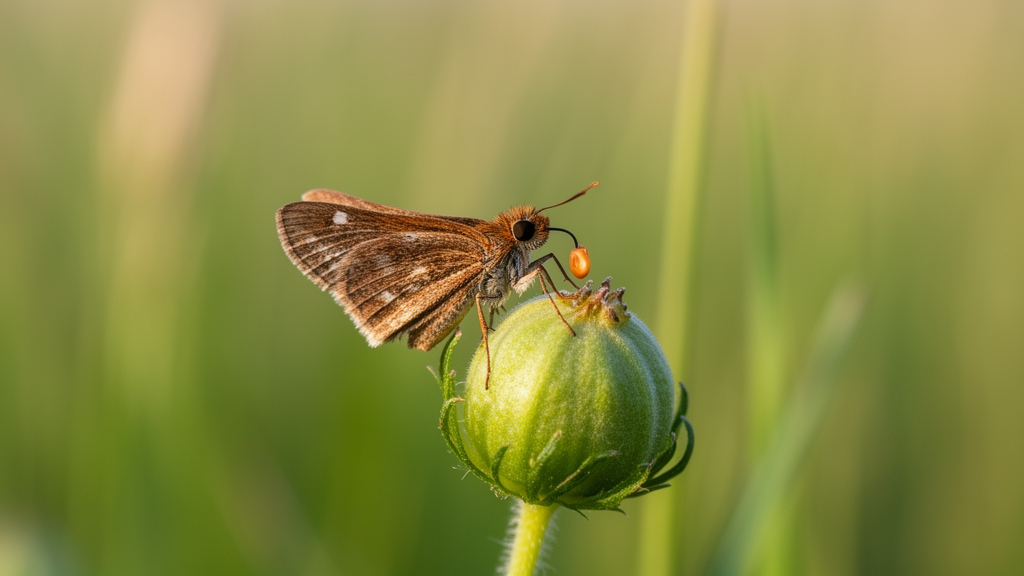
A new species of micromoth described from South Africa has delivered a surprise that stretches far beyond the routine discovery of yet another insect. The species, named Cuphodes spermotrophus by an international team of lepidopterists, is the first seed-feeding member of the moth family Gracillariidae ever confirmed from the African continent. The finding, published in the journal Nota Lepidopterologica, forces a rethink of what this large and ecologically important family of moths is capable of, and it highlights how much of Africa’s insect diversity still hides in plain sight.
Gracillariidae, a family of tiny, slender-winged moths found worldwide, are best known for the habits of their larvae, which spend most of their lives mining tunnels inside leaves. The family includes hundreds of species, some of them serious pests of orchards and ornamental plants, and a few notorious invaders. Yet while leaf mining dominates, the family has repeatedly shown an ability to branch out into other plant tissues. Some species mine stems, others induce galls, and a small number have evolved the remarkable strategy of feeding on seeds and fruits, structures packed with nutrients and defended by the plant precisely because they hold the next generation.
Seed feeding is exceptionally rare in the family. Among the genera known to exploit reproductive structures, Conopomorpha larvae develop inside seeds of tropical fruits in the families Malvaceae and Sapindaceae, and include the cocoa pod borer, a significant pest in Southeast Asia and Oceania. Epicephala has become famous among evolutionary biologists for its obligate pollination mutualisms with Phyllanthaceae plants, in which female moths actively carry pollen on a specialized proboscis and deposit it on flowers while laying their eggs, guaranteeing that their offspring will find developing seeds to eat. Such intricate relationships, however, remain poorly documented in the Afrotropical region, where three Conopomorpha and six Epicephala species are known but their life histories are largely unresolved.
That is what makes the new South African species so striking. Its larvae develop inside the berries of Rhamnus prinoides, an evergreen shrub or small tree of the buckthorn family that ranges from Ethiopia to South Africa and into central and western Africa. When the researchers examined fruits from which adult moths had emerged, they found a distinctive exit hole on the fruit surface near the calyx, and beneath it, an emptied seed. Only a single exit hole was ever observed per fruit, suggesting that a single larva consumes the contents of one seed before leaving the fruit to pupate elsewhere.
The discovery was the product of patient, methodical fieldwork rather than chance capture. Over a full year, from early July 2023 to early July 2024, the team collected ripe, purple-red berries from 18 individual R. prinoides shrubs, mostly along forest edges in the southern Western Cape between the towns of George and Knysna. The fruits were brought to a laboratory at Nelson Mandela University’s George Campus, counted, and placed in rearing pots covered with breathable mesh, misted every three days to maintain humidity. In total, 471 fruits were later dissected under a stereomicroscope, yielding 1,197 seeds that were classified as shrivelled, intact, or empty. Cocoons appeared in the pots in January, February, March, May and July, and adults emerged in September, October, February, April, May and June.
The cocoons themselves turned out to be part of the story. After leaving the fruit, larvae spin cocoons on the underside of leaves along the midrib, and for reasons that remain unclear, the larva covers its cocoon with frothy bubbles produced from the anus and expelled through small slits in the cocoon wall, where they remain attached to the outer surface. This odd behaviour has been reported in other Cuphodes species and in related genera such as Chileoptilia and Marmara. It also provides field biologists with a handy diagnostic clue: the presence of the moth can be confirmed simply by inspecting the underside of the host plant’s leaf midribs.
Placing the new species in the right genus required careful anatomical detective work. Cuphodes was established in 1897 by the prolific British entomologist Edward Meyrick on the basis of a single female from Australia, and the male of the type species, C. thysanota, is still unknown, leaving the genus in a state of taxonomic uncertainty that has persisted for more than a century. Today the genus comprises 28 species distributed across Australia, Africa and southeastern Asia, and the nine species with known biology were all thought to be leaf miners, associated with plants in the families Ebenaceae, Fabaceae, Putranjivaceae and Rhamnaceae. Four Cuphodes species were already listed from South Africa, but two of them have unknown biology and the taxonomy of several remains uncertain.
The new species is separated from its relatives by a suite of morphological characters. Adults have a forewing length of about 4.5 millimetres, dark brown wings edged dorsally by a thin white line with an irregular internal margin, and a small ochre-white patch at the wing apex bearing a central dark brown dot. The mid and hindlegs are strongly setose, clothed in thin, pointed, spine-like white scales, a trait that apparently misled Meyrick when he originally compared the genus with Stathmopoda. In the male genitalia, the tegumen carries two bristles at its apex, a feature seen in some other gracillariid genera and in the Australian pyrochroma species group but not described in the South African Cuphodes illustrated by earlier workers. The wing venation, notably the absence of veins R1 and R2 in the forewing, matches that of the type species, supporting the placement of the new species in Cuphodes, at least provisionally.
Molecular evidence reinforced the morphological case. The team sequenced the DNA barcode region of the mitochondrial COI gene from two specimens at the Canadian Centre for DNA Barcoding, using PacBio sequencing technology, and compared the results with 22 existing Cuphodes barcodes from the BOLD database. The two new sequences formed a unique Barcode Index Number, BOLD:AHB8508, sitting 9.66 percent from the nearest gracillariid barcode in the database, a genetic distance consistent with species-level distinctness. In a maximum likelihood tree built from all 24 sequences, the new species occupied an isolated branch. Six Rhamnaceae-feeding specimens belonging to three undescribed Asian Cuphodes species formed a single clade, hinting at conservatism in host plant use, but the new species did not fall within that group, and the internal nodes were poorly supported. The authors note that with more sequence data the Rhamnaceae feeders may yet prove monophyletic, or alternatively the new species may have evolved its seed-feeding habit independently from Ebenaceae-feeding ancestors; the current data cannot discriminate between these scenarios.
The broader implications reach into ecology, agriculture and conservation. Rhamnus prinoides is a plant of considerable economic and cultural importance across Africa: all of its parts are harvested for food, medicinal or traditional uses, it is planted to control soil erosion, and its berries feed many bird species. A moth that consumes its seeds could, in principle, influence seed production wherever the two overlap, yet the moth’s apparent restriction so far to a stretch of the Western Cape between George and Nature’s Valley may simply reflect how rarely anyone has looked. The authors suggest that the growing use of Malaise traps in international DNA barcoding campaigns, combined with targeted rearing of fruits and seeds, offers a practical path to mapping the true distribution of C. spermotrophus and other cryptic seed-feeders. With more than a third of South Africa’s 168 recorded gracillariid species still biologically unknown, the continent’s micromoth fauna, and the hidden feeding habits it contains, is only beginning to come into focus.
Subject of Research: A newly described seed-feeding gracillariid moth species from South Africa and its biology, taxonomy and DNA barcoding
Article Title: A new species of seed-feeding Cuphodes Meyrick, 1897 ( Lepidoptera , Gracillariidae ) from South Africa
Article References: Triberti, P., Swart, R. C., van Noort, S., & Lopez-Vaamonde, C. (2026). A new species of seed-feeding Cuphodes Meyrick, 1897 (Lepidoptera, Gracillariidae) from South Africa. Nota Lepidopterologica, 49, 117-135. https://doi.org/10.3897/nl.49.189942
Image Credits: AI Generated
DOI: 10.3897/nl.49.189942
Keywords: Gracillariidae, Cuphodes spermotrophus, seed-feeding moth, South Africa, Rhamnus prinoides, DNA barcoding, COI barcode, leaf miners, Lepidoptera, new species, Western Cape, host plant association
Cite Scienmag News
Gavin Prescott. (October 15, 2026). Tiny moth that eats seeds: new species rewrites the habits of a leaf-mining family. Scienmag. https://scienmag.com/tiny-moth-that-eats-seeds-new-species-rewrites-the-habits-of-a-leaf-mining-family/
Gavin Prescott. "Tiny moth that eats seeds: new species rewrites the habits of a leaf-mining family." Scienmag, 15 October 2026, https://scienmag.com/tiny-moth-that-eats-seeds-new-species-rewrites-the-habits-of-a-leaf-mining-family/. Accessed 15 October 2026.
Gavin Prescott. "Tiny moth that eats seeds: new species rewrites the habits of a leaf-mining family." Scienmag. October 15, 2026. https://scienmag.com/tiny-moth-that-eats-seeds-new-species-rewrites-the-habits-of-a-leaf-mining-family/


