


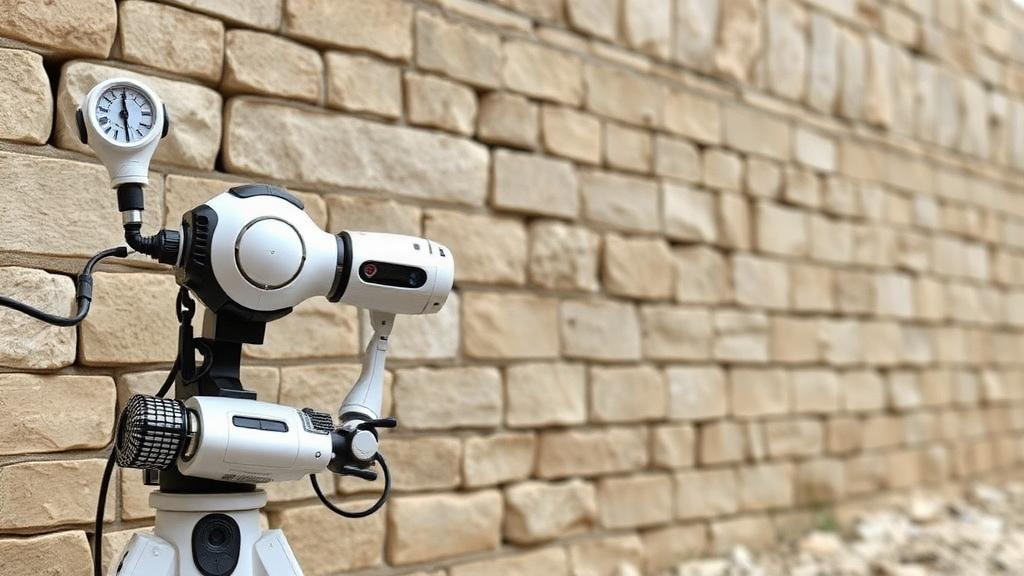
Deep inside a narrow tomb corridor, where a single misplaced footstep could shatter a thousand-year-old mural, a small aerial robot hovers silently, its sensors scanning every crack and pigment flake without ever touching the fragile surface. This is not science fiction but the emerging reality of heritage conservation, and a new systematic review published in npj Heritage Science on 28 September 2026 offers the most comprehensive map yet of how robotic survey systems can document immovable cultural heritage without leaving a trace.
The review, led by Wei Zhou and Yanmin Xue of Xi’an University of Technology in Shaanxi, China, together with colleagues from the university’s School of Mechanical Engineering and School of Art and Design, tackles a problem that has long frustrated conservators: how to survey vast, fragile, and often inaccessible heritage sites—cave temples, ancient tombs, towering murals, and crumbling masonry—when the very act of measurement risks damaging what it seeks to protect. Traditional surveying demands physical proximity, scaffolding, and human presence, all of which introduce vibration, dust, humidity fluctuations, and the constant threat of accidental contact with surfaces that may have survived centuries only to be lost in a moment of carelessness.
Non-contact robotic systems promise a way around this dilemma. Drones can slip through openings too narrow for a person, ground robots can traverse uneven floors while their laser scanners capture millimeter-accurate geometry, cable-driven platforms can glide along walls like mechanical spiders, and robotic manipulators can extend sensors into recesses that no ladder could reach. But until now, the field has been fragmented: each research group developed its own platform, its own algorithms, and its own case study, with little systematic comparison of which approach works best under which conditions. The new review addresses this gap directly, synthesizing evidence across aerial robots, ground mobile robots, and special-purpose systems including cable-driven robots and manipulator arms, as well as heterogeneous teams that combine several platform types in a single mission.
The methodology is as notable as the findings. Rather than simply cataloging robotic systems, the researchers applied a structured pipeline: systematic literature screening to identify relevant studies, evidence-role classification to distinguish between core demonstrations and supporting reports, cross-platform coding to allow apples-to-apples comparison, and technology-readiness assessment to gauge how close each system category is to real field deployment. Platforms were then evaluated along three conservation-oriented axes: conservation safety, meaning the risk the system poses to the artifact itself; task effectiveness, meaning the quality and completeness of the survey data; and deployment maturity, meaning how practically the system can be brought into a real heritage site.
The results reveal a landscape of trade-offs rather than a single winner. Suitability, the authors find, depends on four interlocking factors: the material sensitivity of the heritage object, the spatial configuration of the site, the specific survey requirements, and the deployment conditions on the ground. A fragile fresco in a cramped burial chamber demands an entirely different robotic solution than a monumental stone facade in an open courtyard. Aerial robots excel at covering large volumes quickly but must contend with downdrafts that could disturb loose debris or delicate surfaces, and their propellers generate noise and airflow that conservators may find unacceptable near vulnerable materials. Ground robots offer stability and payload capacity but struggle with stairs, rubble, and narrow passages. Cable-driven systems minimize contact risk by suspending sensors from above, yet require anchor points that historic structures rarely provide. Manipulators reach into confined spaces with precision but sacrifice coverage speed.
Perhaps the most striking finding concerns where research attention has flowed—and where it has not. The review shows that current research overwhelmingly emphasizes localization, path planning, and control: the algorithmic muscles that let robots know where they are, decide where to go, and execute smooth trajectories. These are genuine achievements, and progress in simultaneous localization and mapping under GNSS-denied conditions—where satellite signals cannot penetrate tomb walls or dense temple interiors—has been remarkable. Yet the authors identify a critical blind spot: embodiment and deployment design, the physical and practical questions of how a robot’s body interacts with heritage materials and how a system is actually installed and operated in the field, have received far less attention despite being essential to accessibility, observation effectiveness, and real-world deployability. A robot with flawless navigation is useless if its landing gear scratches a mosaic or if its deployment requires scaffolding that itself endangers the site.
This imbalance has real consequences for conservation practice. In constrained environments—the tight corridors of rock-cut tombs, the layered interiors of pagodas, the cluttered interiors of historic buildings—the physical form of the robot is not an afterthought but a primary determinant of success. Every gram of weight matters when a platform must perch on a fragile ledge; every centimeter of clearance matters when navigating a passage carved two thousand years ago; every joule of acoustic or vibrational energy matters when the substrate itself is the artifact. The review argues that these embodiment considerations deserve the same rigorous engineering attention that algorithms currently enjoy.
In response, the authors propose what they call a design-first paradigm for heritage-oriented robotics. Rather than beginning with an existing platform and adapting it to a site, the paradigm integrates platform selection, embodiment design, low-disturbance deployment, and field validation from the outset, treating the conservation constraints as primary design drivers rather than secondary complications. This inversion places the artifact’s safety and the site’s specific geometry at the center of the engineering process, ensuring that the resulting system can actually be deployed where it is needed, not merely demonstrated in laboratory conditions.
The implications extend well beyond China’s rich heritage landscape, though the study’s origins in Shaanxi Province—home to the Terracotta Army, hundreds of Tang dynasty tombs, and countless cave temples—are telling. The work was supported by the Key Research and Development Program of Shaanxi Province, reflecting a national commitment to applying advanced robotics to cultural preservation. As heritage sites worldwide face pressures from tourism, climate change, and simple age, the ability to document them comprehensively without physical intrusion becomes ever more urgent. Digital twins built from robotic surveys can guide restoration, enable virtual access that reduces foot traffic, and preserve precise records for future generations even if the originals are lost to disaster.
For conservators, the review offers a practical decision framework: match the robotic platform to the material, the space, the survey goal, and the deployment reality. For roboticists, it issues a challenge: redirect innovation toward the unglamorous but decisive problems of embodiment and field deployment. And for anyone who has marveled at humanity’s ancient wonders, it signals that the machines now being built to study them are being designed, at last, with the same reverence that conservators bring to the artifacts themselves. The full review, published open access in npj Heritage Science, is available to researchers and heritage professionals worldwide.
Subject of Research: Conservation-oriented comparison of non-contact robotic survey systems for immovable cultural heritage in constrained environments
Article Title: Conservation-oriented comparison of non-contact robotic survey systems for immovable cultural heritage in constrained environments
Article References: Zhou, W., Xue, Y., Wang, S., Qi, K., Zhang, Z., Zhang, Y., & Ge, C. (2026). Conservation-oriented comparison of non-contact robotic survey systems for immovable cultural heritage in constrained environments. npj Heritage Science. https://doi.org/10.1038/s40494-026-03009-1
Image Credits: AI Generated
DOI: 10.1038/s40494-026-03009-1
Keywords: robotics, cultural heritage, conservation, drones, 3D surveying, archaeology, npj Heritage Science, Conservation-oriented, comparison, non-contact, robotic, survey
Cite Scienmag News
Courtney Benton. (October 15, 2026). Robots That Read Ancient Walls: New Review Maps the Future of Non-Contact Heritage Surveying. Scienmag. https://scienmag.com/robots-that-read-ancient-walls-new-review-maps-the-future-of-non-contact-heritage-surveying/
Courtney Benton. "Robots That Read Ancient Walls: New Review Maps the Future of Non-Contact Heritage Surveying." Scienmag, 15 October 2026, https://scienmag.com/robots-that-read-ancient-walls-new-review-maps-the-future-of-non-contact-heritage-surveying/. Accessed 15 October 2026.
Courtney Benton. "Robots That Read Ancient Walls: New Review Maps the Future of Non-Contact Heritage Surveying." Scienmag. October 15, 2026. https://scienmag.com/robots-that-read-ancient-walls-new-review-maps-the-future-of-non-contact-heritage-surveying/


