


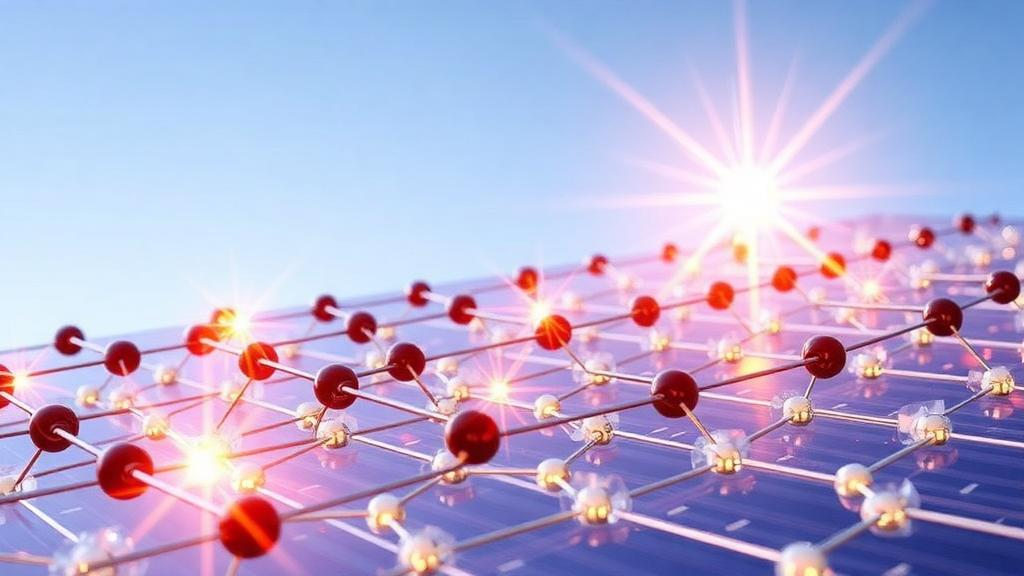
Turning carbon dioxide back into useful fuel using nothing but sunlight is one of chemistry’s most seductive promises, and one of its most stubborn problems. A new review published in Frontiers in Chemistry examines a class of materials that may finally dissolve the field’s central dilemma: covalent organic frameworks, or COFs, that carry catalytically active metal centers built directly into their crystalline lattices. Written by Yuan-Hui Zhong of Jiaying University and Lai-Hon Chung of Guangdong University of Technology, the review argues that these metallolinker frameworks can combine the atomic precision of molecular catalysts with the durability and recyclability of solid materials, offering a credible route toward practical solar-driven carbon conversion.
The dilemma the review addresses is familiar to anyone working in catalysis. Homogeneous molecular complexes, dissolved in solution, present metal centers in perfectly defined coordination environments, which makes their selectivity exquisite and their mechanisms easy to study. But they degrade, aggregate, leach into the reaction medium, and are notoriously difficult to recover. Heterogeneous semiconductors, by contrast, survive harsh conditions and can be filtered out and reused, yet their active sites are so ill-defined that researchers often cannot say which atoms actually do the chemistry, let alone control it. A catalyst that offered both molecular clarity and heterogeneous toughness would transform the field, and COFs assembled from pre-metalated building blocks are presented as exactly that hybrid.
The underlying chemistry is demanding. Carbon dioxide is a famously inert molecule: its carbon-oxygen bonds are short and strong, at roughly 750 kilojoules per mole, and the direct one-electron reduction to the bent radical anion CO2•− requires a punishing potential of about −1.90 volts versus the standard hydrogen electrode at neutral pH. Photocatalytic systems sidestep this barrier by using proton-coupled electron transfer, in which electrons and protons are delivered together, avoiding the accumulation of the high-energy intermediate. Even so, the reduction potentials for the desirable products—carbon monoxide, formic acid, formaldehyde, methanol, methane—all cluster within a narrow window between roughly −0.7 and −0.2 volts, overlapping with the potential for hydrogen evolution. Product selectivity therefore depends less on thermodynamics than on kinetics: on how strongly and in what geometry the catalyst binds key intermediates such as *COOH and *OCHO.
This is where the metallolinker concept earns its keep. In these frameworks, a metal center held by a chelating ligand is installed at the monomer stage, before polymerization, so the coordination environment is locked into the crystalline lattice rather than imposed afterward. Porphyrins, phthalocyanines, and salen-type ligands serve as the workhorse metallolinkers, each offering a distinct coordination pocket and light-absorption profile. The review emphasizes that the metal site does more than catalyze: it also shapes light harvesting, charge separation, CO2 adsorption, and the local reaction environment through synergistic interactions with the surrounding conjugated framework. Changing only the central metal in an otherwise identical framework can dramatically alter excited-state dynamics and product distribution.
The evidence is striking. In one series of porphyrinic COFs, the zinc variant showed the narrowest band gap at 1.49 electron volts and the longest fluorescence lifetime, and produced carbon monoxide with essentially 100 percent selectivity while simultaneously oxidizing water to oxygen—without any sacrificial electron donor. In another study, a symmetry-breaking design in which one pyrrole ring of a nickel porphyrin was replaced by thiophene created spatially separated functions within a single framework: the thiophene acted as an electron-transport channel, the remaining pyrroles as proton-hopping sites, and the nickel center as the CO2-binding site. The result was a carbon monoxide production rate of 22.7 millimoles per gram per hour, roughly 65 times higher than the symmetric analog.
Perhaps the most conceptually elegant result involves nothing more exotic than a change in oxidation state. In the same porphyrinic lattice, cobalt(III) and cobalt(II) centers with different spin states produced different product spectra: the cobalt(III) framework favored formic acid, while cobalt(II) yielded more carbon monoxide and methane. Computational analysis traced the divergence to orbital-level details—the cobalt(III) site binds the CO2-derived intermediate more strongly, shortening the cobalt-oxygen distance from 2.82 to 2.31 angstroms and lowering the barrier for formic acid formation from 1.32 to 0.68 electron volts. A single electron, in effect, rewrites the free-energy landscape of the entire reaction.
The review also treats post-synthetically metalated COFs, in which chelating sites are built into the framework first and metals are introduced later, as a closely related family for comparison. These systems reveal how framework architecture, independent of the metal, governs performance. Two pyrene-bipyridine COFs differing only in the position of a substituent showed a 5.7-fold difference in carbon monoxide evolution after cobalt incorporation, because the torsional geometry of the precursor propagated into different interlayer separations and excited-state lifetimes. Reversing the polarity of an imine linkage in a nickel-containing framework changed activity eightfold by altering interlayer electronic coupling. Even the choice between polarized imine and continuous olefinic connectivity proved decisive, with a vinylene-linked rhenium framework sustaining charge-separated states hundreds of times longer than its imine counterpart and operating for 50 hours in pure water without a sacrificial agent.
Dual-metal sites push the design logic further. A framework bearing two neighboring zinc salen centers produced carbon monoxide at six times the rate of its single-zinc counterpart, and—critically—retained most of its activity when the CO2 feed was diluted to 15 percent, approximating flue gas. Infrared spectroscopy detected the *COOH intermediate only in the dual-site material, and calculations showed the rate-determining barrier dropping from 2.00 to 0.69 electron volts. The two adjacent centers cooperatively stabilize the adsorbed intermediate, a feat single isolated sites perform poorly. This cooperative geometry hints at a path toward the field’s holy grail: C2+ products such as ethylene and ethanol, which require two carbon-containing intermediates to meet and couple, something single-site catalysts structurally struggle to enable.
None of this means solar fuels are around the corner. The review is candid about the obstacles: most high-performing systems still rely on sacrificial electron donors that mask true efficiency; hydrogen evolution parasitically competes with CO2 reduction, especially given that water dissolves only about one CO2 molecule per 1,300 water molecules; imine linkages hydrolyze, metals leach, and long-term stability data under realistic conditions—dilute, impure gas streams and continuous sunlight—are scarce. C2+ selectivity remains rare, and mechanistic claims often rest on steady-state measurements that cannot distinguish whether activity comes from the metal site or the framework’s exciton dynamics. The authors call for standardized benchmarking, operando spectroscopy to watch oxidation states evolve in real time, computational screening of linker-metal combinations, and reactor engineering that moves beyond powder-in-a-flask experiments.
Still, the trajectory is unmistakable. Within a few years, metallolinker and metalated COFs have advanced from proof-of-concept curiosities to materials producing carbon monoxide at rates exceeding 10 grams of product per gram of catalyst per hour in optimized cases, with selectivities above 90 percent and demonstrated recyclability. What makes the platform genuinely powerful is not any single record number but the design space it opens: metal identity, oxidation state, spin state, linker conjugation, linkage polarity, pore environment, and site spacing can each be tuned nearly independently within one crystalline solid. That level of control, the review argues, is what will finally let researchers move from empirical catalyst hunting to mechanistically informed design—and, perhaps, to reactors that close the carbon cycle using only sunlight, water, and the CO2 already in the air.
Subject of Research: Metallolinker-assembled and post-synthetically metalated covalent organic frameworks for photocatalytic CO2 reduction
Article Title: Bridging molecular and heterogeneous catalysis: metallolinker-assembled and post-synthetically metalated covalent organic frameworks for photocatalytic CO2 reduction
Article References: Zhong, Y.-H., & Chung, L.-H. (2026). Bridging molecular and heterogeneous catalysis: metallolinker-assembled and post-synthetically metalated covalent organic frameworks for photocatalytic CO2 reduction. Frontiers in Chemistry, 14, Article 1976872. https://doi.org/10.3389/fchem.2026.1976872
Image Credits: AI Generated
DOI: 10.3389/fchem.2026.1976872
Keywords: covalent organic frameworks, photocatalysis, CO2 reduction, metallolinker, solar fuels, porphyrin, phthalocyanine, single-atom catalysis, donor-acceptor frameworks, product selectivity, water oxidation, heterogeneous catalysis
Cite Scienmag News
Bethany Barker. (October 15, 2026). Metal-Built Crystalline Frameworks Bring Molecular Precision to Solar CO2 Conversion. Scienmag. https://scienmag.com/metal-built-crystalline-frameworks-bring-molecular-precision-to-solar-co2-conversion/
Bethany Barker. "Metal-Built Crystalline Frameworks Bring Molecular Precision to Solar CO2 Conversion." Scienmag, 15 October 2026, https://scienmag.com/metal-built-crystalline-frameworks-bring-molecular-precision-to-solar-co2-conversion/. Accessed 15 October 2026.
Bethany Barker. "Metal-Built Crystalline Frameworks Bring Molecular Precision to Solar CO2 Conversion." Scienmag. October 15, 2026. https://scienmag.com/metal-built-crystalline-frameworks-bring-molecular-precision-to-solar-co2-conversion/


