


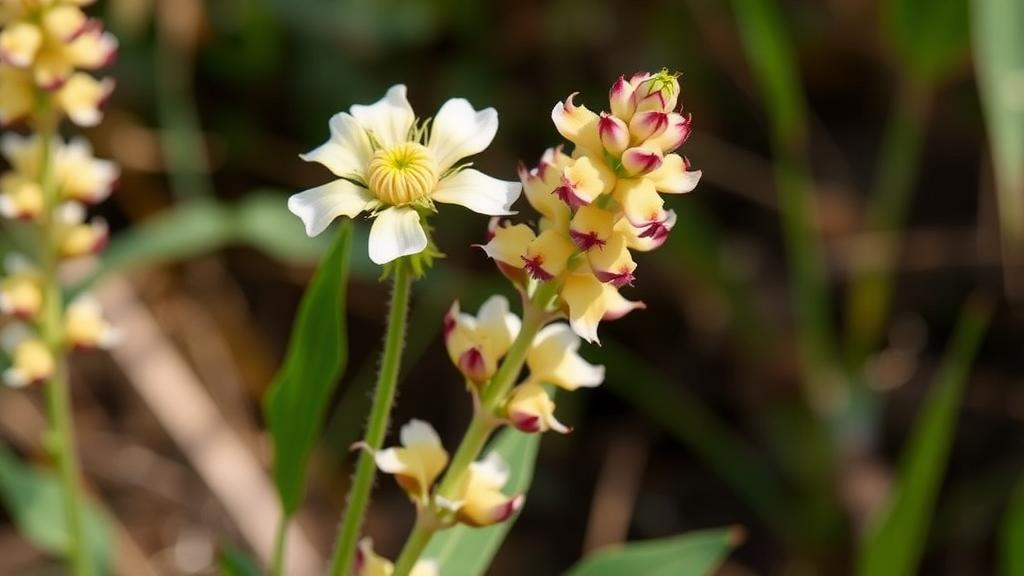
Deep in the alpine grasslands of Kuerdening, in Gongliu County of China’s Xinjiang Uygur Autonomous Region, botanists have identified a mullein species new to science. The plant, now formally described as Verbascum gongliuensis in the journal PhytoKeys, belongs to the figwort family Scrophulariaceae and was collected during field surveys conducted between 2023 and 2026. Its discovery adds a seventh species to the Chinese Verbascum flora, five of which are concentrated in Xinjiang, the country’s center of diversity for the genus.
The new species was found at an elevation of roughly 1,614 meters at the edge of alpine forest, growing as a biennial herb that can reach 150 centimeters in height. What immediately caught the surveyors’ attention was the plant’s covering of long-stalked glandular hairs, which clothe the stems, leaves, calyx, corolla, and capsule. At first glance the species superficially resembles V. macrocarpum and V. blattaria, but closer examination revealed a combination of characters not present in any other known Verbascum, prompting its description as new.
Confirming a new species in this genus is no small task. Verbascum comprises more than 360 species distributed mainly across Eurasia, and its taxonomy has been revised repeatedly since Linnaeus first separated the genus into Celsia and Verbascum based on stamen number in his 1753 Species Plantarum. Bentham later divided the group into sections according to anther morphology, and Murbeck subdivided it further using seed characters. Ferguson and Huber-Morath eventually merged Celsia back into Verbascum, a conclusion now strongly supported by molecular phylogenetic studies. Turkey holds the world record for mullein diversity with 254 species, 193 of them endemic, while Kazakhstan hosts nine species and China six, one of which remains incompletely known.
To verify the status of the Gongliu population, the researchers cross-checked their specimens against the Flora of China, Flora Xinjiangensis, Flora of Kazakhstan, Flora of Turkey and the East Aegean Islands, and the Flora of the USSR, as well as the diagnostic key of Huber-Morath. They also compared material held in the Herbarium of Shihezi University and consulted online databases including iPlant, Plants of the World Online, the Plant Photo Bank of China, and the Global Biodiversity Information Facility. Floral and fruit structures were dissected and examined under a stereomicroscope, and photographs and GPS coordinates were recorded in the field.
The morphological evidence proved decisive. Verbascum gongliuensis differs from its closest relative V. macrocarpum by bracts that are shorter than the flowers rather than longer, a smaller corolla, a denser glandular indumentum, and a capsule that conspicuously exceeds the persistent calyx. Compared with V. ponticum, its corolla measures 18 to 23 millimeters across rather than 26 to 33 millimeters, and its indumentum is exclusively glandular. It is separated from V. bornmuellerianum by the two anterior filaments being glabrous near the apex, whereas in that species the violet filament hairs extend right up to the anthers. From V. zerdust, which typically bears four stamens, the new species is readily distinguished by having five stamens, rarely four.
The detailed description records a biennial herb with unbranched or mid-branched stems 30 to 150 centimeters tall, densely glandular throughout. The basal leaves are ovate, elliptic to lanceolate, with bicrenate margins and undulate teeth, measuring 5 to 35 centimeters long and 3 to 6 centimeters wide on petioles of 3 to 6 centimeters. Cauline leaves are sessile, oblong-ovate to triangular-ovate, and dentate. The inflorescence is a simple or few-branched raceme with solitary flowers, each subtended by densely glandular bracts 0.5 to 1.5 centimeters long. The yellow corolla, 18 to 23 millimeters in diameter, carries purple and white appendages at the base of the upper two lobes, and its lobes are unequal, the upper two slightly smaller than the lower three. Stamens number four or five, with purple woolly filaments of unequal length, and the anthers are laterally compressed, curved, narrowly reniform, and decurrent at the base. The ovoid-globose capsule, 6 to 10 millimeters long, exceeds the calyx and bears a short beak about 1.5 millimeters long. Flowering occurs from June to August and fruiting from July to September, with cylindrical seeds 0.5 to 1 millimeters long marked by longitudinal undulate striations.
Geography and ecology add further weight to the species’ recognition. Verbascum gongliuensis occupies alpine steppe at around 1,600 meters in the central Tianshan Mountains, whereas V. blattaria inhabits lower-elevation riverbanks and marshes. Cultivation observations suggest the new species prefers humid, low-temperature environments, while V. blattaria tolerates high temperatures and strong sunlight. Although V. macrocarpum occupies a similar habitat, its nearest recorded population lies in the southern basin of Lake Alakol in Kazakhstan, roughly 800 kilometers from Kuerdening. The authors argue that this geographic isolation has driven divergence in corolla size, bract length, and stamen dimensions between the two taxa.
The type specimen was collected on 30 July 2024 at Kuerdening, at coordinates 43°08’46″N, 82°51’41″E, and deposited as a holotype and isotype at the Shihezi University herbarium under the collection number Wenbin Xu and Yuhao Luo 4546. The species carries the IPNI name identifier urn:lsid:ipni.org:names:77380708-1, and the paper is accompanied by detailed photographs of the plant, its flowers, leaves, capsules, and seeds, together with a distribution map and the holotype specimen image.
Conservation concerns shadow the discovery. The species is currently known from a single location, with an estimated extent of occurrence of less than 20 square kilometers and a population of fewer than 1,000 mature individuals. Its habitat is significantly threatened by grazing and tourism activities, which are projected to cause a continuing decline in the number of mature individuals. Applying the IUCN Red List Categories and Criteria, version 3.1, the authors assessed Verbascum gongliuensis as Vulnerable under criteria D1 and D2, underscoring how narrowly restricted alpine endemism can leave even a newly described species exposed to environmental pressures.
The description also required an updated identification key to the Verbascum species of China. The new species keys out alongside V. blattaria among the yellow-flowered, solitary-flowered, glandular-hairy members of the flora, from which it is separated by its longer-stalked glandular hairs and larger capsule of 6 to 10 millimeters. The full diagnostic comparison with V. macrocarpum and V. zerdust published in the paper documents differences across stems, leaves, bracts, pedicels, calyx, corolla, stamens, and capsules, providing a practical reference for future field surveys in the Tianshan range. As alpine grasslands across Central Asia continue to face grazing and tourism pressures, the discovery highlights both the botanical richness of the central Tianshan Mountains and the urgency of documenting its flora before such narrowly distributed species disappear.
Subject of Research: Verbascum gongliuensis ( Scrophulariaceae ), a new species of Yili, Xinjiang, China
Article Title: Verbascum gongliuensis ( Scrophulariaceae ), a new species of Yili, Xinjiang, China
Article References: Luo, Y., & Xu, W. (2026). Verbascum gongliuensis (Scrophulariaceae), a new species of Yili, Xinjiang, China. PhytoKeys, 280, 73-81. https://doi.org/10.3897/phytokeys.280.201229
Image Credits: AI Generated
DOI: 10.3897/phytokeys.280.201229
Keywords: Verbascum gongliuensis, new species, Xinjiang, Scrophulariaceae, PhytoKeys, taxonomy, IUCN, biodiversity, Verbascum, gongliuensis, species, Yili
Cite Scienmag News
Margaret Porter. (October 15, 2026). New mullein species from Xinjiang joins China’s Verbascum flora. Scienmag. https://scienmag.com/new-mullein-species-from-xinjiang-joins-chinas-verbascum-flora/
Margaret Porter. "New mullein species from Xinjiang joins China’s Verbascum flora." Scienmag, 15 October 2026, https://scienmag.com/new-mullein-species-from-xinjiang-joins-chinas-verbascum-flora/. Accessed 15 October 2026.
Margaret Porter. "New mullein species from Xinjiang joins China’s Verbascum flora." Scienmag. October 15, 2026. https://scienmag.com/new-mullein-species-from-xinjiang-joins-chinas-verbascum-flora/


